
A same-day surgery technician prepares a 55-year-old patient scheduled for morning abdominal surgery with general anesthesia and a pre-operative abdominal CT with contrast, whose chart lists NPO after midnight, allergies, and dentures. The nurse asks the technician to complete standard prep and reinforce teaching. Which pre-operative and pre-diagnostic preparation should the technician provide?
Select an answer to reveal the explanation.
Short Explanation
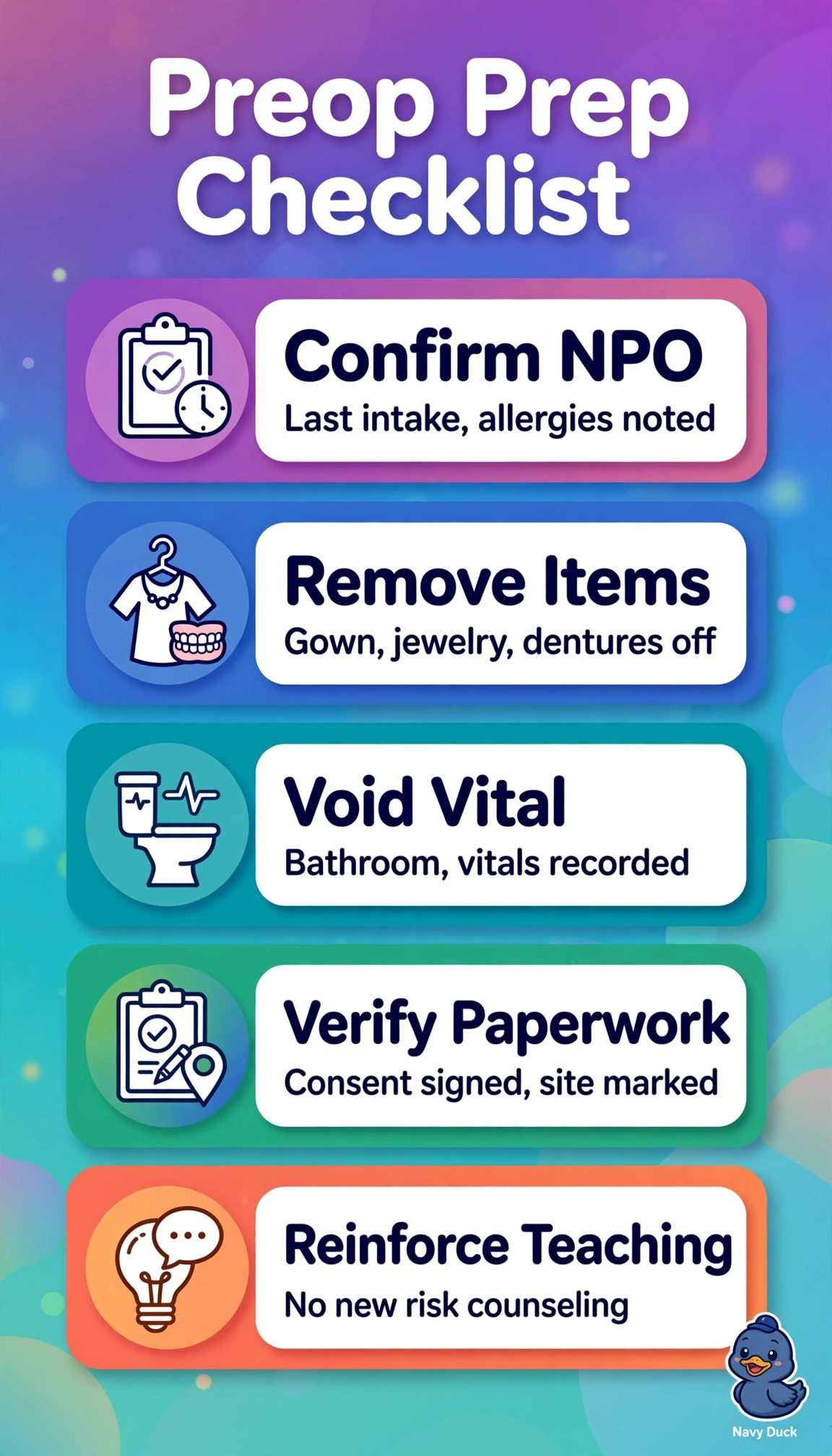
You're setting the stage for a safe surgery, like clearing the runway before takeoff. You'll confirm NPO status, help with the gown and removing jewelry and dentures, and double-check consent and site marking to prevent aspiration and mix-ups.
Full Explanation
The correct preparation integrates NPO verification after midnight for aspiration precaution with general anesthesia, allergy confirmation essential for anesthetic agents and iodinated contrast for CT, assistance with gowning and removal of jewelry to prevent injury, loss, or interference with positioning and equipment, removal of dentures to maintain airway patency during intubation and emergence, and verification that informed consent is documented and site marking is visible to meet safety standards while reinforcing prior teaching. Leaving dentures in place to aid communication fails airway management because removable prostheses risk dislodgement, obstruction, and aspiration under anesthesia and must be removed and secured per protocol. Providing a complete new explanation of operative and contrast risks fails delegation and scope because the technician reinforces established teaching and reports questions, while initial disclosure of risks and benefits remains with the surgeon, anesthesiologist, and ordering provider. Completing gown, jewelry, denture, NPO, consent, and site checks without reviewing allergies fails contrast and anesthesia safety because hypersensitivity history guides prophylaxis, agent selection, monitoring, and need for provider notification. An exam caveat is that the verb reinforce signals support, clarification of understood information, and referral, not independent consent or risk counseling. A practical check is to verbalize NPO time, allergy names and reactions, denture and jewelry removal and storage, and consent and mark presence during handoff before transport to imaging and surgery.