
In a busy emergency department, a 62-year-old adult with crushing chest pain has a bulky dressing over the right chest after recent mastectomy, has a left above-elbow amputation with a short stump, is diaphoretic, and needs a stat 12-lead EKG without delay. Which adapted electrode placement best preserves signal quality for this mastectomy and amputee EKG?
Select an answer to reveal the explanation.
Short Explanation
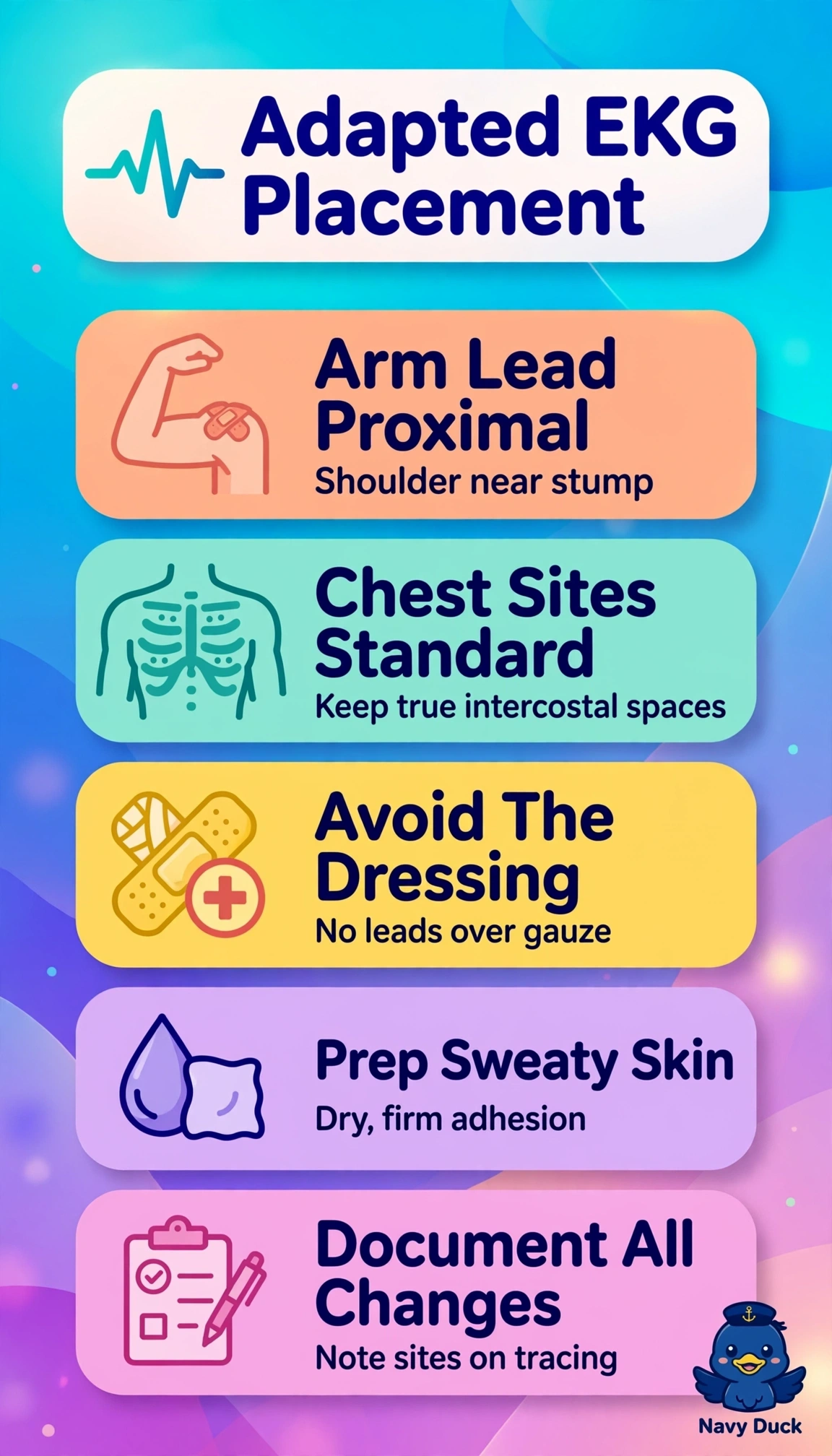
You can work around the dressing and missing limb without losing the heart’s view. Placing the arm electrode near the shoulder stump and keeping chest leads in standard spaces preserves fidelity without delaying the EKG.
Full Explanation
Placing the left arm electrode on the left shoulder near the stump approximates the usual limb-lead geometry, while keeping chest leads in standard spaces off the bulky dressing preserves precordial landmarks; documenting these adaptations helps the tracing remain interpretable without delay. Drying sweaty skin and using the shoulder stump is helpful, but moving V1–V3 down one interspace to clear the dressing changes precordial positions: inferior displacement alters R-wave progression and can mimic or mask anterior ischemia, affecting STEMI interpretation. Keeping chest leads in standard spaces and documenting adaptations is appropriate, but placing the left arm electrode on the left lower leg changes limb-lead geometry; inferior relocation can reshape the frontal axis and distort ST comparisons. Using the shoulder stump and standard chest positions is also appropriate, but delaying the recording to remove and reapply the dressing conflicts with the need for a stat tracing in crushing chest pain, when door-to-tracing time informs reperfusion triage and the dressing should be worked around. Exam caveat: with amputation and a dressing, prioritize the closest-to-standard placement that avoids delay, rather than ideal contact at the cost of time. Practical check: dry sweaty skin, ensure firm electrode adhesion away from the dressing, inspect for baseline wander, verify calibration, and document the stump, dressing, and any minimal shift for the interpreter.