
A PCT must move two patients for therapy: one post-op patient who is ordered partial weight-bearing with standby help, and one stroke patient ordered non-weight-bearing on the affected side who cannot assist. A gait belt and a mechanical sit-to-stand lift are available. Which transfer plan correctly matches assistance to weight-bearing status?
Select an answer to reveal the explanation.
Short Explanation
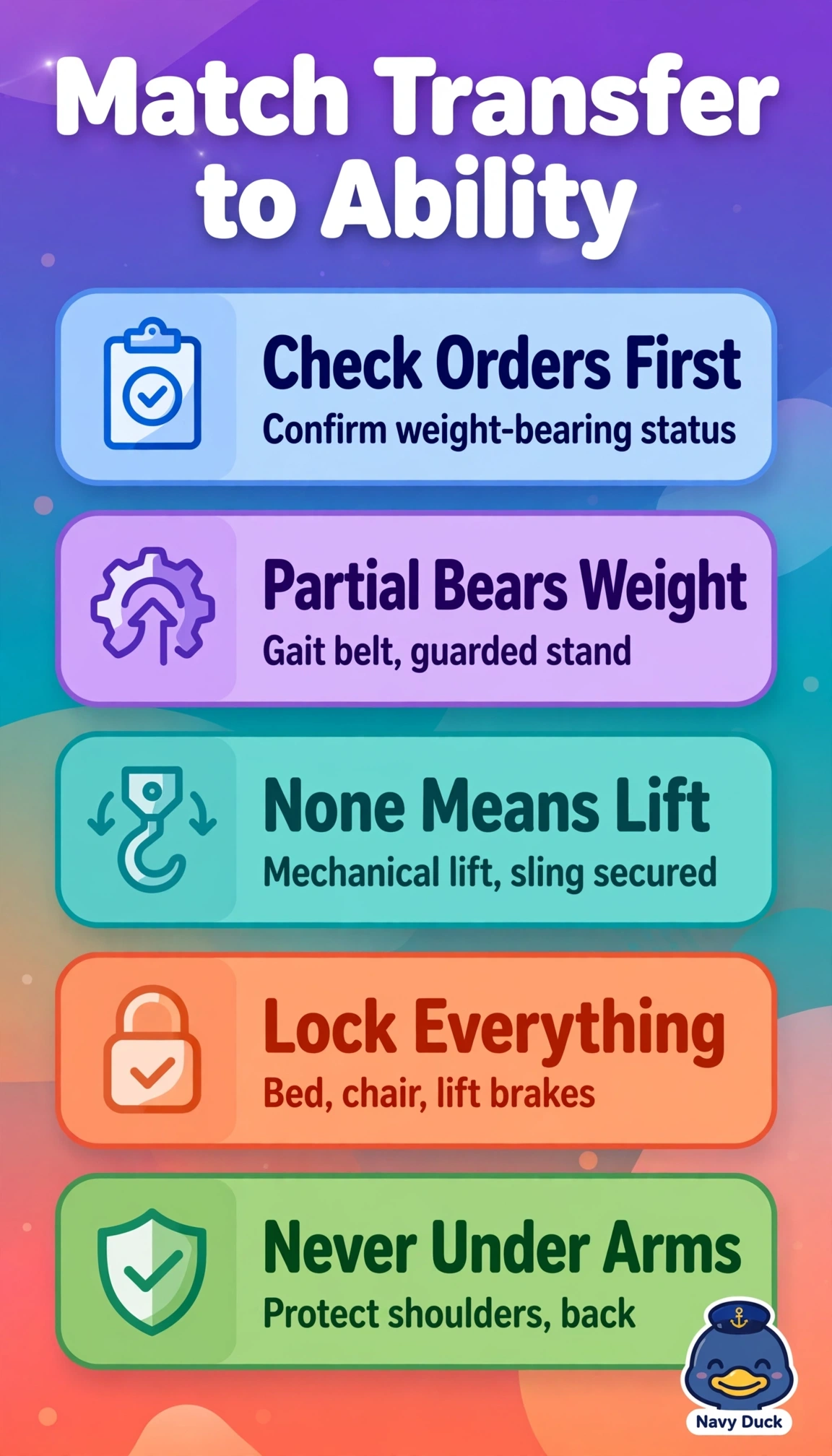
You're matching muscle to machine, letting ability guide your hands. Weight-bearing gets a belt assist while no help means mechanical lifting keeps you both safe.
Full Explanation
Safe transfer selection hinges on weight-bearing orders and patient ability to bear weight and follow commands, with gait belts providing trunk control and balance support only when the patient can bear some weight through the legs, while total dependence or non-weight-bearing status requires powered assistance to avoid staff injury and patient falls. The partial weight-bearing patient can stand and step with aid, so a gait belt with close guarding is appropriate and promotes rehabilitation. The non-weight-bearing patient who cannot assist has no safe pivot option, so a mechanical lift with sling is required per care plan and manufacturer weight limits. Reversing the devices over-assists the capable patient and dangerously under-assists the dependent patient by attempting to manually lift dead weight with a belt, risking drops and back injury. Using a belt for both assumes both can bear weight and ignores the non-weight-bearing order and inability to assist. Pulling under the arms without devices risks shoulder dislocation, skin tears, and staff musculoskeletal injury and provides no trunk control. An exam caveat is to always verify the current weight-bearing order and lock beds and wheelchairs before any move. A practical check is to confirm sling size, lift battery, and that two trained staff operate the lift.