
In a rehabilitation gym, you must move two patients back to their rooms: one patient is partial weight-bearing after hip surgery and one is non-weight-bearing with strict orders for no pressure on the affected leg. Which transfer method should the technician select for safe handling?
Select an answer to reveal the explanation.
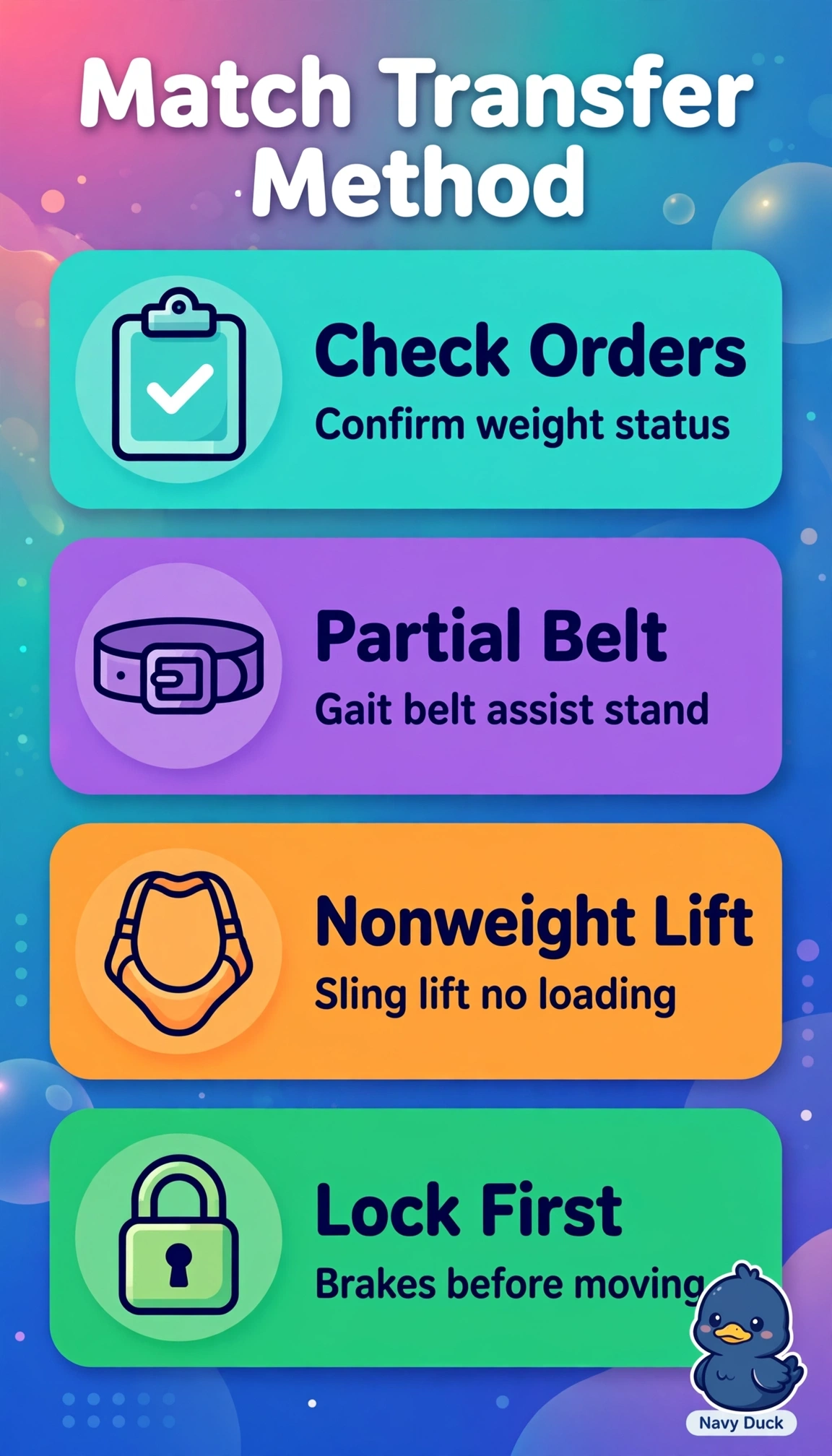
Short Explanation
You're matching the tool to the legs they can use. Pairing a gait belt for partial support with a lift for zero weight keeps joints safe and your back too.
Full Explanation
The correct pairing matches support to prescribed loading because partial weight-bearing after hip surgery allows controlled force through the operative leg, so gait-belt guarding permits the technician to control the trunk, cue the prescribed load, and prevent falls while encouraging active gait training, whereas strict non-weight-bearing with no pressure forbids any loading of the affected leg, so a mechanical lift with padded sling fully suspends the patient and guarantees offloading during transport without touchdown, shear, or hip torque. The cane approach fails on stability concept because a cane offers only unilateral balance help and cannot distribute or limit load to partial levels early after hip surgery, risking overload, limping compensation, and falls when a walker-level base is needed. The stand-assist approach fails on device-demand concept because operation requires foot placement, knee extension, and active rising, which necessarily loads the prohibited leg and violates the no-pressure order despite appearing less restrictive than a full lift. The standing pivot approach fails on transfer-mechanics concept because pivoting requires bilateral foot contact and weight acceptance through both legs to rotate to the seat, which again loads the affected limb and threatens fixation and healing. An exam caveat is to read weight-bearing and device verbs literally, since partial, non-weight-bearing, stand-assist, pivot, and full lift each imply distinct loading that decides legality. A practical check is to reconfirm orders, select and inspect sling size and loops, lock brakes, keep the affected leg supported and clear, observe hip precautions, and guard with the belt without lifting under the arms.