
A busy medical-surgical nurse asks a trained patient care technician to ambulate a stable postoperative patient who has walked before, with clear distance, assist level, and check-in instructions. The technician is competent in ambulation, the assignment fits policy, and the patient agrees. Which acceptance best satisfies the Five Rights of Delegation?
Select an answer to reveal the explanation.
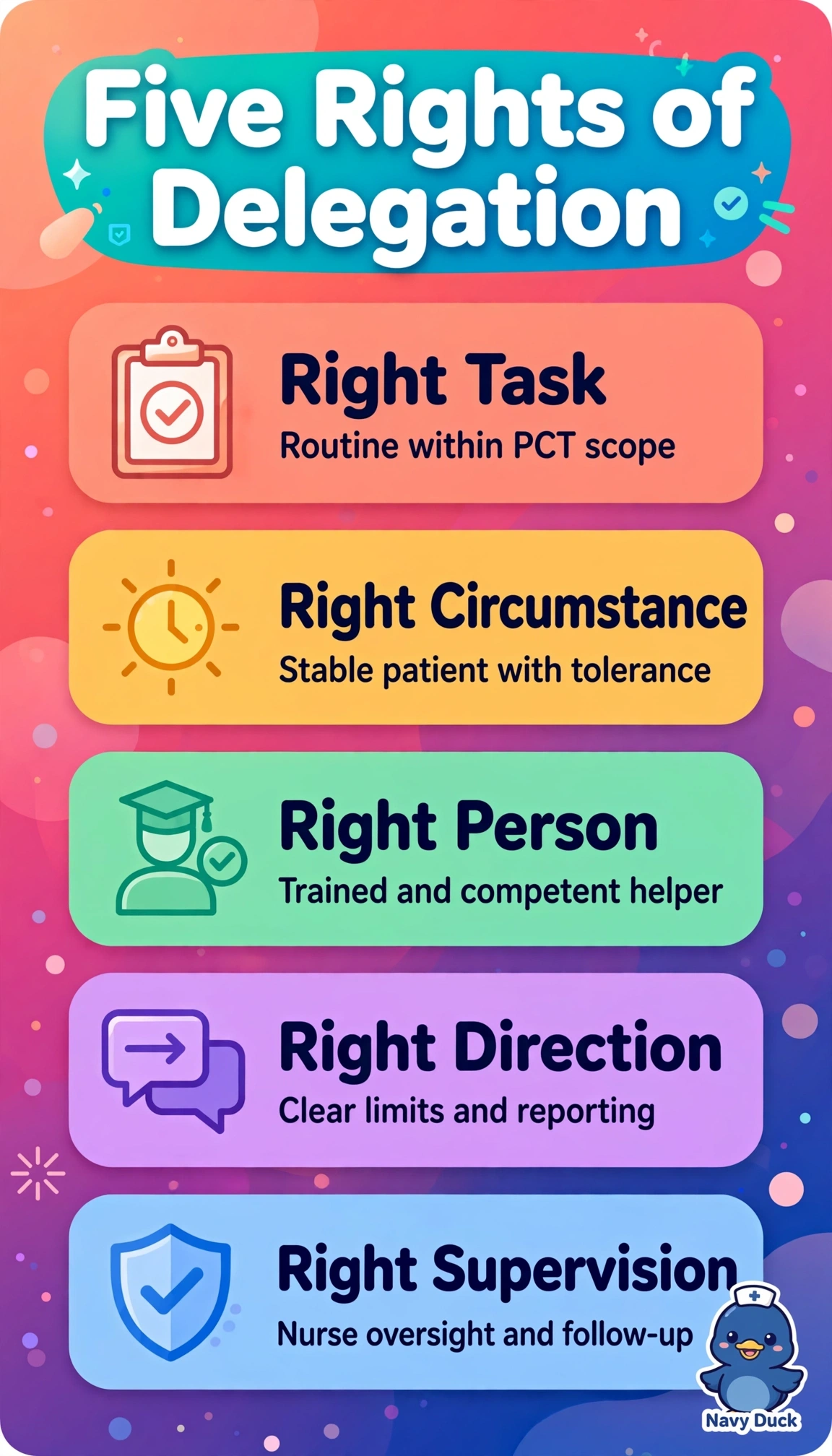
Short Explanation
You say yes only when all five pieces click into place together. Matching the right task to the right patient with clear guidance is delegation done safely like passing the right tool with instructions.
Full Explanation
The correct acceptance satisfies the Five Rights because repeat ambulation of a stable postoperative patient is a routine, predictable, policy-allowed task in the appropriate circumstance with patient agreement, given to a technician with validated ambulation competence, with clear direction on distance, assist level, and reporting, plus planned supervision with check-in and nurse evaluation. The first-walk version fails circumstance because initial postoperative mobilization demands registered nurse assessment of pain, orthostasis, dizziness, wound status, and tolerance, so a history of having walked before is the key factor permitting delegation. The unverified-competency version fails person because general helpfulness or float experience does not establish task-specific validated skill, and the delegating nurse must confirm documented check-off rather than assume ability. The no-check-in version fails supervision and evaluation because safe delegation requires specified monitoring, availability, and timely review of outcome and documentation rather than independent completion. As an exam caveat, stable condition plus detailed instructions can look sufficient, yet delegation remains incorrect if any single right is absent, so compare every stem detail against task, circumstance, person, direction, and supervision. As a practical check, verify current stability and consent, confirm policy and competence, give explicit limits and red flags, set a check-in time, and reevaluate the patient yourself.