
A rehabilitation unit has a 68-year-old patient who cannot stand after hip surgery, uses a wheelchair full-time, and needs an accurate daily weight to guide fluids. The room has a standing platform scale, a wheelchair roll-on scale, and no bed scale available today. Which weighing method best provides accurate weight using a wheelchair scale?
Select an answer to reveal the explanation.
Short Explanation
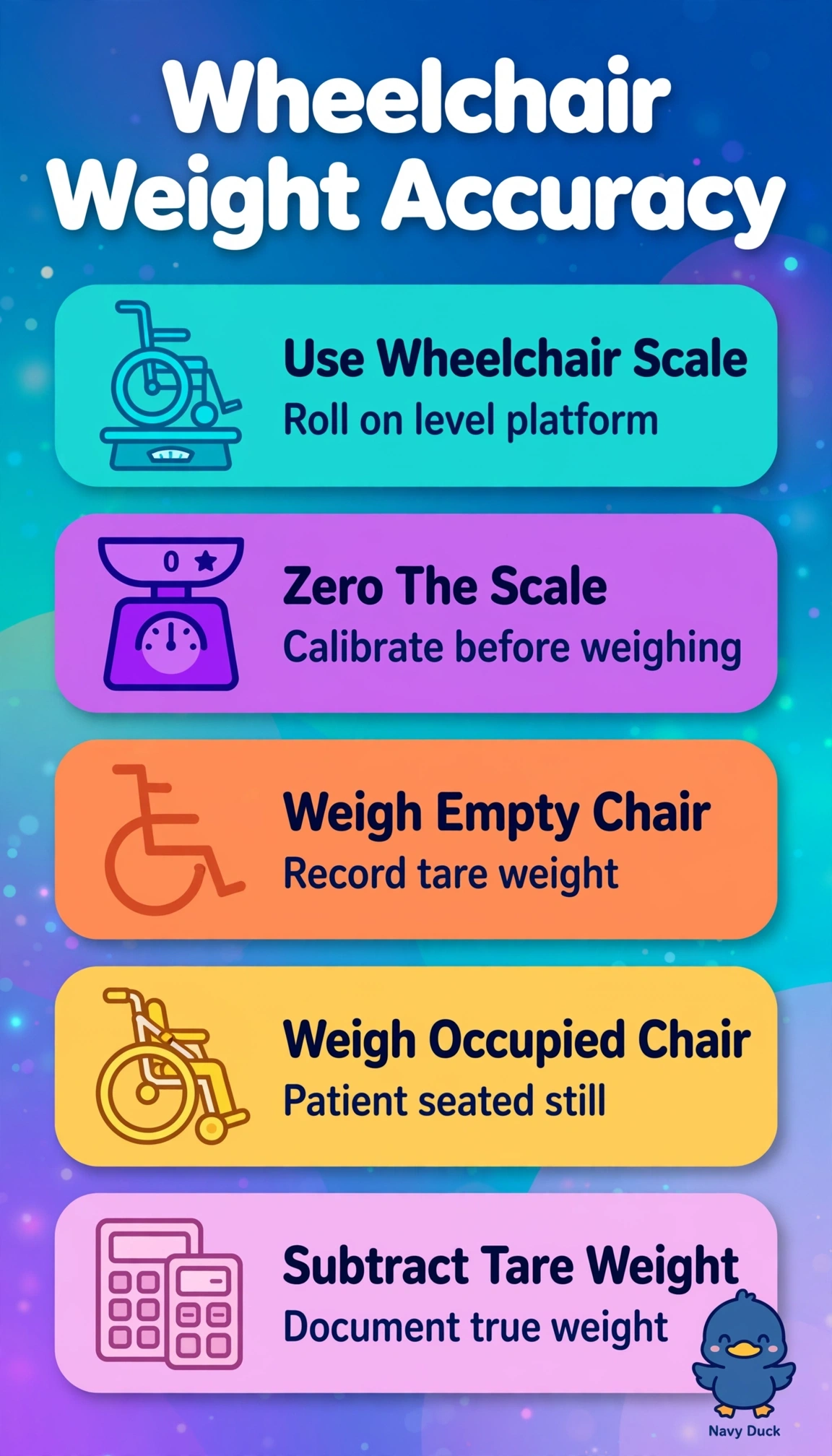
You can’t lift accuracy from a guess, and every pound matters for fluids. Subtracting the actual tare weight gives you a true daily weight without risky standing.
Full Explanation
The correct method works because a wheelchair roll-on scale is designed to accommodate the combined load safely when standing is contraindicated after hip surgery, and subtracting an actually weighed empty chair isolates true body mass for sensitive daily fluid decisions, preserving accuracy despite cushions, accessories, urine bags, or chart discrepancies. Weighing with the manufacturer's listed chair weight fails by concept of stated versus actual weight, since listed weights omit added components and wear and can introduce a systematic kilogram-level error that obscures true fluid shifts. Tracking the combined patient-plus-chair total fails by concept of gross versus net weight, because even consistent technique leaves baseline chair mass embedded in the trend, so fluid orders would be titrated to an inflated value rather than physiologic change. Weighing twice weekly with intake-output supplementation fails by concept of frequency versus acuity, since intermittent weights cannot capture day-to-day fluid retention or loss required for active titration in a high-risk postoperative patient. An exam caveat is to read equipment and frequency cues literally, because questions that state daily weight, inability to stand, and available wheelchair scale are testing selection of the available appropriate device plus tare correction rather than general acceptable practice. A practical check is to weigh the empty wheelchair on the same scale after the patient transfers out, record that tare, weigh at the same time of day in similar clothing and same chair, and verify scale zeroing and wheel position fully on the platform before documenting net weight.