
A PCT in the emergency department must draw basic metabolic panel and CBC tubes, and the tubes are small-volume with strict fill requirements. The patient has a fragile hand vein, the department is rushed, and policy requires bedside labeling. Which collection technique best prevents hemolysis and quantity-not-sufficient rejection while ensuring correct identification?
Select an answer to reveal the explanation.
Short Explanation
You're protecting fragile cells and that tiny sample volume with every gentle step. Good site choice plus quick tourniquet release and bedside labeling keeps results accurate and accepted.
Full Explanation
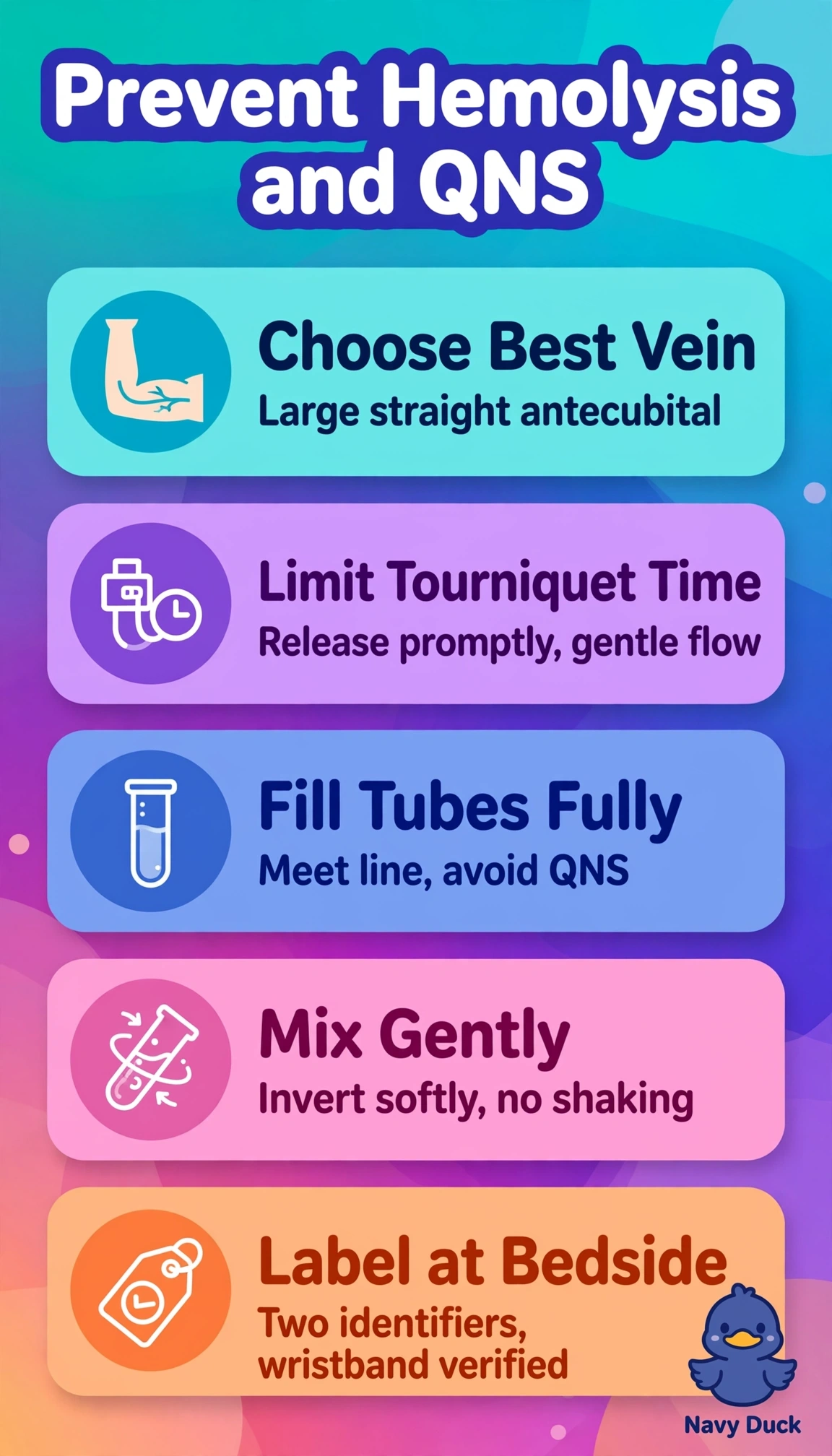
The correct technique integrates vein selection, circulatory physiology, volume accuracy, and identification safety. A suitable antecubital vein provides larger diameter and steady flow that reduces shear stress and hemolysis while reliably delivering enough blood to satisfy strict fill requirements for small-volume BMP and CBC tubes, prompt tourniquet release prevents stasis, hemoconcentration, and potassium shifts, correct filling maintains critical additive ratios, and bedside labeling ensures positive identification under policy. One incorrect technique uses the fragile hand vein with otherwise meticulous release, filling, and bedside labeling, which seems gentle and patient-centered but fails hemodynamics because fragile distal veins collapse easily, create turbulence, and increase hemolysis and quantity-not-sufficient risk. Another incorrect technique performs excellent antecubital collection and filling but labels immediately at the central workstation, which preserves quality yet breaks the bedside identification chain and risks mislabeling that outweighs technical perfection. A third incorrect technique keeps the tourniquet applied to guarantee complete filling with bedside labeling, which appears practical when rushed but prolongs venous stasis and promotes hemolysis and BMP distortion. An exam caveat is that efficiency or guaranteed volume never overrides stated limits on tourniquet time, site hierarchy, or bedside labeling. A practical check is to assess flow first, time tourniquet under one minute, verify each fill line, mix gently, and confirm patient identifiers on labeled tubes before leaving the bedside.