
You must weigh three patients this morning: an unsteady older adult who can stand briefly, a patient who remains in a wheelchair, and a bedrest patient on a bariatric unit with strict fluid monitoring. Which standing, wheelchair, and bed scale weighing method should you use for accurate comparison?
Select an answer to reveal the explanation.
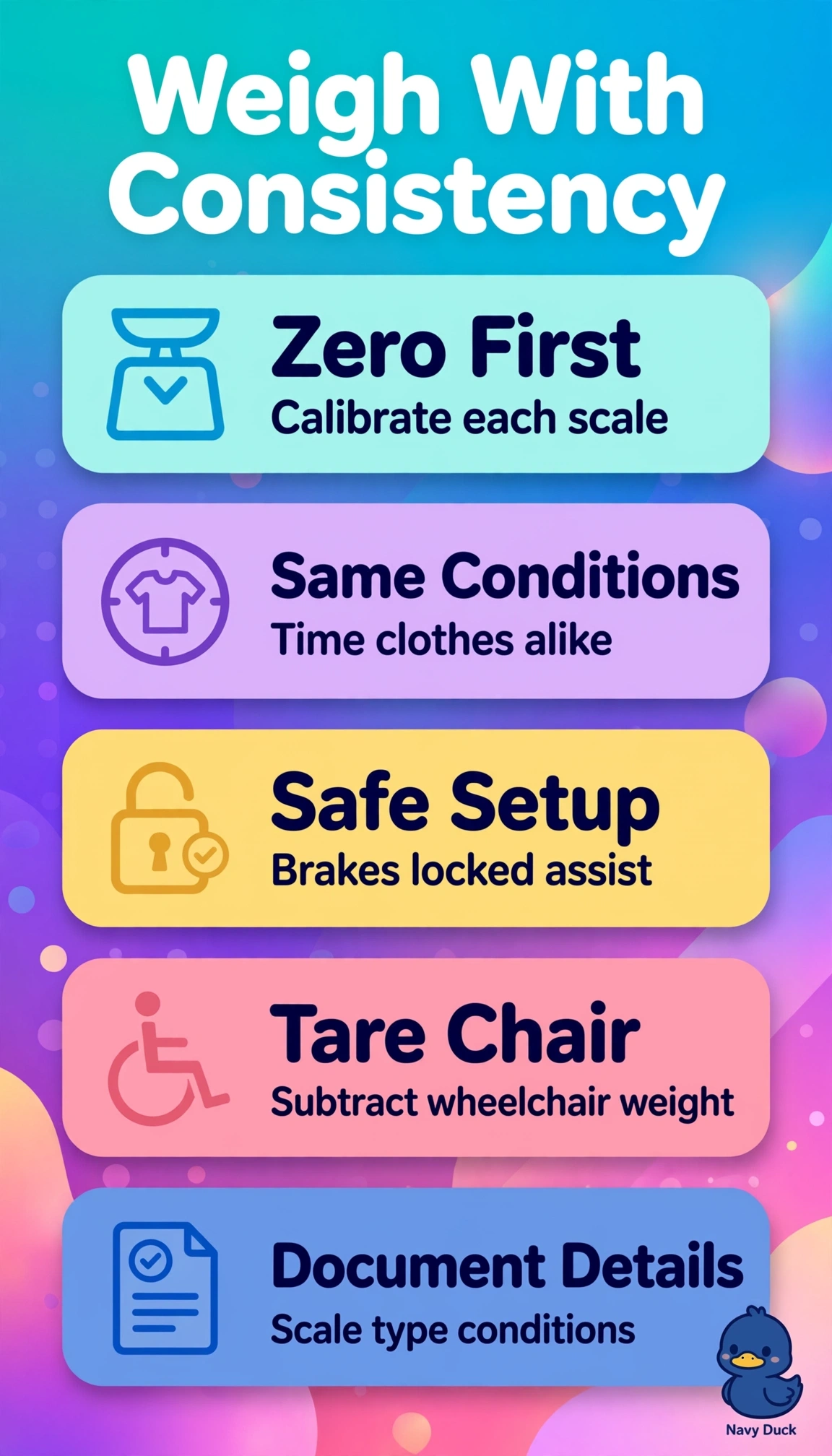
Short Explanation
You're chasing true change, not scale noise. Same conditions each time work like using the same ruler for growth charts. That consistency lets small losses or gains signal real fluid or nutrition shifts.
Full Explanation
Accurate comparison across standing, wheelchair, and bed scales requires eliminating controllable variance, which is achieved by zeroing each scale immediately before use, using the same light clothing at the same morning time after voiding, providing continuous safety support for the unsteady older adult during a brief stand, and taring or mathematically subtracting wheelchair weight so trends reflect body mass, essential for strict fluid monitoring and bariatric dosing where one kilogram equals one liter. An approach that zeroes, supports, and subtracts correctly but accommodates preference for timing and clothing for comfort fails standardization, because meals, fluids, and heavy garments add variable weight and mask true gain or loss. An approach that zeroes, standardizes, and supports safety but records combined patient-plus-wheelchair weight fails tare methodology, systematically overestimating weight and invalidating comparison with standing and bed weights. An approach that standardizes, supports, and subtracts but trusts weekly calibration instead of zeroing fails zero-error control, because residual load and drift offset every reading even on a calibrated device. An exam caveat is that comforting or efficient details are often used as distractors, so when the stem emphasizes accurate comparison or strict monitoring, prioritize identical conditions over flexibility. A practical check is to verify 0.0 before each weigh, keep gown, time, and assistance constant, confirm tare or subtraction, and reweigh when a change does not match intake, output, and assessment.