
In a crowded donation center a healthy young adult becomes pale and sweaty during venipuncture, says the room is spinning, and then reports sharp shooting pain with tingling down the forearm as the needle is repositioned. The collection tube is filling slowly and the donor grips the chair. Which recognition and response best addresses developing syncope with possible nerve involvement during blood collection?
Select an answer to reveal the explanation.
Short Explanation
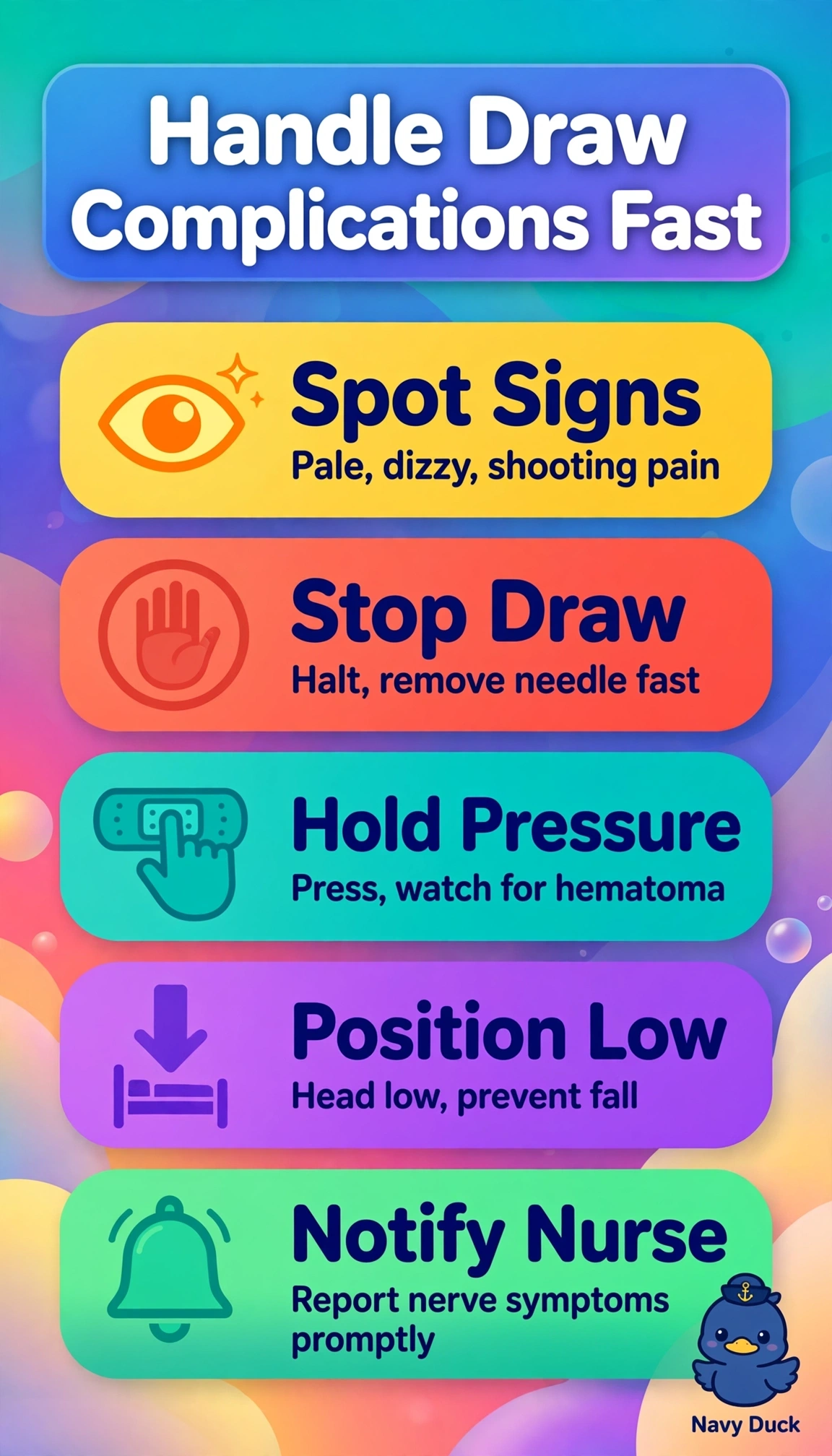
Pulling out fast is mercy when nerves start shouting. You're choosing withdrawal of the needle to halt injury and fainting, then pressure, positioning, and a nurse handoff.
Full Explanation
The correct response addresses concurrent presyncope and possible nerve contact by stopping traction, removing the needle promptly to prevent further irritation, applying pressure for hemostasis, lowering the head to improve cerebral perfusion and prevent fall injury, and notifying the nurse for neurologic assessment and documentation because pale diaphoresis with spinning plus sharp radiating tingling on repositioning signals both vasovagal risk and peripheral nerve involvement. One incorrect response provides appropriate syncope care with removal, pressure, positioning, and observation until resolution but omits reporting of radiating pain, which fails surveillance for nerve injury that requires explicit escalation, assessment, and follow-up rather than routine recovery alone. Another incorrect response correctly halts the draw and escalates tingling yet keeps the donor seated upright, which undermines syncope management because upright posture reduces venous return and cerebral flow and increases likelihood of progression to faint and injury. A further incorrect response appropriately lowers the head but continues to adjust the needle to improve slow filling despite new shooting tingling, which breaches the rule that suspected nerve contact prohibits repositioning or probing and mandates immediate removal. An exam caveat is that slow tube filling normally suggests minor adjustment, yet electric shooting pain overrides sample considerations and makes any manipulation incorrect. A practical check is to freeze needle movement at first radiating pain, remove, apply pressure, position head low, record pain distribution, timing, and vasovagal signs, and hand off both issues directly.