
On a pediatric observation unit you care for a 5-year-old post-injury child with limited number concepts, an alert teenager with abdominal pain, and an older adult with dementia who cannot speak reliably. Which pain-assessment approach should the PCT use to match pain scales to patient ability?
Select an answer to reveal the explanation.
Short Explanation
You're translating pain into language each patient can actually use. Matching the tool to development and cognition makes your match-scale choice accurate and kind. Right scale, right voice, better care.
Full Explanation
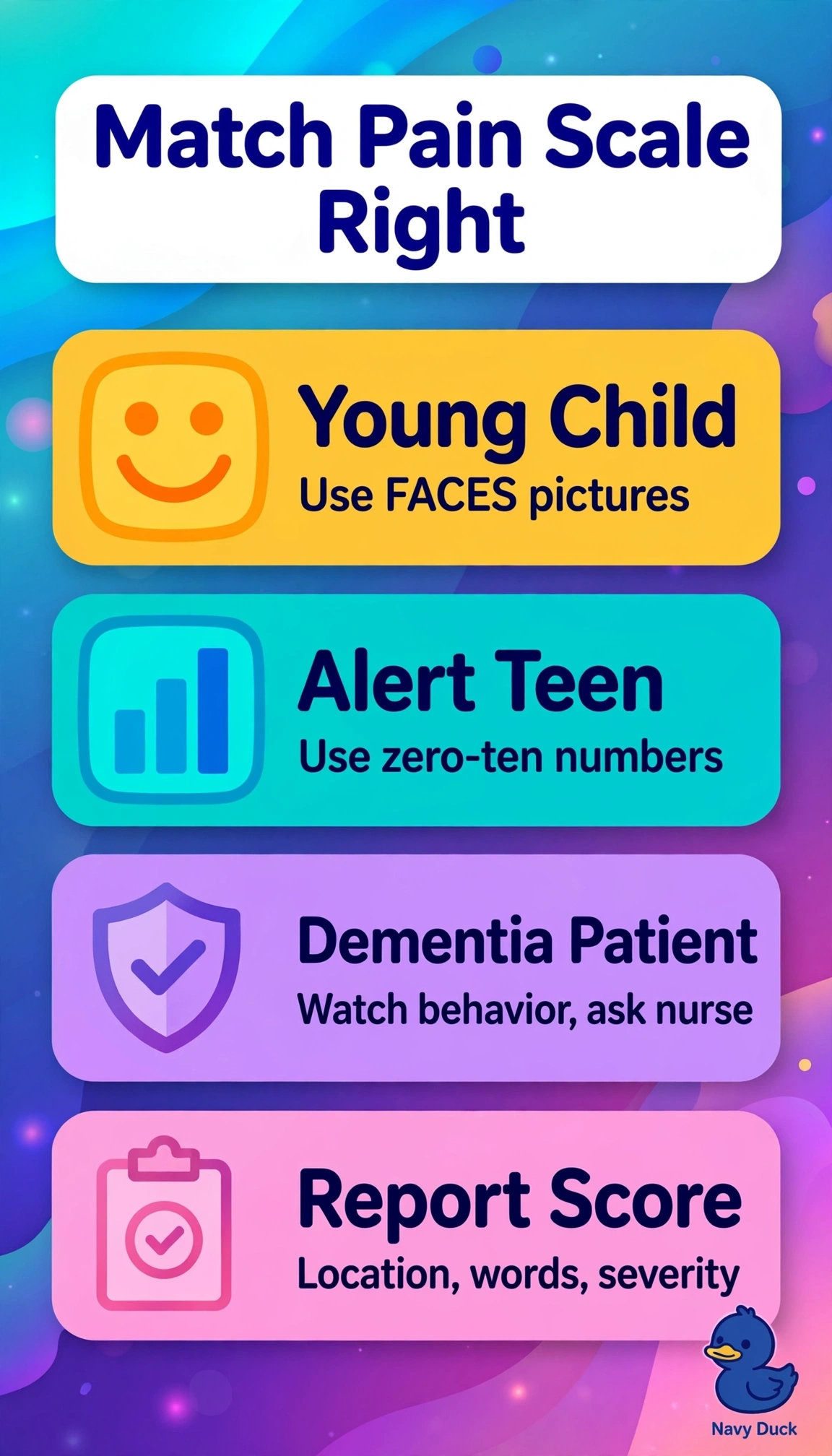
The correct approach matches scale demands to demonstrated ability: a 5-year-old with limited number concepts can self-report with FACES because faces anchor intensity without requiring abstract numeracy, an alert teenager can provide precise gradable data with the 0-10 numeric scale that supports trending for abdominal pain and reassessment, and an older adult with dementia who cannot speak reliably needs structured behavioral observation plus prompt nurse input because grimacing, guarding, restlessness, or vocalizations are nonspecific and require clinical judgment and care planning. The FLACC-based variation fails on self-report priority because replacing FACES with observer scoring for a communicative 5-year-old discards valid subjective data even though FLACC is ideal for preverbal, sedated, or noncommunicative children. The dual-FACES variation fails on developmental sensitivity because an alert teen capable of numeric reporting loses discrimination and comparability when given a simpler pictorial tool suited to limited numeracy. The PAINAD-without-follow-up variation fails on delegation and safety because even correct behavioral observation by the PCT still requires timely RN assessment and intervention for a high-risk nonverbal adult rather than independent monitoring. Exam caveat is to match wording about cognition, language, and reliability rather than age alone, since many stems test switching from self-report to behavioral plus escalation. Practical check is to confirm understanding with teach-back, report score with observed cues immediately, and reassess after comfort measures or analgesia per direction.