
You are setting up a portable EKG unit in a clinic room for a routine 12-lead tracing on a stable adult. The machine shows low paper, the default speed setting was changed by the prior shift, and the tracing must show standard intervals for interpretation. Which EKG machine operation with correct paper speed ensures an accurate acquisition?
Select an answer to reveal the explanation.
Short Explanation
You are giving the heart a standard ruler to be measured against. Locking in 25-mm speed with calibration keeps every interval honest, like keeping a metronome steady for musicians.
Full Explanation
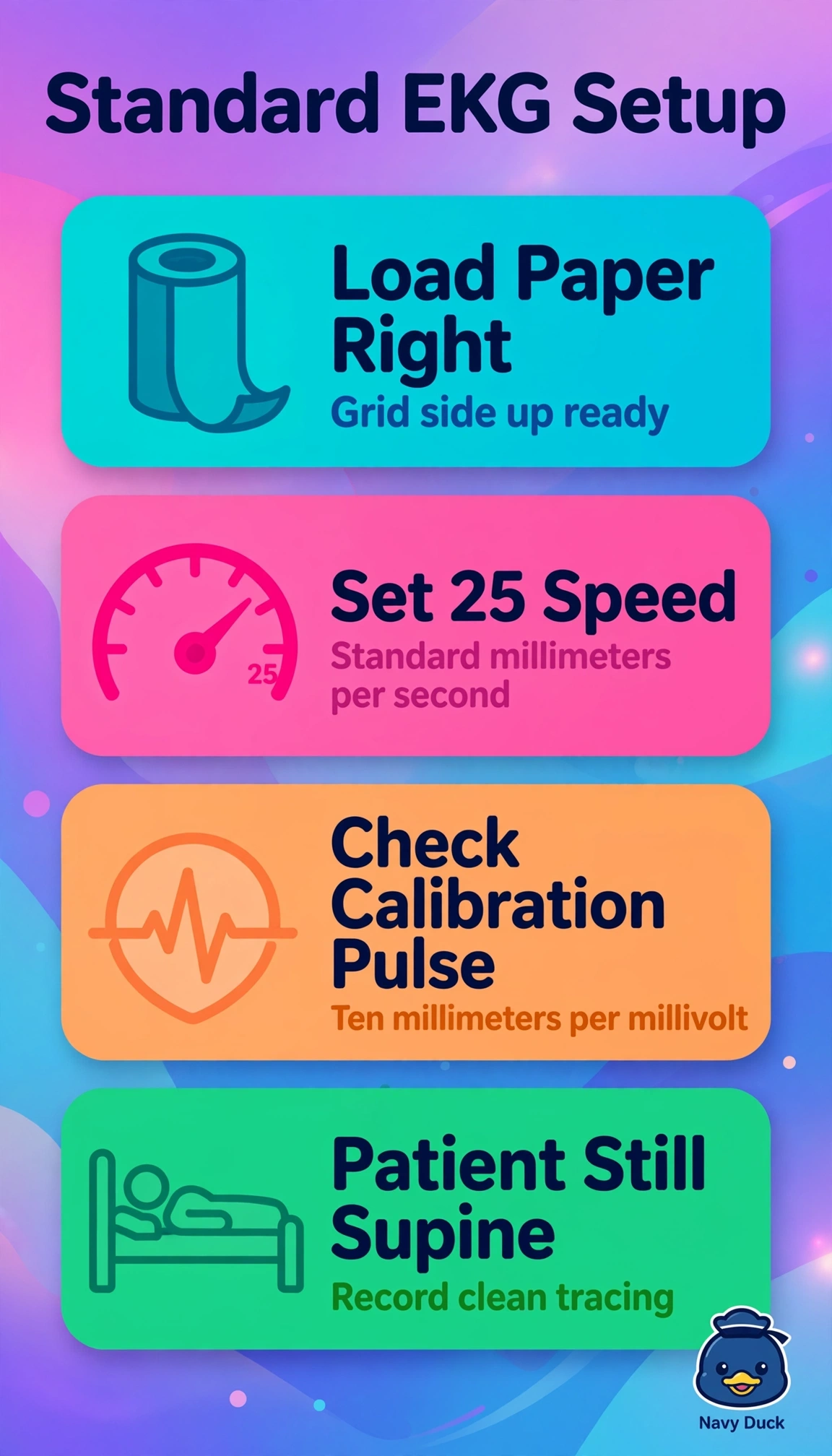
Accurate routine interpretation depends on standardized conditions so intervals, durations, and morphology can be compared to reference norms, which is why loading paper correctly to avoid skew or interruption, restoring paper speed to 25 mm per second, and recording a 1-mV calibration pulse together ensure the tracing is valid; speed defines time on the horizontal axis where 1 mm equals 40 ms, and calibration verifies vertical gain where 10 mm equals 1 mV, so both must be documented on the tracing. Increasing gain to sharpen complexes instead of running a calibration pulse fails by standardization concept because a taller complex without a calibration marker cannot prove correct voltage scaling and may mimic hypertrophy or obscure low voltage. Using 50 mm per second for detail fails by time-base concept because although that speed is commonly used to spread out wide-complex tachycardias for closer measurement, it doubles waveform width and makes routine PR, QRS, and QT measurements appear prolonged unless reinterpreted, violating the stated need for standard intervals. Continuing on low paper without reloading fails by acquisition-integrity concept because even with correct speed and calibration, insufficient or misloaded paper risks abrupt stop, misalignment, or loss of leads during capture. An exam caveat is to distinguish paper speed from gain and filter settings, since questions often pair correct numbers with the wrong adjustment to test whether standardization is preserved. As a practical check, confirm the display reads 25 mm/s and 10 mm/mV, observe a rectangular 10-mm calibration deflection, and advance a short paper test to confirm smooth feed before attaching leads.