
You are caring for a frail older adult with full dentures, limited mobility, and an indwelling urinary catheter who needs morning mouth care, denture cleaning, and perineal-catheter care in a long-term care room. Which combined oral, denture, perineal, and catheter care technique should you use for this patient?
Select an answer to reveal the explanation.
Short Explanation
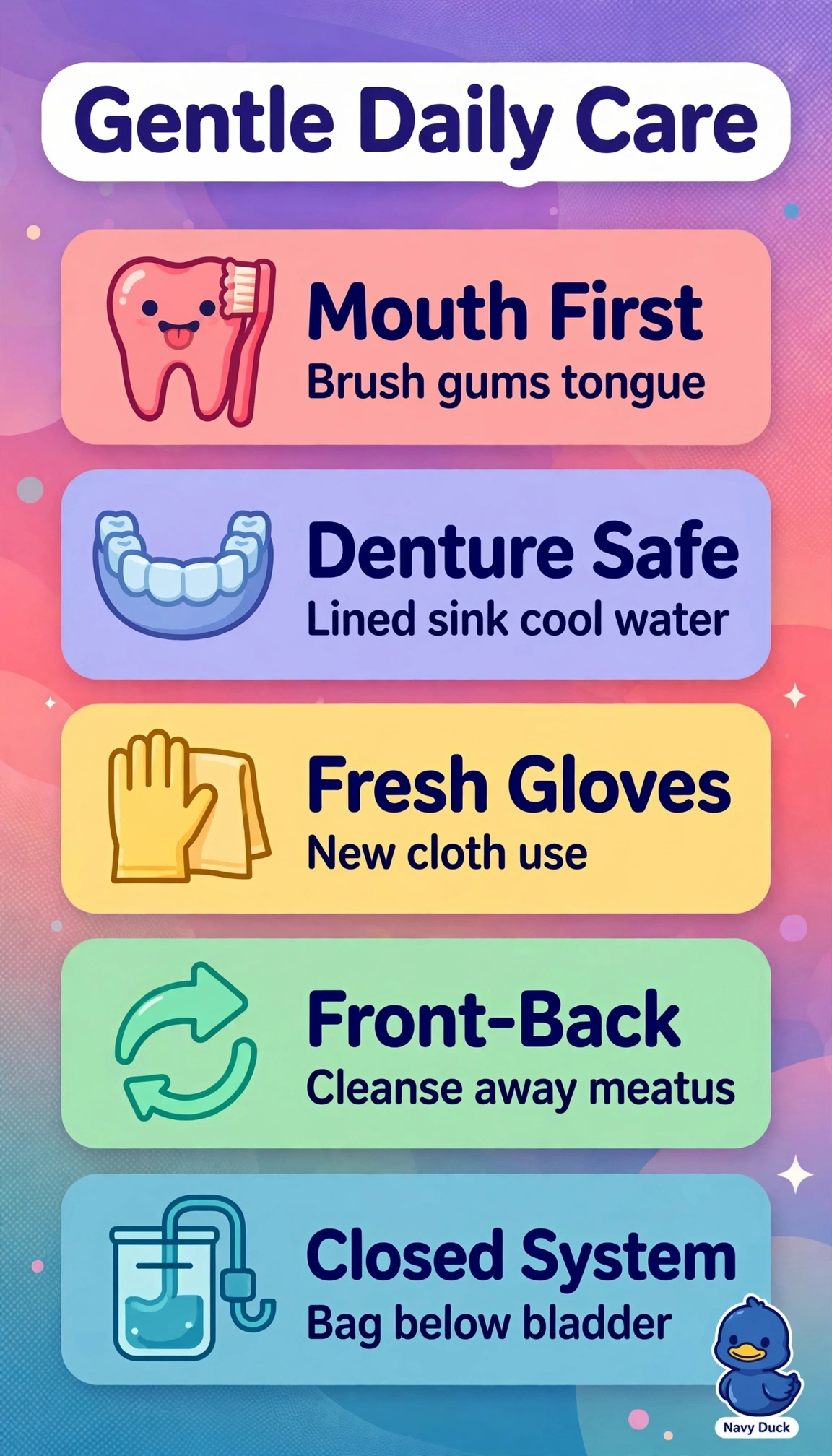
You protect your patient by brushing the gums and tongue with the dentures out, cleaning the dentures over a lined sink, and cleansing front-to-back away from the catheter. That direction helps keep germs from being pushed toward the urinary opening.
Full Explanation
Removing the dentures lets you brush the gums and tongue to remove biofilm; cleaning the dentures over a lined sink helps prevent a drop from fracturing them. Then change gloves and cleanse front-to-back, away from the meatus and catheter, to avoid dragging fecal flora into the urinary tract. The technique that cleanses toward the meatus and catheter fails because it reverses this infection-prevention direction. The technique that holds the collection bag above bladder level fails because urine can reflux toward the bladder and increase infection risk; keep the bag below bladder level and off the floor, without kinks. The technique that uses hot water over a lined sink fails because hot water can warp acrylic dentures and ruin their fit, potentially causing ulceration and poor chewing; use lukewarm water with denture cleanser. Exam caveat: combined-skill questions may make a technique wrong through one reversed cue, such as toward rather than away, above rather than below, or hot rather than lukewarm, so read each qualifier carefully. Practical check: separate oral and perineal supplies, perform hand hygiene between sites, anchor the catheter, confirm free flow with the bag below bladder level, and inspect the mouth and denture fit.