
During morning rounds on a hospital unit you are drawing blood from an adult patient who reports feeling dizzy, then becomes pale and sweaty. A large tender swelling forms at the site and the patient reports sharp shooting pain down the forearm with tingling fingers. Which complication-response action should the PCT take for syncope with hematoma and possible nerve injury?
Select an answer to reveal the explanation.
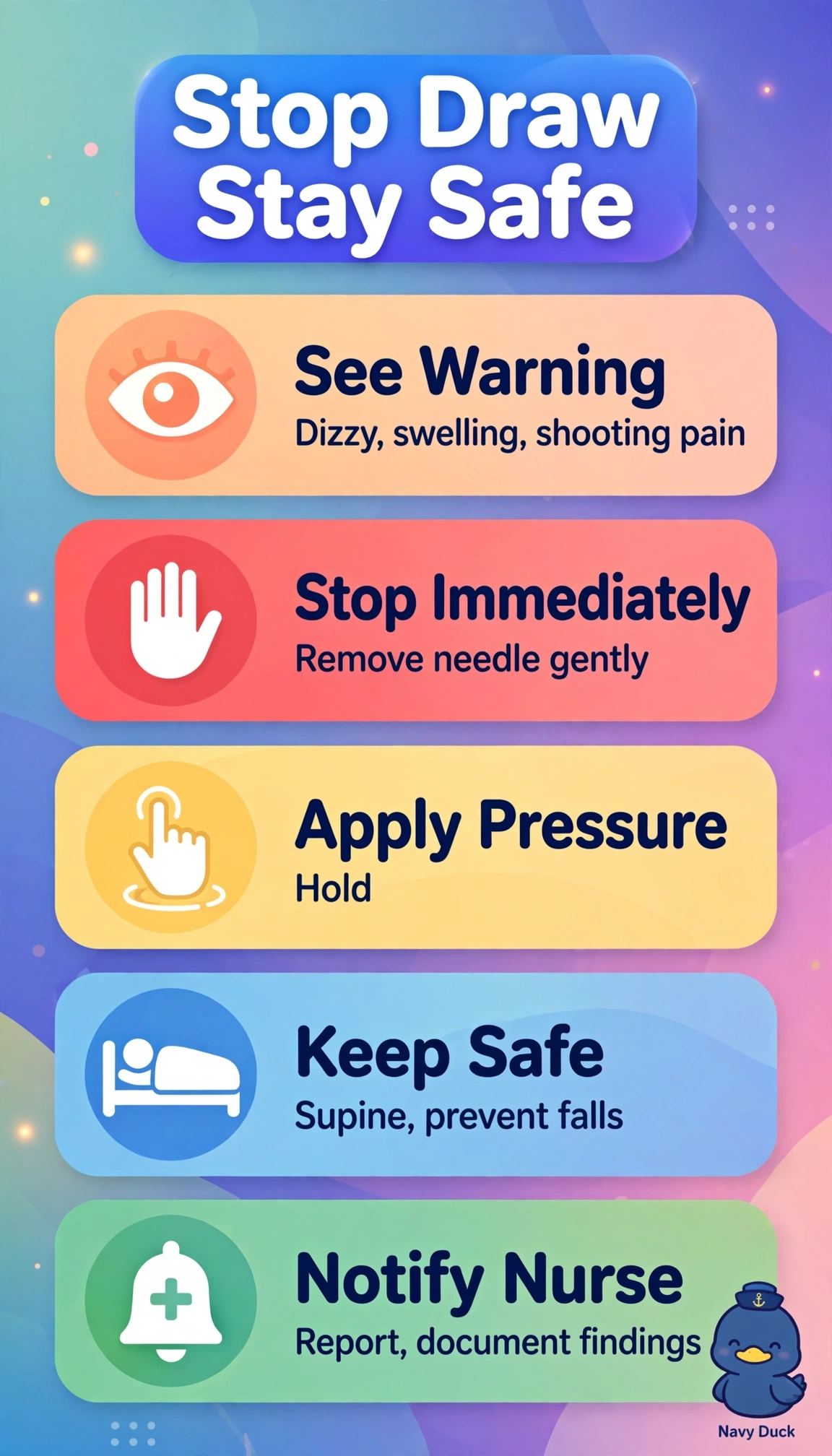
Short Explanation
You’re seeing several warning signs at once, and stopping protects the patient. Stop the draw, keep the patient lying down, and get the nurse involved as your safety-stop against further harm. A quick pause now helps prevent a bigger problem later.
Full Explanation
Stopping and removing the needle, applying pressure, keeping the patient lying down, notifying the nurse, and documenting the symptoms and site address syncope, hematoma, and possible nerve injury together. Needle removal halts further vessel and nerve trauma; pressure limits hematoma expansion; lying down guards against a fall and supports cerebral perfusion. Prompt nurse notification allows evaluation, while recording dizziness, swelling, radiating pain, and tingling preserves details for assessment and helps prevent another stick in that arm. Removing the needle, applying pressure, and keeping the patient flat while monitoring until dizziness resolves supports syncope, but omitting nurse notification and documentation fails to escalate the large swelling and neurologic symptoms. Stopping the draw, holding pressure, applying ice, elevating the arm, and notifying the nurse offers standard hematoma care, but does not keep the patient lying down or document the shooting pain and tingling that need urgent evaluation. Removing the needle, holding pressure, notifying the nurse, and documenting while sitting the patient upright fails syncope safety: pallor, sweating, and dizziness call for supine positioning, fall precautions, and recovery time before sitting or walking. The exam caveat is that a vignette combining faintness, swelling, and nerve pain requires a response that addresses all three; an action covering one problem but neglecting another is incomplete. As a practical check, stop, stay with the patient, call the nurse, keep the patient flat, maintain pressure, ask about pain and tingling, and record symptom onset, site findings, and notification.