
A clinic PCT must obtain a routine 12-lead EKG using a portable cart unit that was unplugged overnight, with paper loaded but calibration unknown, before a provider visit for a calm adult. The order specifies a standard recording. Which machine operation and maintenance sequence should the PCT use to ensure standard paper speed acquisition?
Select an answer to reveal the explanation.
Short Explanation
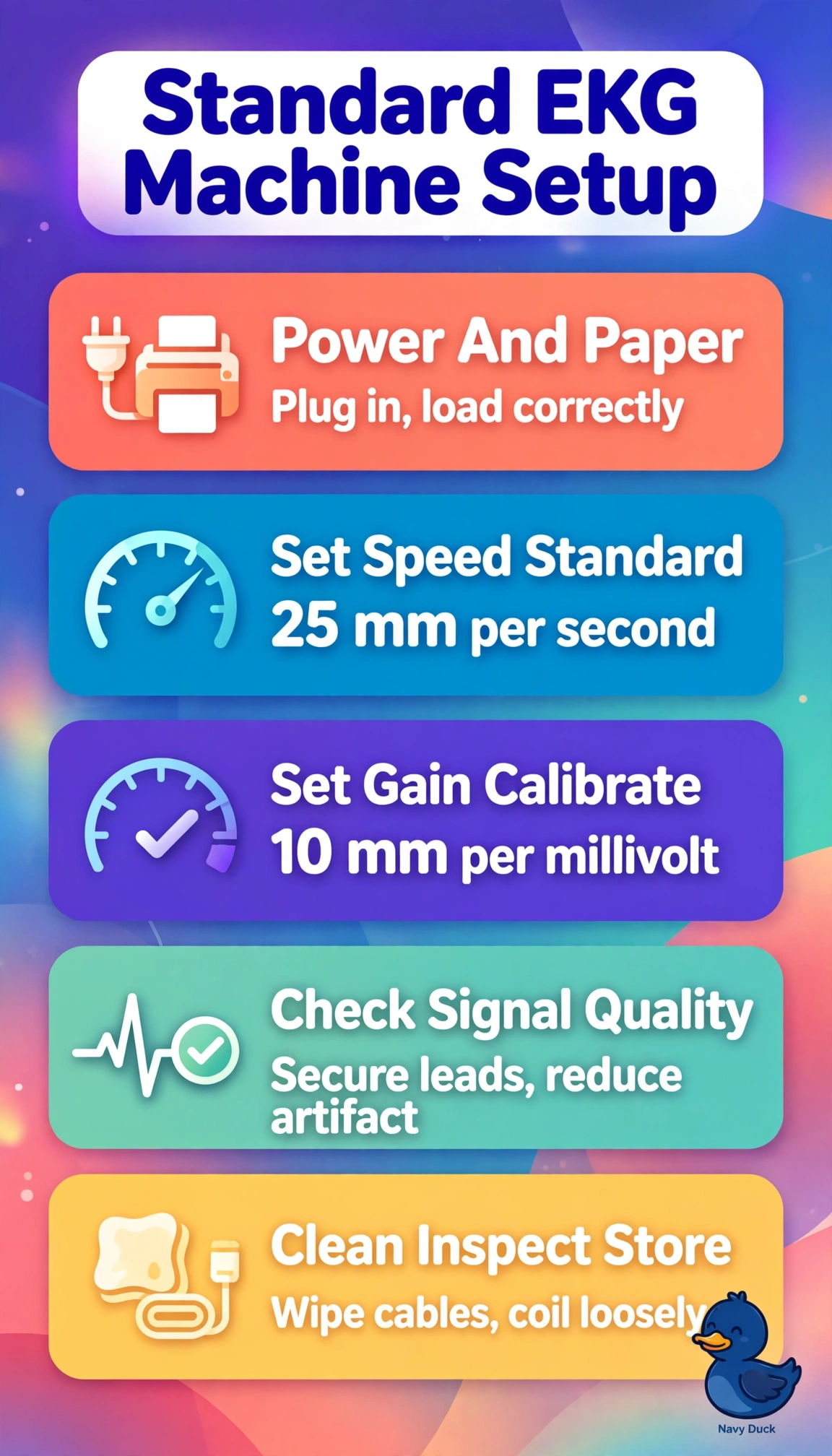
You get a readable tracing when speed and size are standard. Standard EKG settings are like playing music at right tempo — calibration at 25 mm per second keeps intervals true.
Full Explanation
The correct sequence ensures standard acquisition by addressing power, standardization, and upkeep together since connecting the cart to AC power restores reliable function after overnight unplugging and avoids battery-related artifact or shutdown, while confirming 25 mm per second paper speed preserves correct QRS width and interval measurement and confirming 10 mm per mV gain preserves correct amplitude interpretation, followed by post-use cable cleaning to reduce cross-contamination and maintain signal quality. The choice using 5 mm per mV gain fails on sensitivity because halved calibration halves waveform height and can mask ST changes or voltage criteria even though speed, power, and cleaning are appropriate and half gain is legitimately used for very large complexes with provider direction. The choice using 50 mm per second fails on time base because doubled speed stretches waveforms wide and mimics prolonged durations, which is useful for detailed rhythm evaluation but violates the explicit standard recording order for this calm adult. The choice operating on battery fails on power source because portable battery operation is otherwise routine yet is unreliable here after overnight disconnection, risking low-power artifact and interruption during the provider-visit tracing despite correct standardization and cleaning. An exam caveat is to distinguish routine standard orders from special provider-directed modifications and not select a technically valid nonstandard setting when standard is specified. A practical check is to initiate a 1-mV calibration pulse and confirm a 10-mm deflection, confirm the display reads 25 mm per second, confirm steady AC power indication, and inspect paper loading and cable integrity before recording.