
A long-term care resident with an indwelling urinary catheter develops fever and cloudy urine, a roommate carries MRSA in the nose, and a third resident has watery diarrhea later confirmed as C. difficile on a 60-resident wing with shared toilets. Which chain-of-infection explanation best guides your prevention priorities?
Select an answer to reveal the explanation.
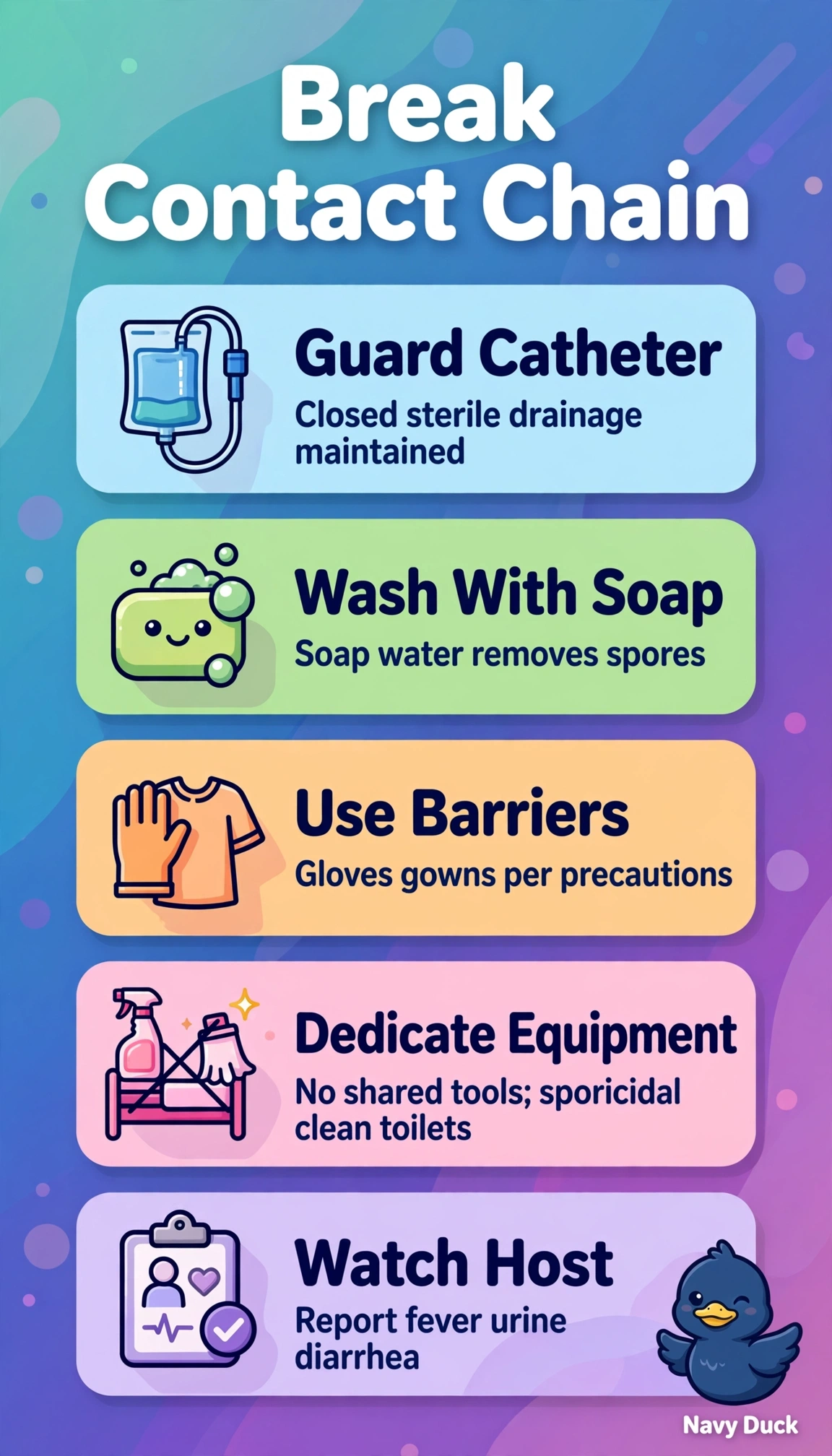
Short Explanation
You’re connecting the risks across the wing beautifully: catheter care protects the urinary portal, while gowns, soap handwashing, and sporicidal toilet cleaning address contact spread. Complete prevention matters because alcohol-based hand disinfection does not kill C. difficile spores.
Full Explanation
The explanation that combines catheter care with soap handwashing, gowns, and sporicidal cleaning of shared toilets addresses all three risks. The catheterized resident’s fever and cloudy urine point to infection involving the urinary portal, so protecting it with careful catheter care is essential. MRSA carriage and confirmed C. difficile can spread through contact, including contaminated hands, clothing, and shared toilet surfaces; gowns and effective environmental cleaning help interrupt that spread. Soap and water physically remove C. difficile spores, which alcohol-based hand disinfection does not reliably kill. An approach that maintains closed sterile catheter drainage and uses gowns but relies on alcohol hand disinfection fails to address the spores. An approach that uses soap, gowns, and sporicidal toilet cleaning but leaves catheter care to routine practice neglects the urinary portal. An approach that includes catheter care, soap handwashing, and sporicidal toilet cleaning but omits gowns fails to provide the listed barrier against contact spread. Exam caveat: confirmed C. difficile makes soap handwashing and sporicidal environmental cleaning especially important; alcohol-based hand disinfection alone is insufficient. Practical check: verify catheter care, gown use, soap handwashing, and sporicidal cleaning of shared toilets.