
A long-term care unit has new cases of MRSA wound infections and C. difficile diarrhea plus a recent CAUTI, and staff review hand hygiene, catheter care, and room cleaning. The PCT must explain prevention to a new aide. Which chain-of-infection explanation should the PCT give to address these common HAIs correctly?
Select an answer to reveal the explanation.
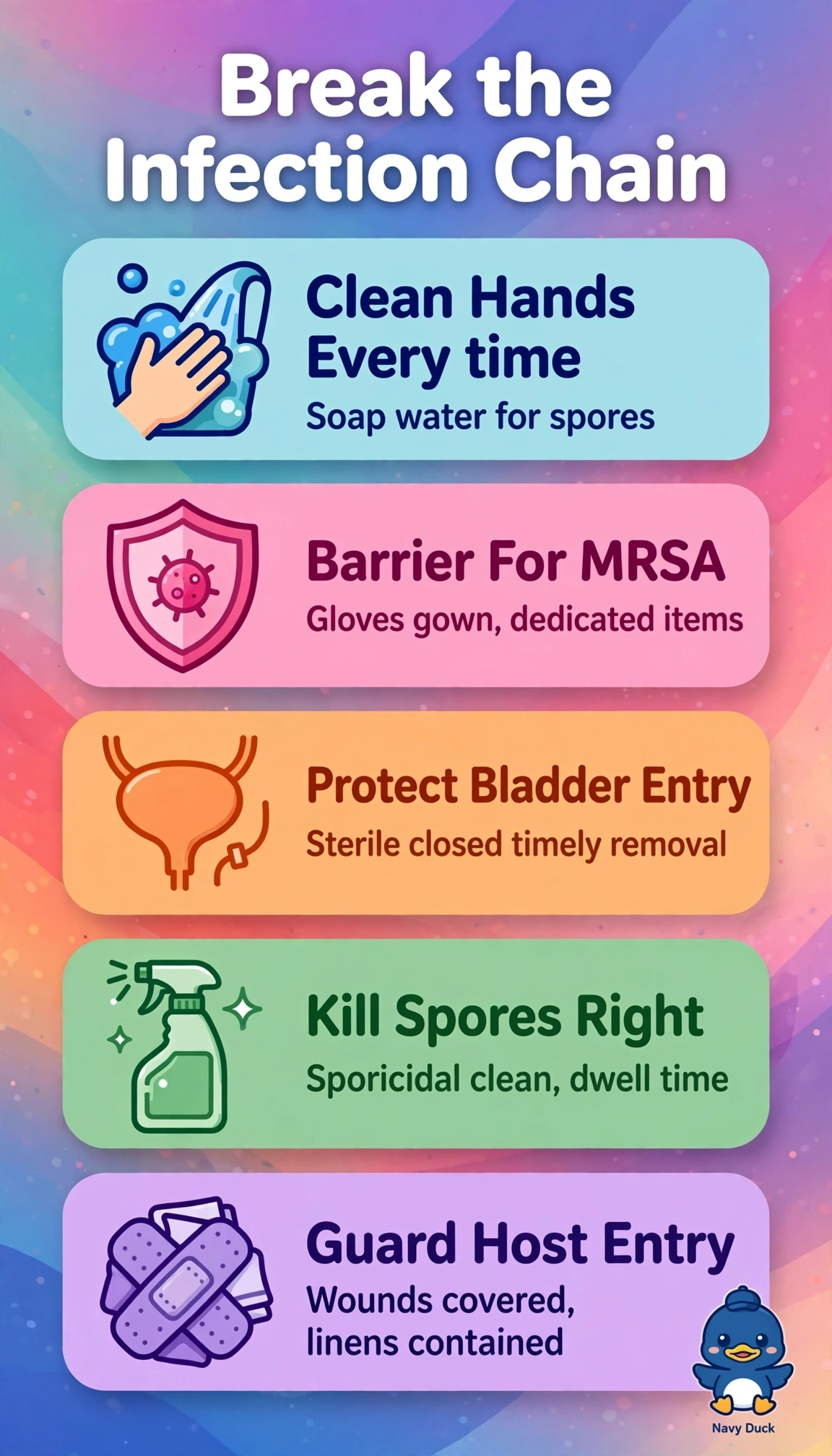
Short Explanation
You stop outbreaks by blocking the germ’s road trip. The chain breaks easiest at transmission — transmission precautions plus cleaning keep hands, catheters, and rooms safe.
Full Explanation
The correct chain-of-infection teaching centers on breaking transmission, the shared controllable link across these HAIs, by combining hand hygiene before and after contact, barrier precautions for wounds and diarrhea, proper catheter insertion, maintenance and prompt removal, and sporicidal disinfection for C. difficile spores that resist alcohol and standard quats. The approach using standard quaternary disinfectants for diarrhea rooms fails on environmental reservoir control because C. difficile forms hardy spores that persist on surfaces and require chlorine-based or other sporicidal products with correct dwell time, so routine cleaning leaves infectious reservoir intact. The approach keeping routine indwelling catheters for continence management fails on portal of entry and susceptibility because each additional catheter day increases biofilm and ascending infection risk, and prevention requires avoiding unnecessary placement and removing promptly when no longer indicated. The approach relying on gloves and wound covering without consistent hand hygiene between tasks fails on transmission dynamics because hands contaminate during glove removal and between patients and alcohol sanitizer does not kill spores, so soap and water and disciplined hygiene remain essential. Exam caveat is to distinguish colonization from infection and standard versus contact precautions, remembering alcohol sanitizer is preferred except for C. difficile and norovirus where soap and water is needed with isolation and dedicated equipment for uncontained MRSA wounds. Practical check is to verify hand hygiene, fresh gown and gloves per room, daily catheter necessity, securement and closed drainage with unobstructed flow, plus sporicidal product, dilution, contact time and high-touch coverage.