
An adult female outpatient in a clinic bathroom needs a midstream clean-catch urine culture for suspected urinary infection and asks how to avoid contamination. She has towelettes, a sterile cup, and written instructions. Which collection instruction should the technician reinforce for an accurate clean-catch specimen?
Select an answer to reveal the explanation.
Short Explanation
You are teaching a contamination-free catch, not just filling a cup. Proper midstream technique washes away skin flora for reliable culture results.
Full Explanation
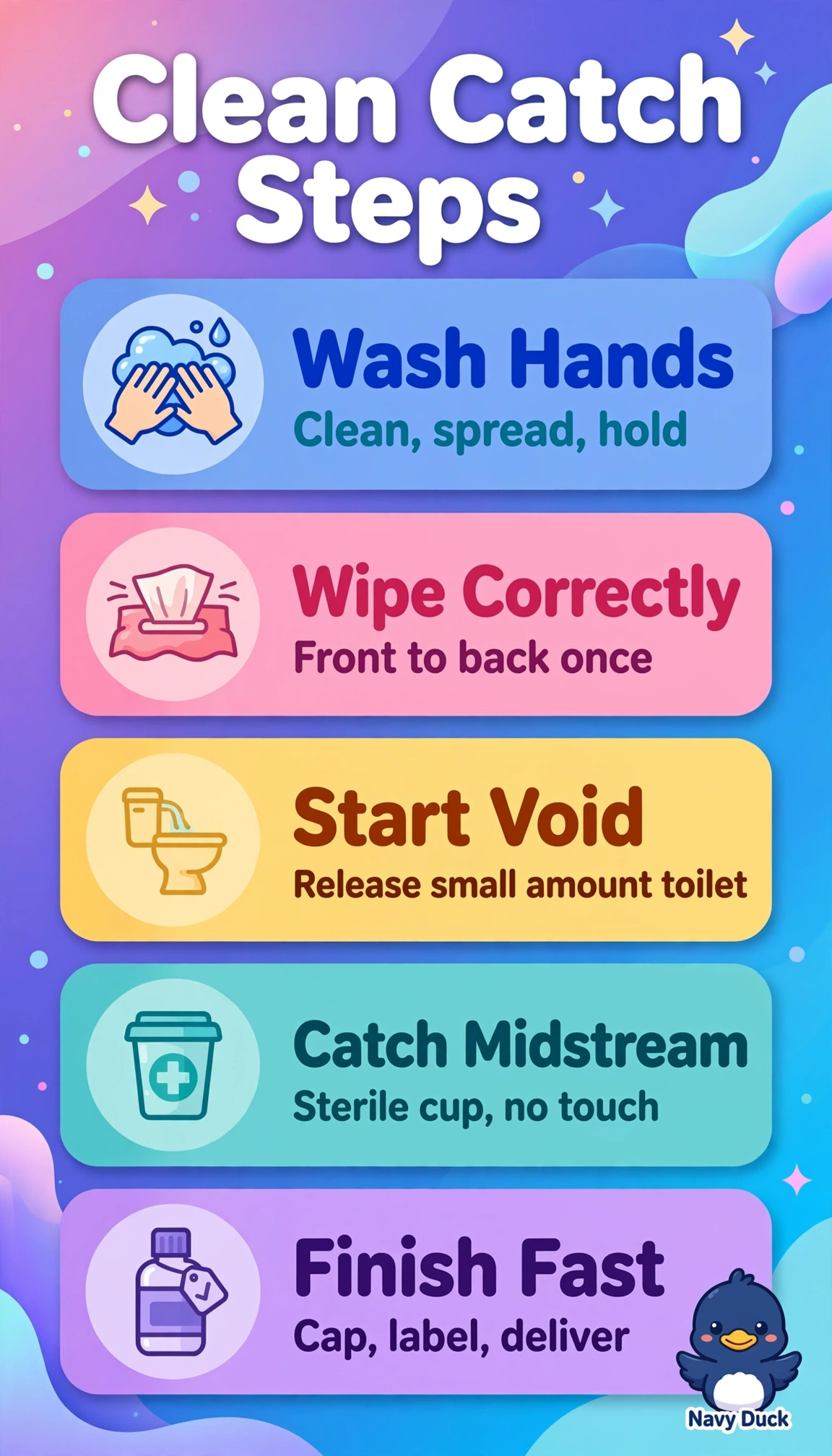
Standard female clean-catch culture combines front-to-back cleansing while separating labia, discarding the initial stream into the toilet to flush urethral and periurethral flora, then capturing midstream urine in one continuous pass without stopping to obtain representative bladder urine with minimal exposure and turbulence. Interrupting flow to position the cup violates continuous-flow asepsis because pausing prolongs meatal exposure, invites skin or cup-rim contact, and allows distal organisms to mix into the sample despite correct cleansing and discard. Saving only terminal drops violates sampling logic because end-stream urine concentrates urethral cells, mucus, and distal flora rather than bladder urine, skewing colony counts despite correct cleansing and initial void. Cleansing in widening outward circles without defined front-to-back direction violates female anatomic control because strokes can carry perineal and anal enterics forward across the meatus, recontaminating the field despite correct discard and uninterrupted capture. An exam caveat is to separate midstream culture from first-void testing for chlamydia and gonorrhea and from complete timed collections, where retention of the initial stream is intentional and must not be applied here. A practical check is teach-back of labial separation, single-use strokes front to back, discard then uninterrupted capture without touching cup interior, immediate capping, hand hygiene, and prompt transport.