
A post-surgical adult on strict intake and output has had 8 oz coffee, 4 oz juice, and 120 mL water by mouth, voided 350 mL urine, and vomited 100 mL into an emesis basin during your shift. The flow sheet requires all volumes in milliliters with emesis counted as output. Which intake and output totals should the PCT document for accurate fluid balance?
Select an answer to reveal the explanation.
Short Explanation
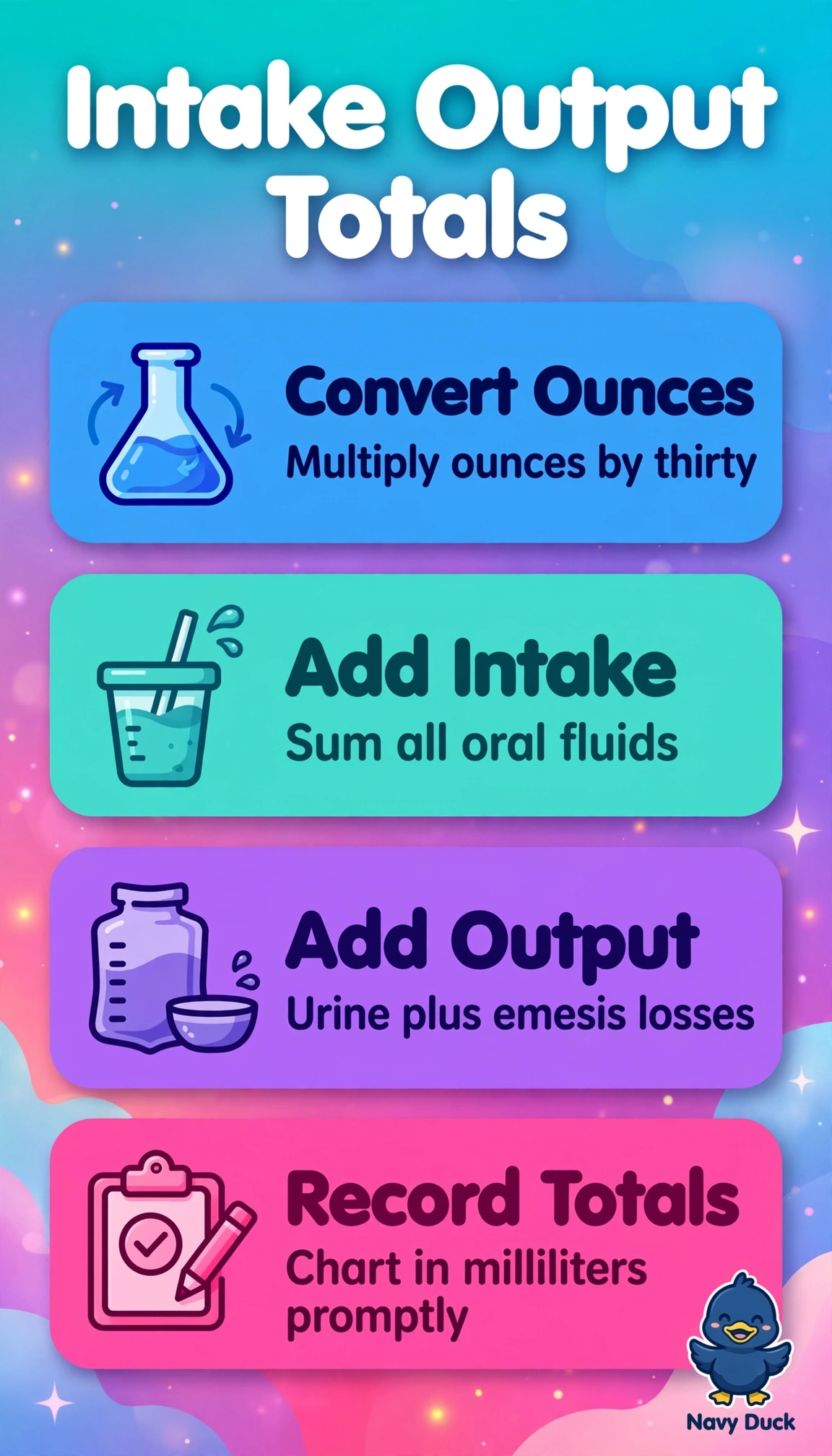
You've got this once ounces become milliliters in your head. Coffee and juice convert to 240 plus 120, so intake hits 480 while urine plus emesis makes output 450, just like balancing a checkbook.
Full Explanation
The correct recording reflects accurate conversion and complete capture of both intake and output because 8 oz coffee equals 240 mL and 4 oz juice equals 120 mL, which added to 120 mL water totals 480 mL intake, while 350 mL urine added to 100 mL vomitus totals 450 mL output as required when emesis is defined as output on a strict sheet. The recording totaling 360 mL intake with full output fails by concept of completeness because it correctly converts ounces and includes all output but omits the 120 mL water, which is still intake even though it was already in milliliters and requires no conversion. The recording totaling 480 mL intake with 350 mL urine only fails by concept of output definition because intake math is correct but it excludes measured emesis despite the explicit instruction to count emesis as output, a common bedside habit when urine is viewed as the only meaningful output. The recording totaling 420 mL intake with full output fails by concept of using stated data over memory because it substitutes a memorized 180 mL coffee cup for the stated 8 oz, yielding 180 plus 120 plus 120, which violates the exam rule to always calculate from the volume given using 1 oz equals 30 mL. An exam caveat is to convert every ounce value before adding and to read whether emesis, drains, or stool count for that question, since requirements change by scenario. A practical check is to re-add intake and output separately, confirm all entries show mL, and verify urine and emesis volumes at eye level with the container on a flat surface before documenting.