
On a night shift in a 36-bed telemetry unit, a technician records vital signs on a stable 72-year-old: temperature 99.2°F, heart rate 118, blood pressure 88/54, respiratory rate 26, SpO2 91% on room air. The patient feels lightheaded but denies chest pain. Which recognition and reporting action for values outside reference ranges is most appropriate?
Select an answer to reveal the explanation.
Short Explanation
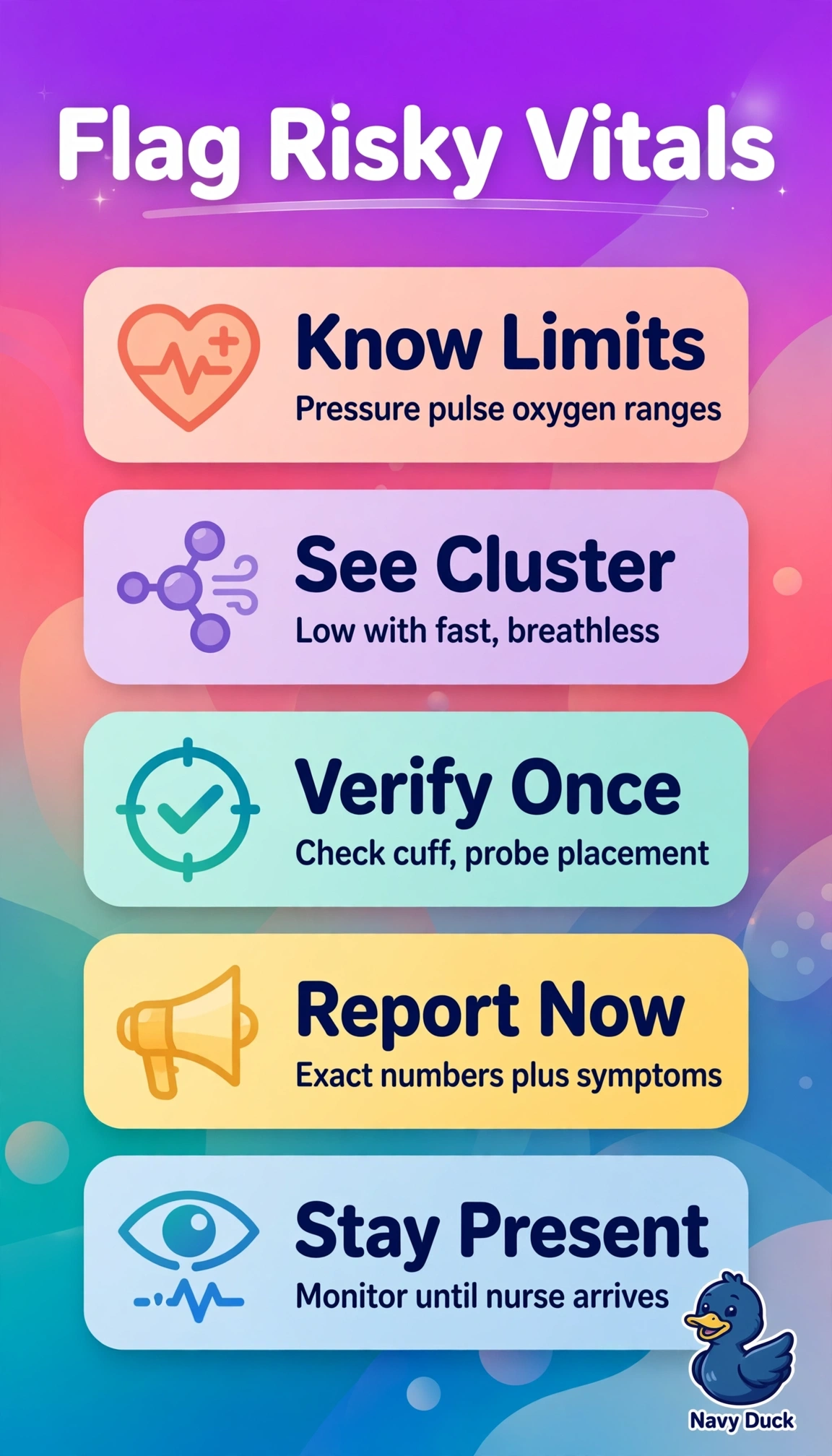
That cluster is talking to you. Low pressure with a fast pulse, fast breathing, and low oxygen needs prompt attention, so escalation helps protect the patient. You spot it, and the nurse evaluates it.
Full Explanation
Reporting the low blood pressure, rapid pulse, fast breathing, and low oxygen together is correct because these findings are all outside adult reference ranges: 88/54 is hypotension, 118 is tachycardia, 26 is tachypnea, and SpO2 91% on room air is hypoxemia. The lightheadedness suggests hypoperfusion, so the nurse needs to evaluate the patient promptly for possible sepsis, arrhythmia, bleeding, or pulmonary compromise and consider oxygen, ECG, fluids, or further escalation rather than routine monitoring. Reporting low blood pressure, rapid pulse, and fast breathing while continuing room-air observation omits hypoxemia; an SpO2 of 91% needs evaluation, not observation alone. Reporting low blood pressure, rapid pulse, and low oxygen but omitting fast breathing fails to recognize tachypnea, which can signal compensation or pulmonary involvement and affect urgency and the differential. Reporting a mild temperature elevation with rapid pulse, fast breathing, and low oxygen misclassifies 99.2°F, which is below the usual fever threshold near 100.4°F, and misses the defining symptomatic hypotension. Exam caveat: absent chest pain or a borderline temperature does not cancel this concerning cluster. Practical check: verify cuff size, count respirations for a full minute, check the oximeter waveform, repeat once, keep the lightheaded patient safe and supine, and promptly escalate using SBAR rather than delaying for repeated rechecks.