
A clinic PCT must obtain a routine 12-lead EKG on a stable adult, the portable machine shows low battery and curled thermal paper, the order specifies standard calibration, and the tracing must allow accurate interval measurement. Which machine operation and paper-speed selection should the PCT use?
Select an answer to reveal the explanation.
Short Explanation
You’re setting the machine to its normal language so the heart’s timing reads true. Standard speed keeps every little box meaning the same, like keeping a ruler in inches. Use 25-mm speed for routine tracings.
Full Explanation
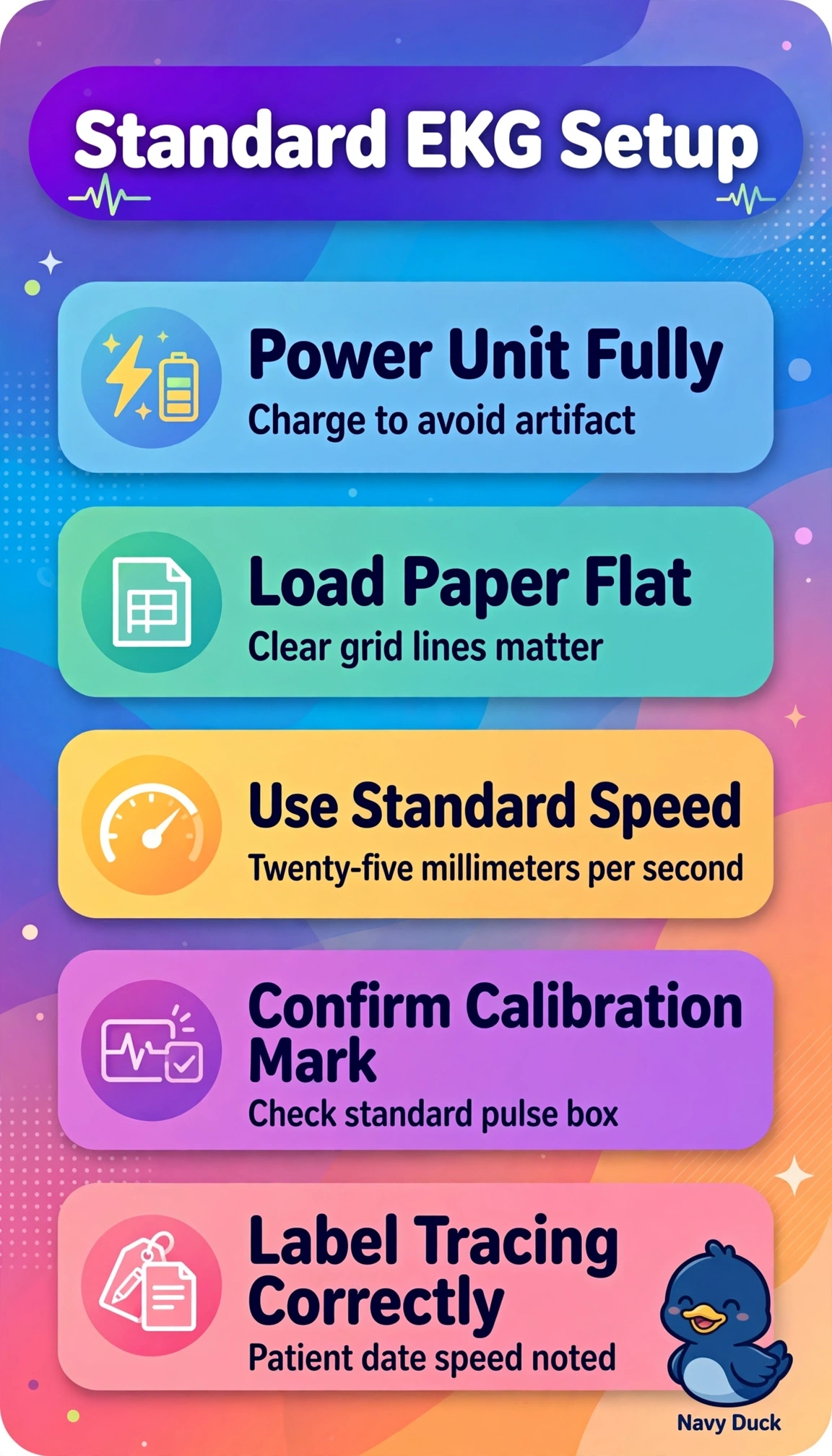
For a routine adult 12-lead ordered at standard calibration, comparability requires 25 mm per second and 10 mm per millivolt plus stable power and flat paper; plugging in the low-battery portable unit prevents shutdown and dampened complexes, while flat loaded thermal paper prevents grid distortion so PR, QRS, and QT intervals can be measured accurately. Recording at 50 mm per second with correct power, paper, and gain is accepted to widen complexes for detailed arrhythmia analysis, but it doubles width, violates the stated standard-speed order, and makes intervals appear prolonged and noncomparable to reference ranges. Operating on battery power with correct paper, gain, and 25 mm per second is normally acceptable for portability, but with an explicit low-battery warning it risks interruption, wander, and poor stylus response requiring repeat testing. Using half-standard 5 mm per millivolt gain with correct power, paper, and speed is appropriate for very tall QRS voltages to prevent overlap, but it halves amplitude, violates the order for standard calibration, and obscures voltage criteria such as low voltage, hypertrophy, and ST changes. A frequent exam caveat is to separate speed from gain because speed determines width and timing while gain determines height and voltage, so any nonstandard setting must be ordered and labeled. As a practical check, confirm mains power, flat paper, 1-mV pulse 10 mm tall, header shows 25 mm per second, and patient is supine, still, and properly prepped.