
A stroke patient with left shoulder weakness lies in bed, reports stiffness but no sharp pain, has no new swelling or redness, understands instructions, and has an order for range-of-motion exercises twice daily with the siderails managed for safety. The shoulder elevates only halfway with effort and the elbow and wrist are also stiff. Which ROM approach should the PCT use to perform safe shoulder exercises?
Select an answer to reveal the explanation.
Short Explanation
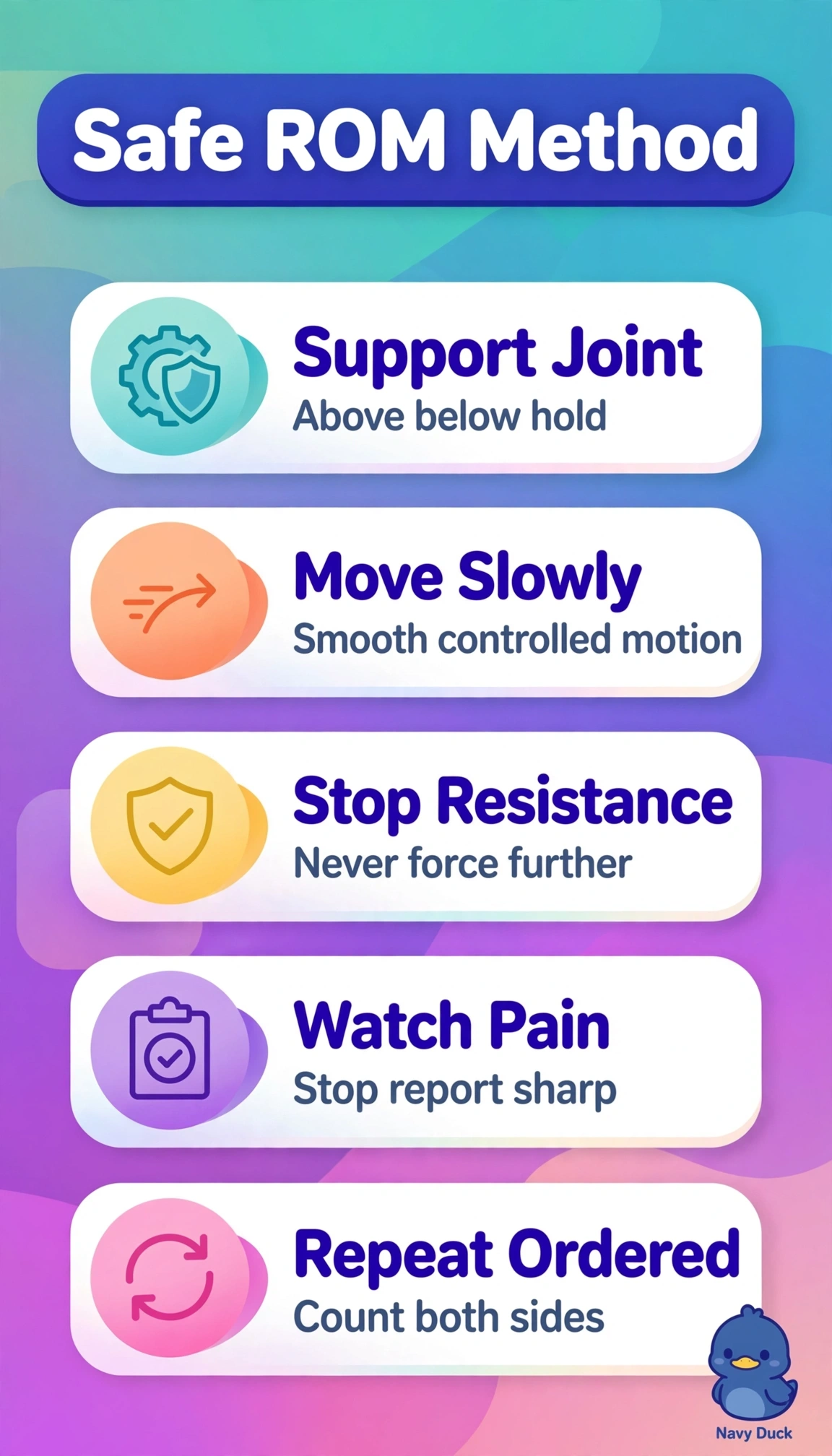
You are oiling a stiff hinge, not forcing a locked door. Support above and below the joint with slow movement to resistance protects tissue while keeping blood flowing and joints mobile.
Full Explanation
The correct approach fits because weakness with only halfway effortful elevation requires fully supported passive motion to prevent subluxation and contracture, while stiffness without sharp pain or new swelling or redness makes gentle motion safe, and supporting above and below distributes weight, moving slowly allows assessment, stopping at resistance without forcing protects tissues, and twice-daily performance with managed siderails ensures consistency and safety. Coaching independent active lifting suits an alert patient but fails on assistance level because a weak post-stroke shoulder cannot stabilize alone and unsupported effort risks strain and fatigue. Using correct support and speed but three times daily fails on following orders because frequency is prescribed to prevent overuse and define scope, and extra sessions risk soreness. Continuing with support through full range despite halfway resistance fails on endpoint because resistance is the safe stop signal and forcing past it risks microtrauma despite absent pain. An exam caveat is to separate expected stiffness from sharp pain, new swelling, redness, deformity, or trauma that require holding exercise and notifying the nurse. A practical check is to position siderails safely, support the limb, move rhythmically, watch the face, ask about comfort, stop at tightness, and document tolerance.