
A PCT witnesses an adult visitor collapse in the hospital lobby, unresponsive with no normal breathing and no pulse felt, while another bystander brings an AED and a wheelchair is nearby. Which first aid and BLS sequence follows current AHA guidelines for the PCT as responder?
Select an answer to reveal the explanation.
Short Explanation
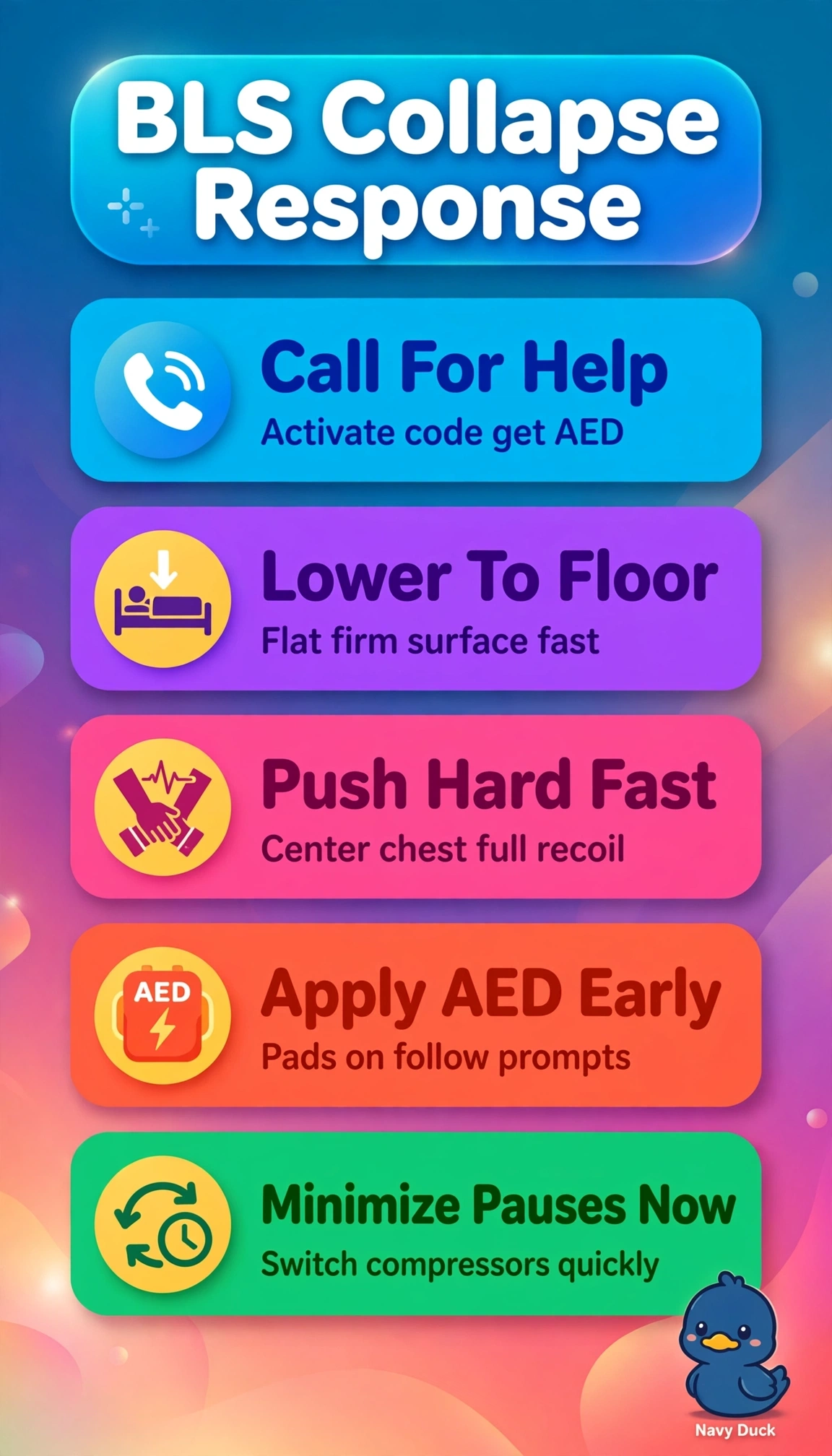
When you find someone unresponsive with no normal breathing and no pulse, activate emergency response and start compressions right away. Your firm, fast compressions help keep blood flowing while you bring the AED into use promptly.
Full Explanation
For a witnessed adult collapse with unresponsiveness, no normal breathing, and no pulse, activate the hospital emergency response, begin high-quality chest compressions immediately, and use the available AED promptly. Continuous perfusion, early rhythm analysis, and rapid defibrillation support survival in a shockable arrest. Delaying AED use until after five cycles of CPR fails the priority of early defibrillation: apply the AED as soon as it arrives rather than waiting for a fixed interval, because time to first shock strongly predicts outcome. Using the AED while the person remains seated in a wheelchair fails safe, effective positioning; place the person supine on a firm, flat surface so compressions can reach proper depth with full recoil and the AED can be used safely. Providing compressions with a 30:2 ventilation ratio but not using the AED is incomplete when the device is at hand: 30:2 is valid in other circumstances, but withholding defibrillation removes the only therapy for ventricular fibrillation or pulseless ventricular tachycardia. On exams, the visitor’s status and nearby equipment do not change BLS priorities, and the combined pulse and breathing check must take no more than ten seconds. Practically, confirm unresponsiveness, activate response, place the person supine on the floor, check pulse and breathing briefly, start compressions at the proper rate and depth with minimal interruptions, power on the AED promptly, clear for analysis and shock as prompted, and resume compressions immediately.