
A PCT monitors telemetry on a post-cardiac unit and sees a previously stable older adult develop a wide-complex rapid rhythm around 180 beats per minute with no visible P waves and a faint pulse reported by the nurse. Which rhythm recognition and monitoring action best addresses this suspected ventricular tachycardia?
Select an answer to reveal the explanation.
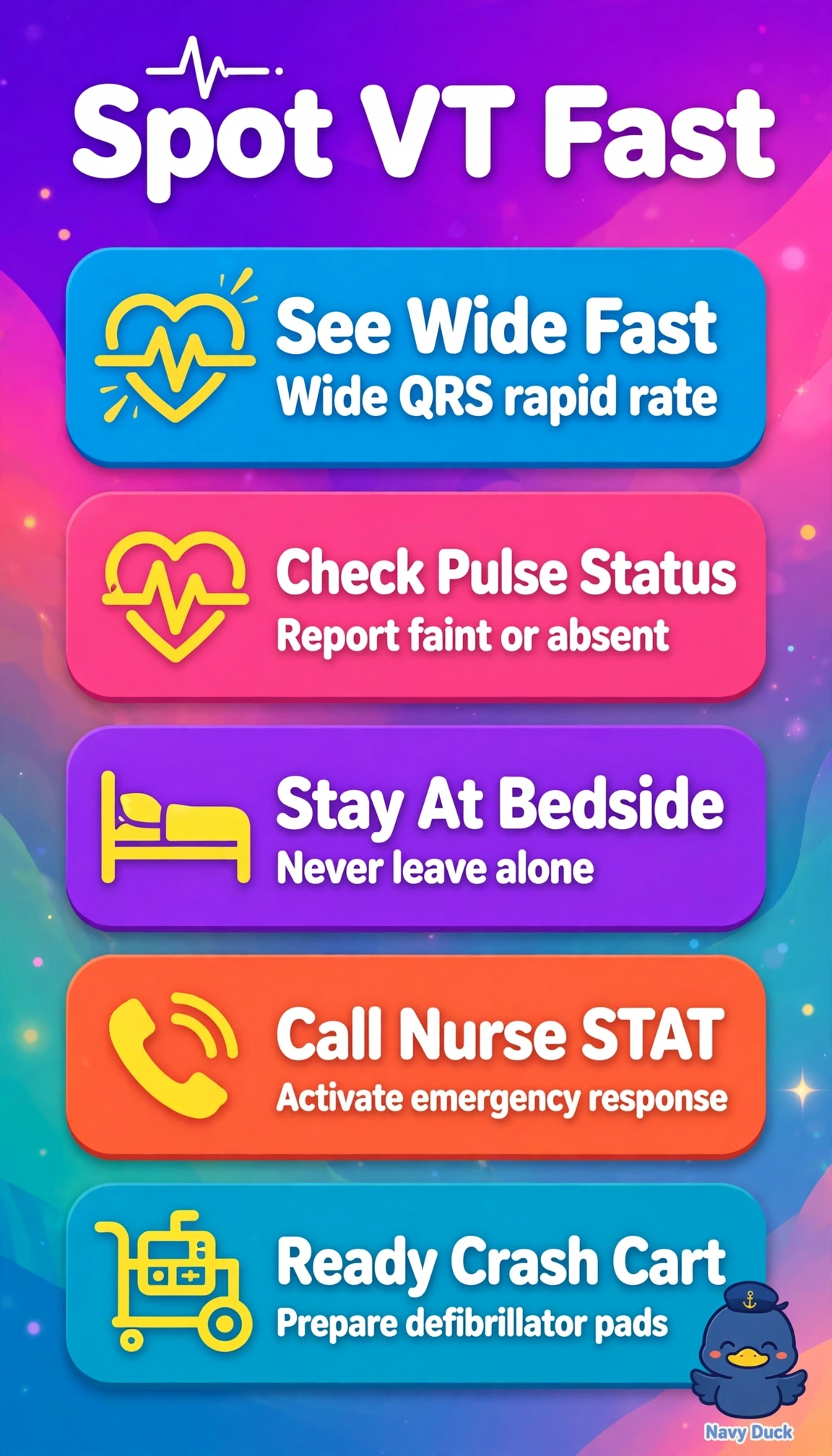
Short Explanation
You’re right to treat this fast, wide rhythm as an urgent call for help, not a moment to pause for extra testing. Escalation and resuscitation readiness matter when a faint pulse could disappear.
Full Explanation
The correct action is to stay with the patient, call the nurse STAT, and prepare defibrillation and resuscitation equipment. The older adult’s post-cardiac status, rate near 180, absent visible P waves, and faint pulse suggest ventricular tachycardia with compromised perfusion, which can deteriorate to pulseless arrest. Staying at the bedside and escalating promptly maintains observation, speeds assessment, and avoids delaying resuscitation readiness. Obtaining a 12-lead ECG to differentiate the rhythm while continuing telemetry is appropriate for stable wide-complex tachycardia, but the faint pulse signals instability, so immediate readiness takes priority over diagnostic precision. Preparing adenosine for supraventricular tachycardia follows a common SVT pathway, but the wide-complex rhythm should be treated as ventricular tachycardia until proven otherwise; adenosine does not terminate VT and can waste critical time. Applying pacing pads for symptomatic bradycardia addresses unstable slow rhythms, but this rhythm is rapid at 180, so pacing is ineffective; urgent cardioversion is indicated if a pulse persists, and defibrillation if it is lost. Exam caveat: perfusion cues such as a faint pulse, hypotension, altered mentation, chest pain, or dyspnea distinguish unstable from stable tachycardia; preparation language keeps the PCT within scope. Practical check: keep the patient supine, maintain alarms, reconfirm pulse and responsiveness, ensure oxygen, suction, and code access, and report the rate, QRS width, absent P waves, and any pulse change to the nurse.