
A middle-aged patient in the emergency department is sweaty, has dense chest hair, is breathing fast, and needs a STAT 12-lead EKG while lying still with the bed flat, skin intact, and no implanted device or allergy noted. The monitor shows wandering baseline and loose limb tracings during the first attempt. Which patient preparation and electrode placement step should the PCT perform to obtain an accurate 12-lead tracing?
Select an answer to reveal the explanation.
Short Explanation
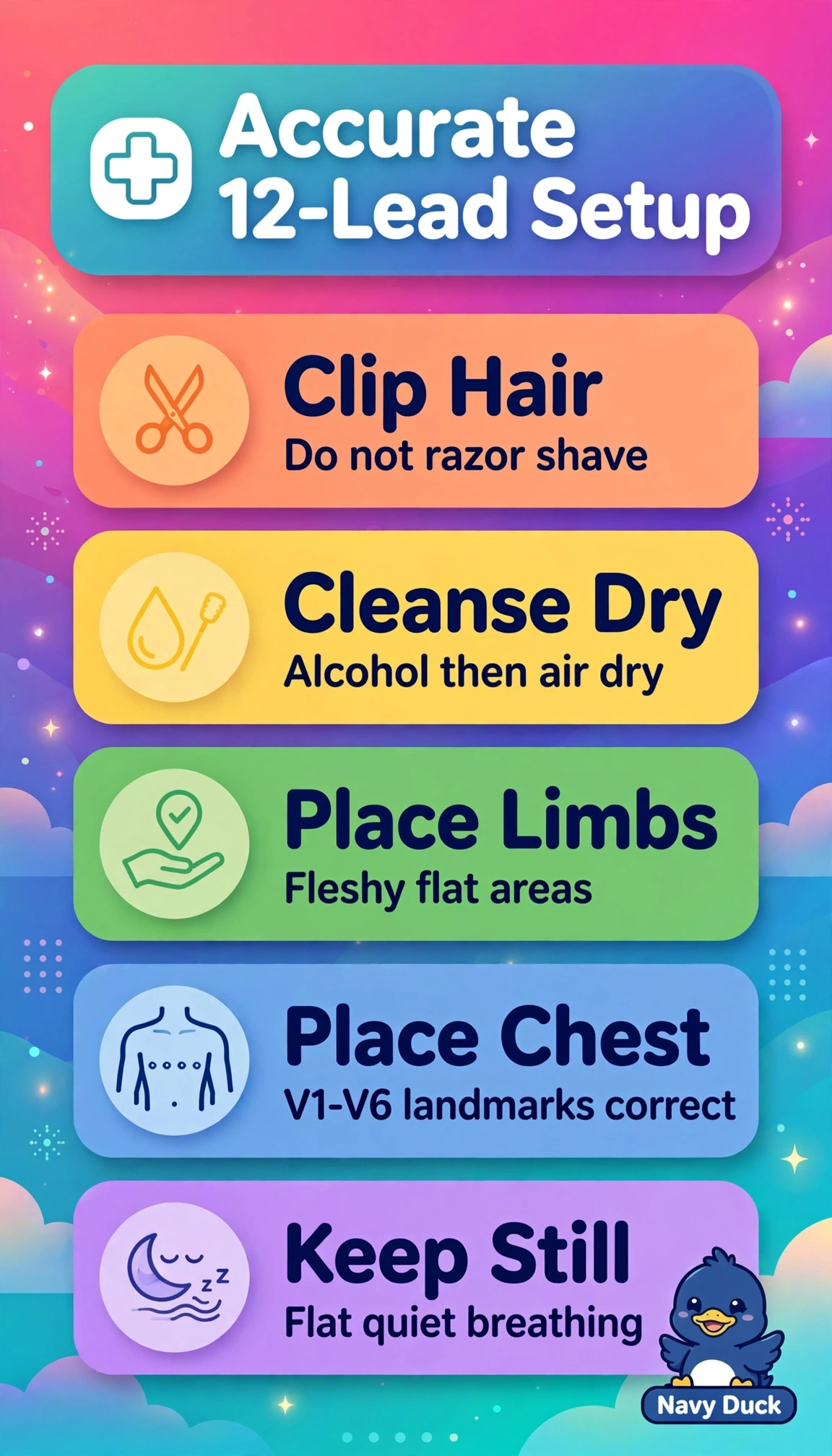
You'll get a much cleaner tracing when you've clipped extra hair, wiped the skin with alcohol, and let it dry fully before placing your limb and chest leads. That solid contact helps your electrodes pick up the heart's signal nice and clear, like tuning a fuzzy station into music.
Full Explanation
The correct approach preserves standardization by clipping dense hair to protect intact skin, removing sweat and oil with alcohol and drying fully to restore contact and resolve wandering baseline and loose tracings, then placing limb electrodes on limbs with V1-V6 in anatomic order with the patient still and supine with the bed flat for a STAT tracing. The torso-placement variation handles sweat, hair, and precordial sites well and reflects routine monitoring where limb leads are moved to reduce motion artifact, but for a diagnostic 12-lead it alters vectors, voltage, and axis and yields a noncomparable tracing. The leave-the-hair variation also cleanses, dries, and positions correctly but leaves dense hair under the electrodes, which traps air, raises impedance, and sustains the wandering baseline and loose tracings already seen; the hair should be clipped (not shaved, which risks microabrasions). The elevated-bed variation also prepares and positions correctly and understandably eases rapid breathing, a standard comfort measure for dyspnea, but elevation shifts cardiac position and morphology away from the flat supine reference required here. The exam caveat is that STAT urgency never excuses wet skin, altered landmarks, or non-supine positioning, so monitoring or comfort measures remain wrong for a diagnostic tracing. The practical check is to confirm the bed is flat, the patient is motionless, skin is clipped and fully dry, wires are secure, and to re-prep and repeat if artifact persists.