
In an outpatient clinic, a technician must obtain vital signs on a frightened 3-year-old with a small arm and on an 84-year-old with loose skin, tremor, and orthostatic dizziness. Supplies include multiple cuff sizes, axillary and tympanic thermometers, and a pulse oximeter. Which adapted vital-sign technique best fits pediatric, geriatric, and special-population needs?
Select an answer to reveal the explanation.
Short Explanation
Little arms and unsteady elders need tailored care. The right fit plus unhurried support gives you numbers you can trust, and sizing is the secret. Comfort first, accuracy follows.
Full Explanation
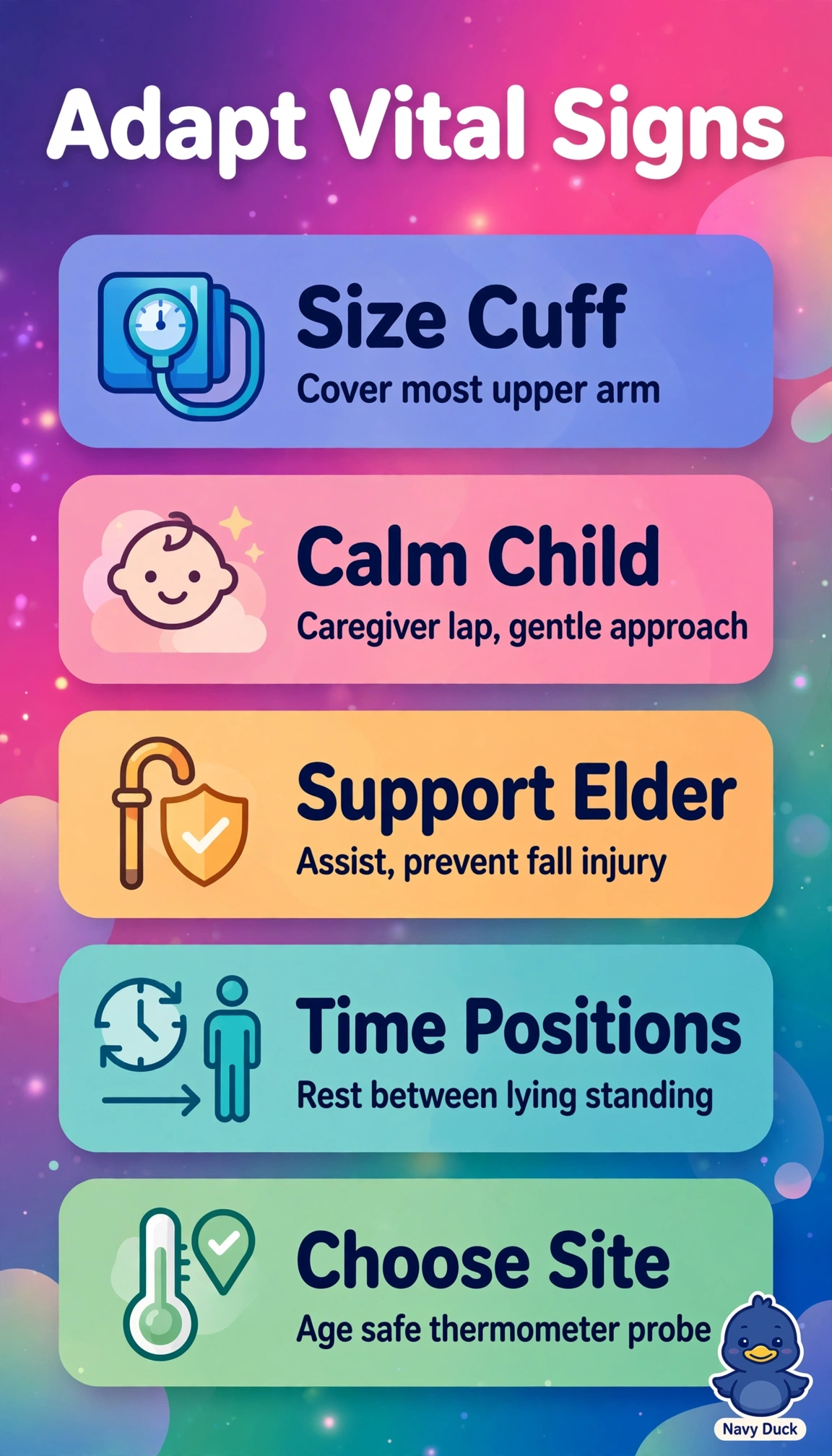
The correct technique succeeds because a child-sized cuff with bladder covering most of the upper arm maintains the width-to-circumference ratio that prevents falsely high readings in a small arm, while slow supine-to-standing orthostatics with support allow equilibration, reduce tremor and loose-skin artifact, and protect a dizzy elder from falls. The wrist-cuff approach fails by site selection because wrist oscillometry is a sound comfort strategy in cooperative adults when held at heart level, yet in a frightened moving toddler positioning error and hydrostatic effects undermine accuracy and it does not meet the upper-arm standard implied by available cuff sizes. The deferral approach fails by indication because watchful resting is commonly used to avoid overtesting when symptoms resolve, yet new orthostatic dizziness in an 84-year-old requires formal supine then 1- and 3-minute standing assessment to document a 20-mmHg systolic or 10-mmHg diastolic drop and guide interventions. The seated-only approach fails by sensitivity because seated pressures are widely used to lower fall risk when standing is unsafe, yet they systematically blunt venous pooling and underdetect orthostatic hypotension, so they cannot substitute when evaluation of dizziness is requested. For exams, a plausible fall-safety rationale does not override an explicit orthostatic indication, and in practice confirm cuff coverage of about two-thirds of the upper arm, enlist caregiver calming, lock support, use the same arm, and monitor symptoms between timed readings.