
A patient care technician is monitoring an older adult on telemetry with a history of dizziness who now reports chest pressure, appears pale and confused, is short of breath, and shows a regular very slow rhythm near 30/min with low blood pressure while leads are confirmed attached. Which immediate response should the technician take for symptomatic bradycardia with cardiopulmonary compromise?
Select an answer to reveal the explanation.
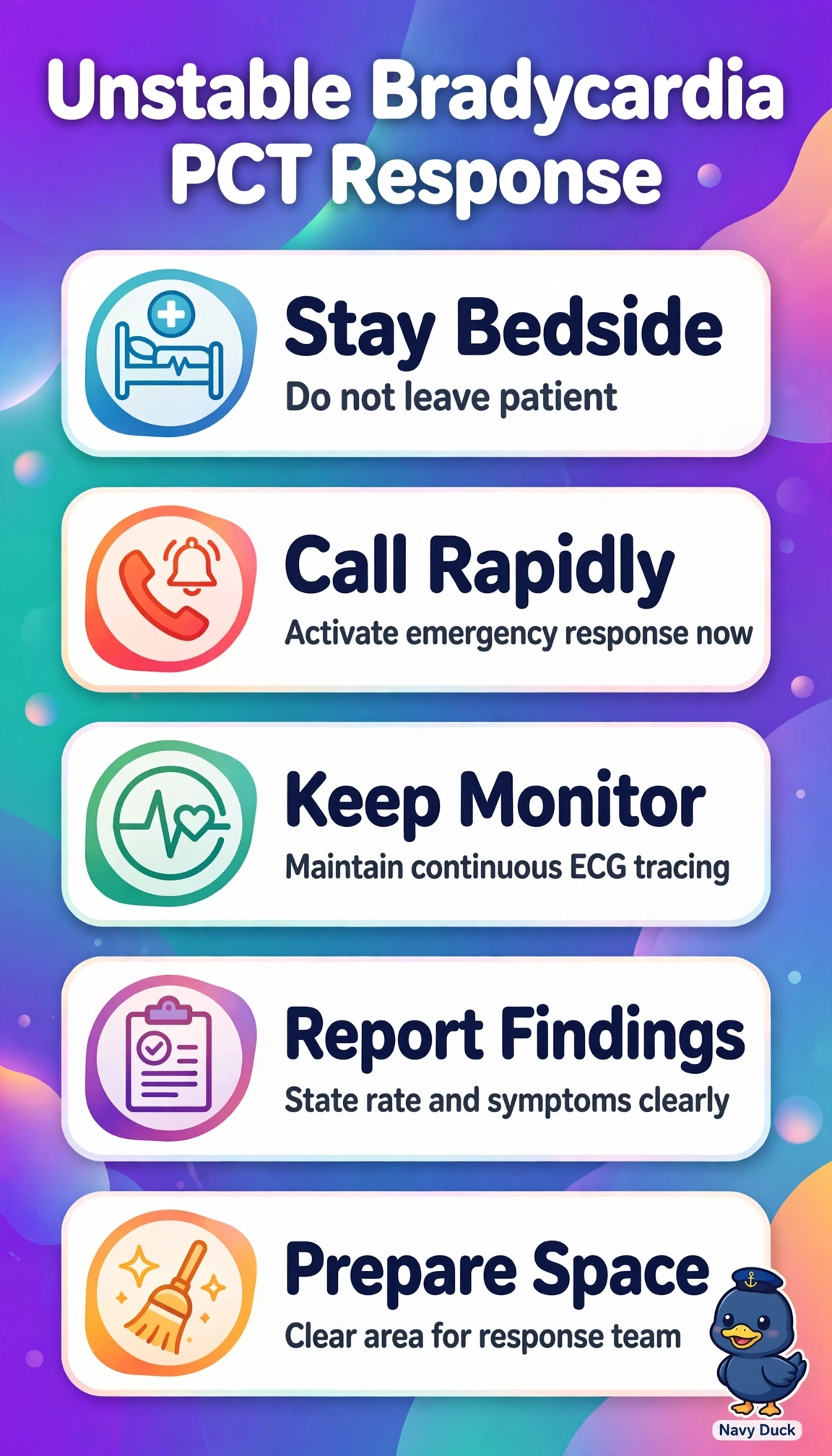
Short Explanation
You’re the safety net here, not the fix: stay with the patient, activate the rapid response system, and keep the monitor on. That gives the team a live ECG trace while urgent help is on the way.
Full Explanation
Staying with the patient, activating the rapid response system, and maintaining continuous ECG monitoring are appropriate because chest pressure, pallor, confusion, shortness of breath, hypotension, and a regular rate near 30/min indicate symptomatic bradycardia with cardiopulmonary compromise. The patient needs immediate higher-level help, while you remain at the bedside and preserve uninterrupted monitoring within your role. Staying with the patient, notifying only the assigned nurse, and maintaining monitoring fails to match the urgency: hypotension and altered mentation with chest pressure require rapid response activation, not notification alone. Staying with the patient, activating rapid response, and collecting a dizziness history prioritizes background information over immediate support and continuous surveillance during active instability. Staying with the patient, activating rapid response, and repositioning the telemetry leads to confirm rhythm accuracy is unnecessary because lead attachment is confirmed and the patient’s symptoms support a true clinical problem; lead troubleshooting could distract from monitoring. Exam caveat: confirmed lead attachment does not make a severely symptomatic patient stable or remove the need for urgent escalation. Practical check: remain bedside, keep the ECG monitor and alarms on, summon rapid help without leaving, and report the symptoms, rate near 30/min, blood pressure, and confirmed lead contact when the team arrives.