
In a long-term care unit, an 82-year-old resident with dementia is incontinent overnight, has damp gown and sheets, has intact but moisture-prone skin, and can turn side to side with assist but cannot leave bed. The nurse delegates a morning bed bath with an occupied-bed linen change. Which bathing and occupied-bed technique best meets hygiene and safety for this linen change?
Select an answer to reveal the explanation.
Short Explanation
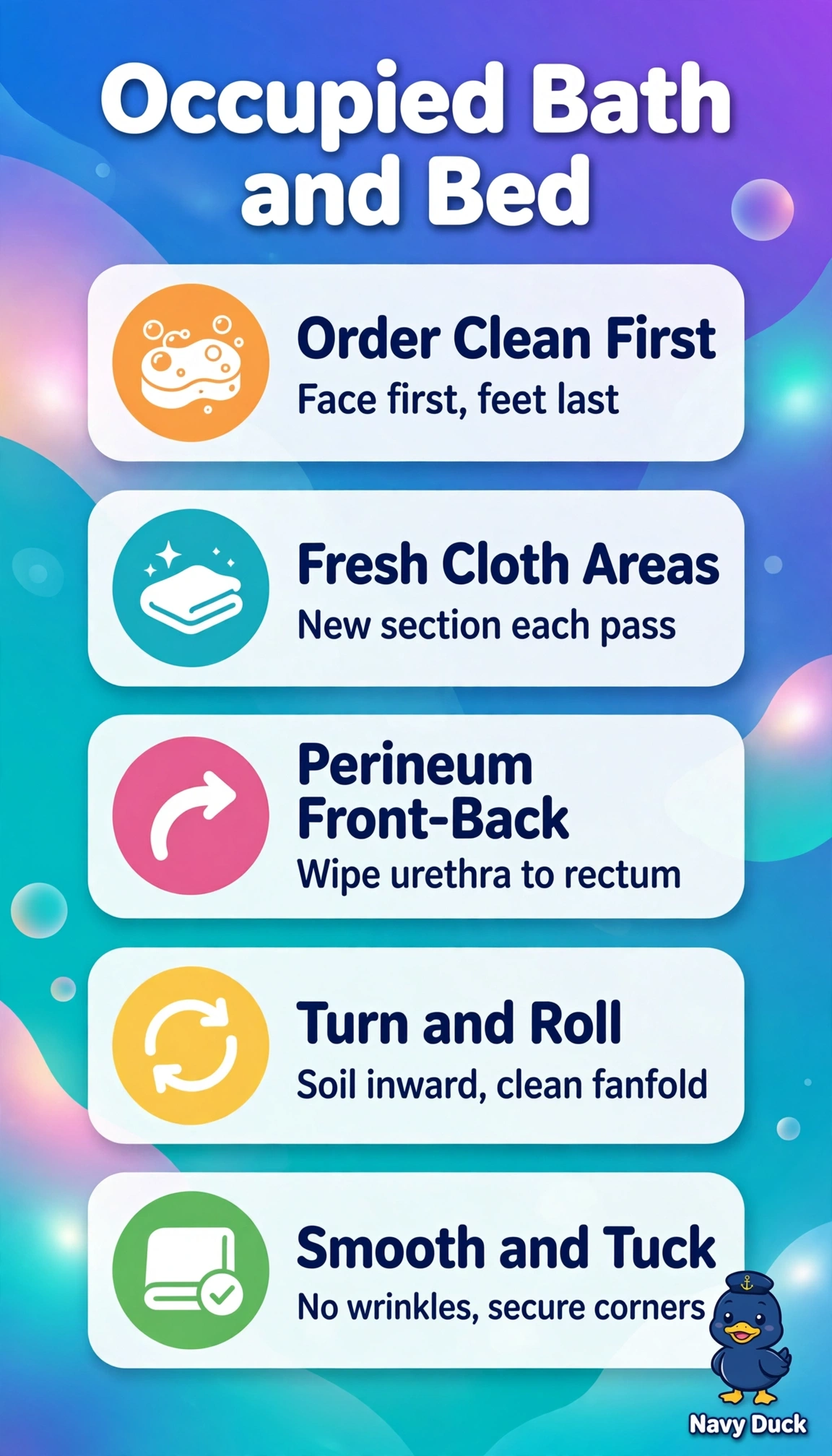
You're protecting fragile skin while swapping sheets under someone who can't get up. Fresh cloth sections plus front-to-back cleaning and inward rolling keeps cross-contamination down like changing a tablecloth without clearing the table.
Full Explanation
The correct technique succeeds because it combines cephalocaudal hygiene, incontinence care, and occupied-bed mechanics for a resident who turns with assist but cannot leave bed, moving from cleaner face toward feet with fresh cloth surfaces to limit cross-contamination, providing prompt front-to-back perineal cleansing to remove overnight urine and stool from intact but moisture-prone skin while protecting the urethra, and turning side to side to roll soiled linen inward so contaminants are contained and clean sheets can be pulled tight and wrinkle-free with a dry gown to prevent maceration and pressure injury. One distractor fails by infection-control concept by reusing the same cloth area throughout, which appears efficient but carries facial, body, and perineal flora across sites and is unsafe after incontinence. Another fails by perineal asepsis concept by washing back to front, which may look thorough but drags anal flora toward the urethra and raises urinary infection risk, violating the front-to-back standard. A further alternative fails by occupied-bed mechanics by tucking linens while lying flat and lifting hips, a bridging method suited to independent adults but unsafe and ineffective at 82 with dementia, ignoring the preserved ability to turn, impairing containment and smoothing, and leaving dampness and wrinkles. On exams, use mobility cues to separate occupied-bed turning from dangling or bridging methods and never delay incontinence care to keep linen dry. As a practical check, confirm perineum is clean and dry, gown and sheets are fully dry and tight, and skin folds show no redness or lingering moisture.