
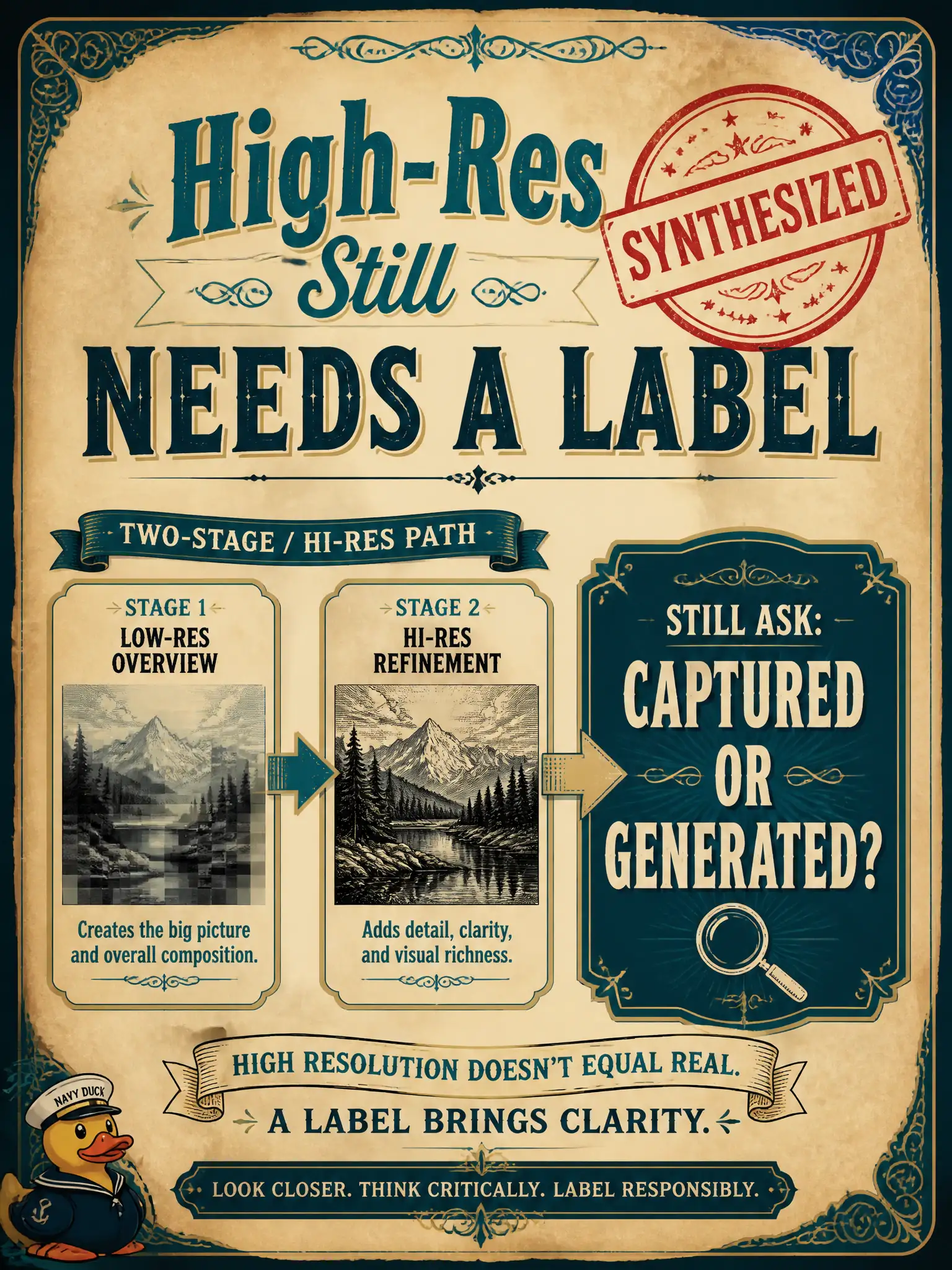
A town-crier poster was grown through a two-stage latent high-resolution path and looks like a period broadside. What authenticity step still applies?
Select an answer to reveal the explanation.
Short Explanation
A polished forgery of an old poster is still a forgery until you say so. High-resolution synthesis needs the same “captured or generated?” label as a rough sketch.
Full Explanation
A town-crier poster grown through a two-stage latent high-resolution path that looks like a period broadside still needs disclosure that the still was synthesized, kept visible to readers even when it looks period-perfect. High resolution does not convert a render into an archival scan for civic history walls.
Skipping labeling because high resolution proves the poster was scanned from an archive fails: resolution ≠ capture provenance. Treating the item as Domain 6 transfer learning because two stages mean fine-tuning fails domain—the question is authenticity disclosure. Replacing authenticity checks with a pie chart of print dpi fails: dpi analysis is not a Domain 7 substitute.
Exam caveat: photoreal and period-look stills remain generated until labeled otherwise. Multi-stage latent enhancement does not mint archival authenticity.
Operational check: stamp “synthesized” on visitor-facing town-crier posters; retain generation logs; refuse archive-catalog codes that imply scan provenance for renders. In municipal trustworthy-AI stewardship, record the disclosure, consent, or bias decision and the rejected shortcuts in the gallery change log so future stewards protect residents from undisclosed synthesis and stereotyped generation. Re-audit labels, consent records, and bias samples after the next model or exhibit update to keep the city's public trust intact.