
A family-album scanner sends a short clip plus a question through an NVIDIA AI Blueprint with VIA. A relative asks whether the clip is the real picnic. How should the candidate treat that question?
Select an answer to reveal the explanation.
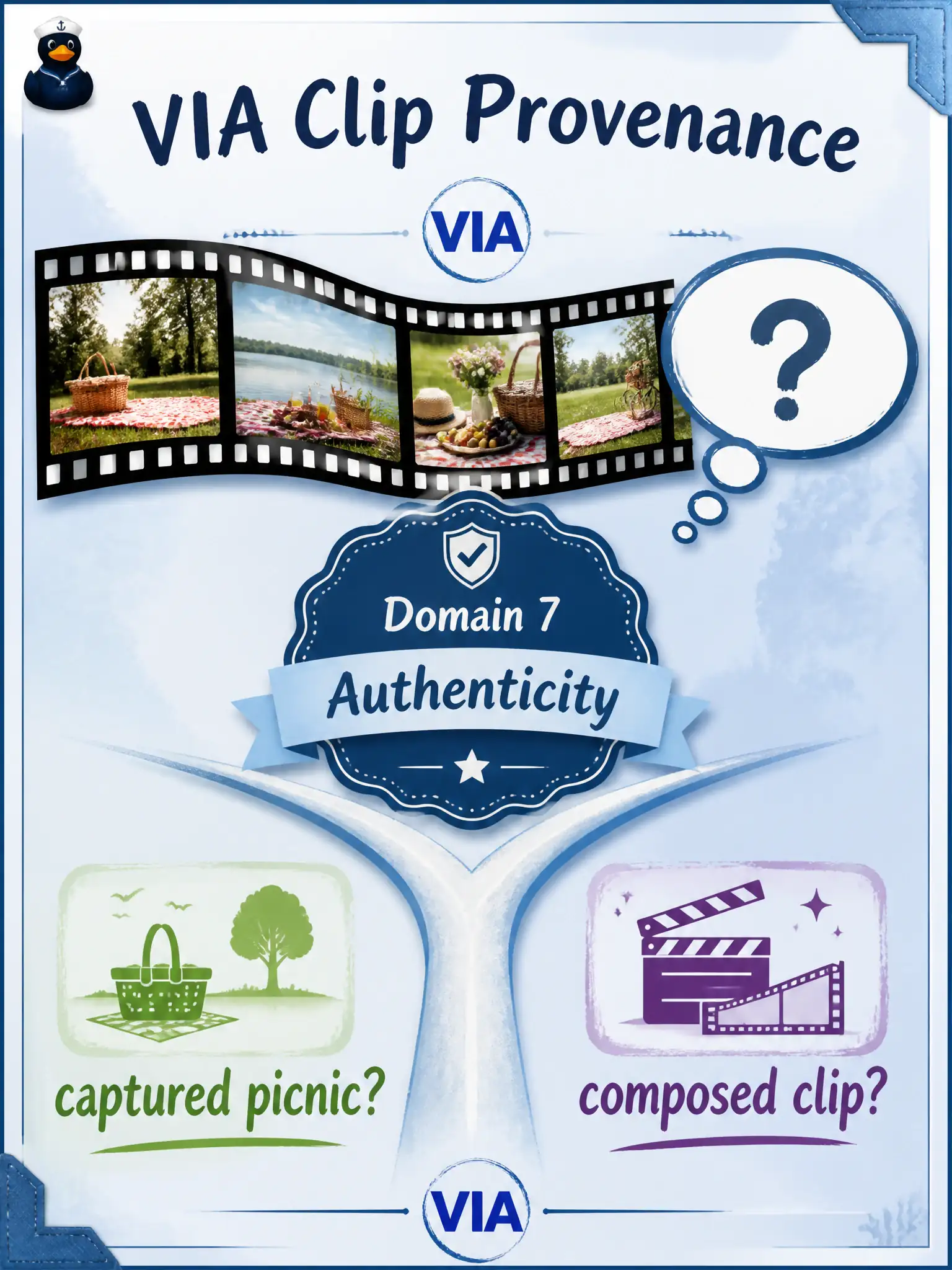
Short Explanation
VIA can answer questions about a clip, but “was this picnic real?” is about provenance. Leave VIA as initials and treat the clip’s origin as trust, not wiring.
Full Explanation
When a family-album scanner sends a short clip plus a question through an NVIDIA AI Blueprint with VIA and a relative asks whether the clip is the real picnic, treat that as a Domain 7 authenticity question about whether the video arm’s clip was captured or composed—not as Domain 4 rewiring or Domain 6 latency.
Treating it as a Domain 4 customization task to rewire Blueprint nodes fails: the relative asked about clip authenticity, not node wiring. Treating it as a Domain 6 latency check on how fast VIA answers fails the trust question. Treating it as proof that VIA must be expanded into a spelled-out product name fails materials discipline.
Exam caveat: VIA Q&A can surface authenticity questions about the video arm. Keep VIA as initials; answer capture-versus-composed separately from customization or speed.
Operational check: maintain capture provenance for picnic clips; label composed or heavily edited clips before VIA Q&A in the municipal family-history booth; answer relatives from the provenance record, not from latency graphs. In municipal trustworthy-AI stewardship, record the disclosure, consent, or bias decision and the rejected shortcuts in the gallery change log so future stewards protect residents from undisclosed synthesis and stereotyped generation. Re-audit labels, consent records, and bias samples after the next model or exhibit update to keep the city's public trust intact.