
A tile-glaze kiosk must accept a microphone stream and return spoken audio. Where do the official Riva stages sit in that served app?
Select an answer to reveal the explanation.
Short Explanation
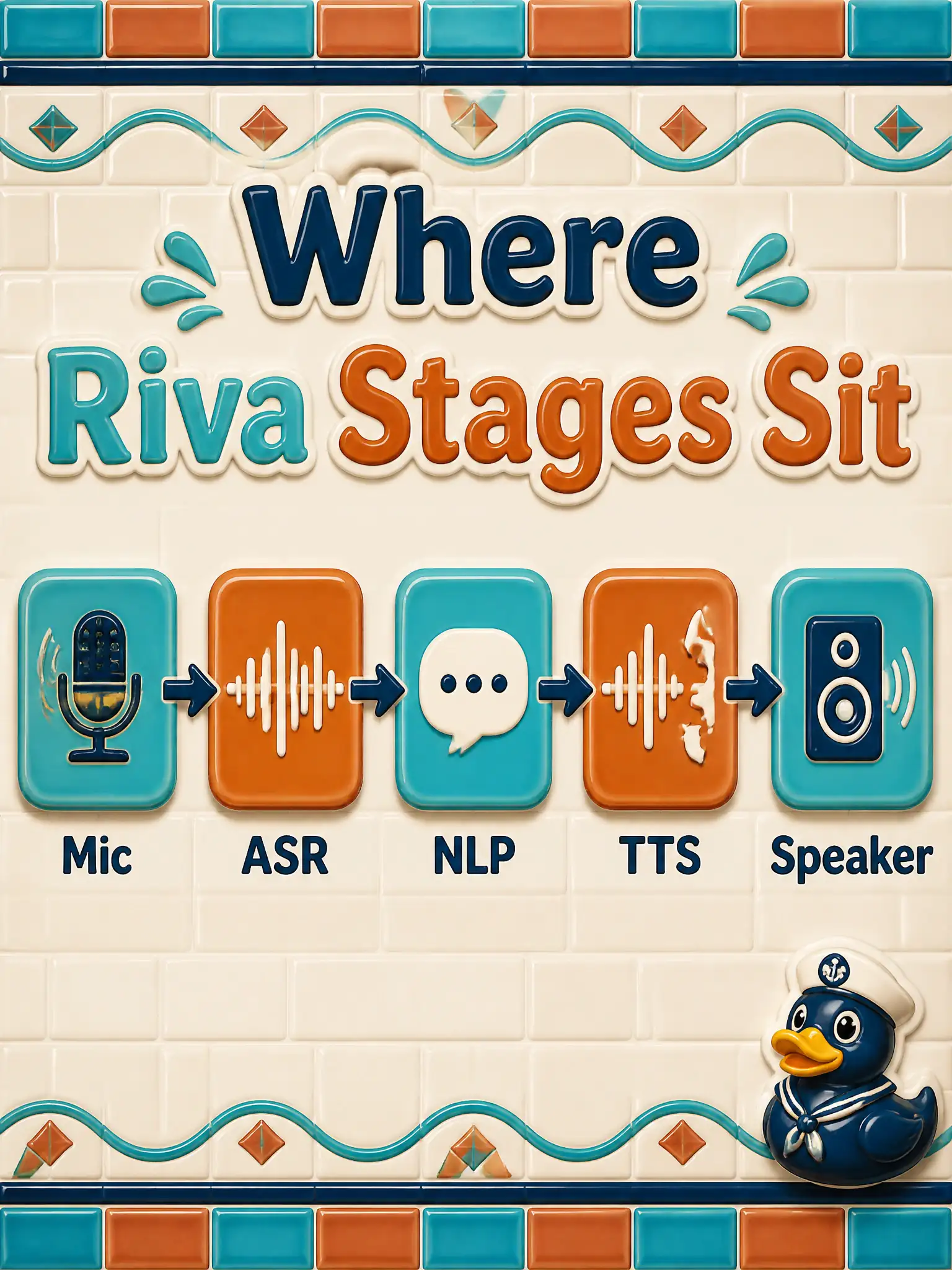
Mic in, voice out: ASR greets the stream, NLP thinks in the middle, TTS talks on the way out. Keep that order for associate serving.
Full Explanation
In a served app that accepts a microphone stream and returns spoken audio, official Riva stages sit as ASR at the incoming speech edge, NLP in the middle, and TTS on the way out. That placement is correct for the tile-glaze kiosk. Civic speech services must keep that edge–middle–egress order so requests are recognized before understanding and synthesis.
TTS first on the microphone edge, then ASR after spoken audio is returned, reverses the pipeline and fails conceptually. An unofficial inference server name instead of mapped Riva stages fails associate naming discipline. NLP alone with no ASR or TTS fails a kiosk that must hear and speak.
Exam caveat: map Riva stages to speech edge, understanding middle, and speech egress. Operational check: verify civic kiosk traffic hits ASR then NLP then TTS; reject reversed or unnamed-server diagrams as the conversational path. Align this choice with the agency’s published multimodal runbook so civic operators can audit why the configuration was accepted. Record the civic software choice in the service README—named modules, inputs, and domain—so operators can replay the same path during audits and handoffs. Prefer explicit, reversible civic decisions over silent assumptions when multimodal data or software paths move toward production.