
A cork-cutting loft is past collecting turns and must stand up hear → understand → speak. Which services should be wired as the implemented conversational pipeline?
Select an answer to reveal the explanation.
Short Explanation
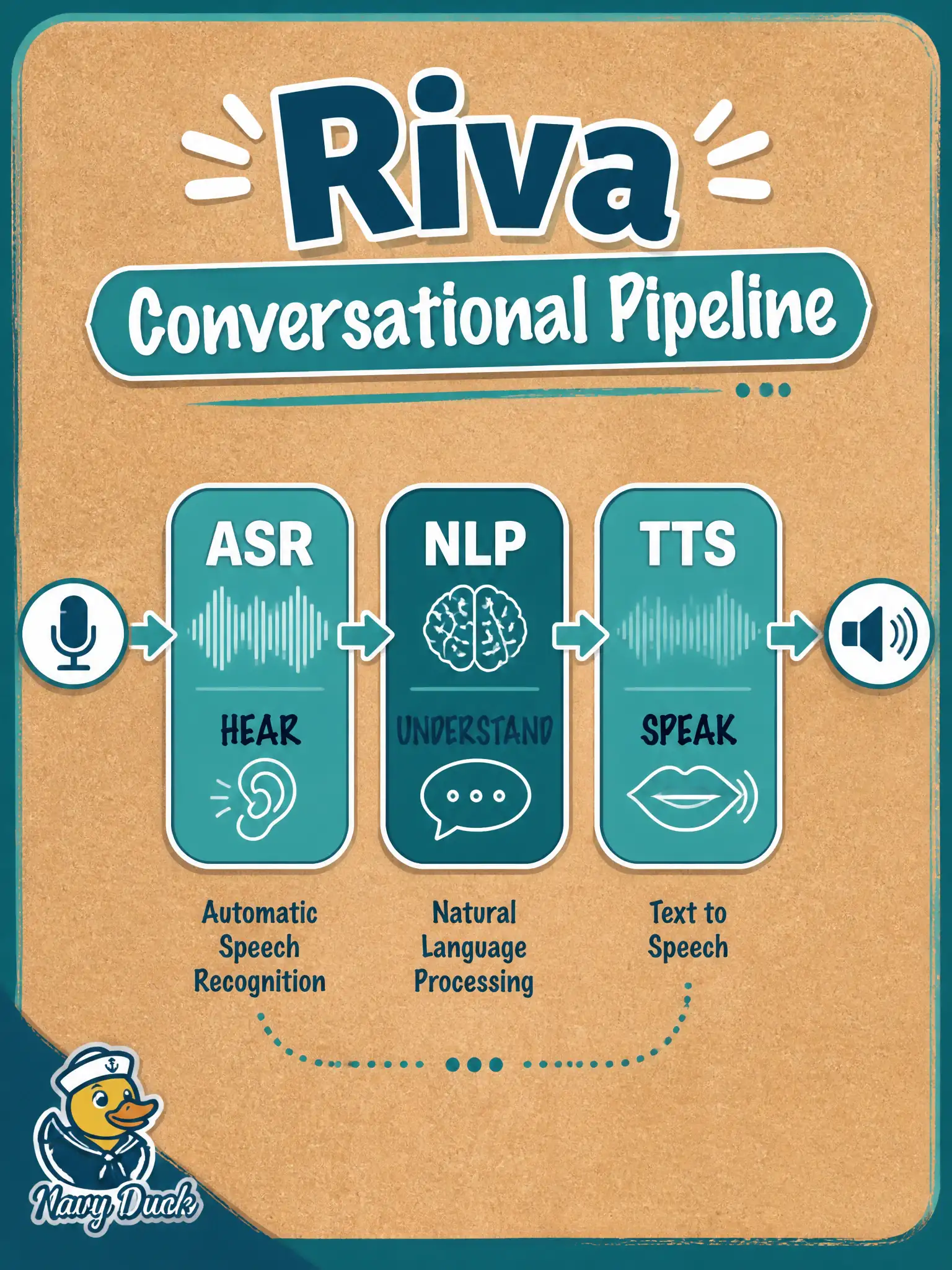
Conversation is a three-station relay: hear with ASR, understand with NLP, speak with TTS. Wire those Riva-centered services—don’t stall in a quality notebook.
Full Explanation
Standing up hear → understand → speak wires Riva ASR, an NLP stage, and Riva TTS as the three-stage conversational path. That service set is correct for the cork-cutting loft past corpus collection. Civic kiosks that must hear residents, understand requests, and speak replies implement the same three stages.
Only a Domain 1 ASR quality trial with no TTS or NLP stage fails the full conversational pipeline. A CLIP dual encoder with no speech input or output path fails modality. A single denoising diffusion module that replaces all speech stages fails by substituting image generation for conversation.
Exam caveat: conversational Riva pipelines are ASR + NLP + TTS at associate depth. Operational check: wire civic microphone input through ASR, NLP, and TTS; do not declare conversation done with ASR-only or CLIP/diffusion substitutes. Align this choice with the agency’s published multimodal runbook so civic operators can audit why the configuration was accepted. Record the civic software choice in the service README—named modules, inputs, and domain—so operators can replay the same path during audits and handoffs. Prefer explicit, reversible civic decisions over silent assumptions when multimodal data or software paths move toward production.