
A wheelwright intern offers to “make the vision stack faster by writing a kernel.” What is the associate implementation stance?
Select an answer to reveal the explanation.
Short Explanation
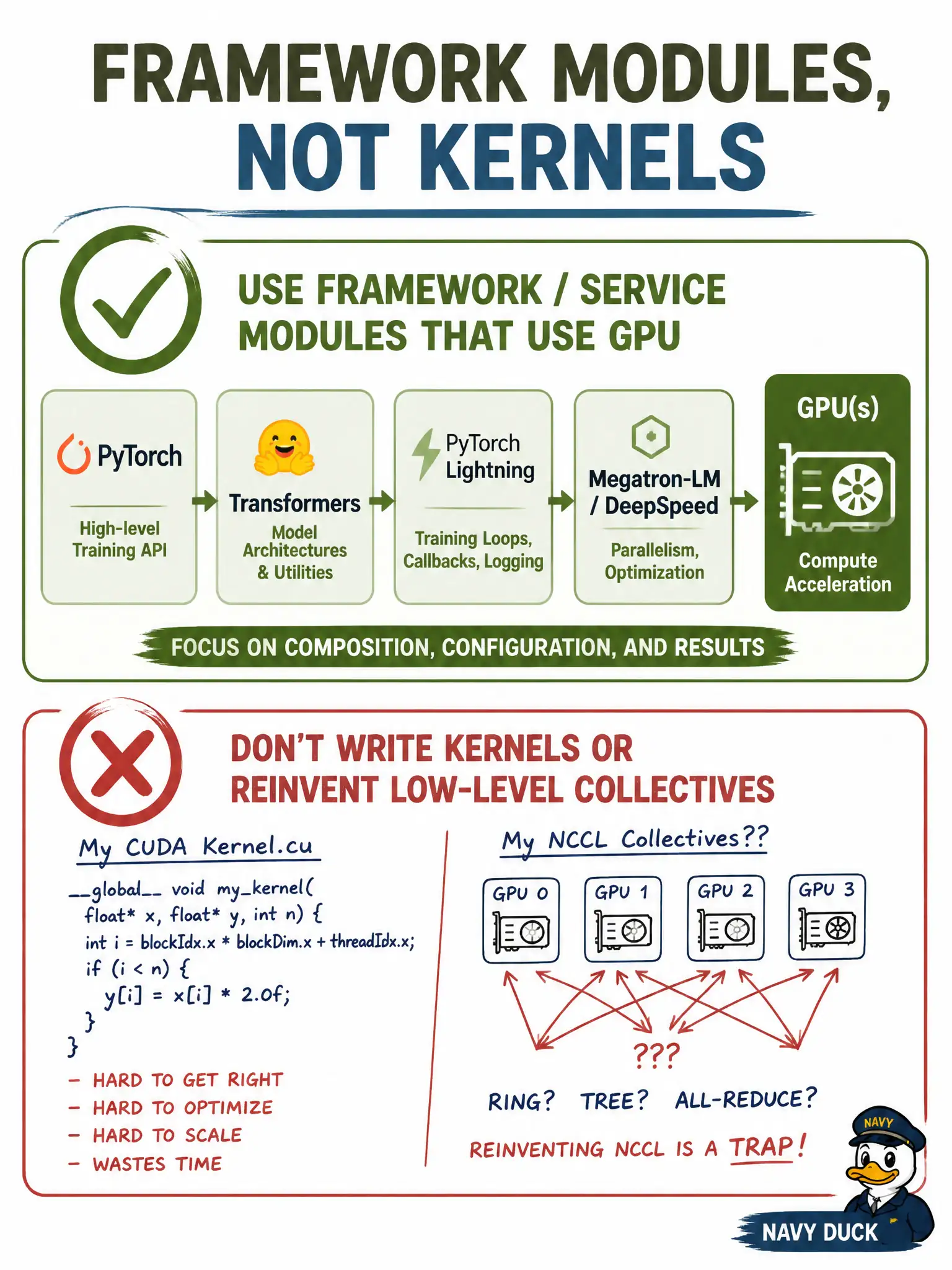
Speed at associate level means using the framework’s GPU path—not carving a custom kernel. Stay on modules and official services.
Full Explanation
Associate implementation keeps work on GPU-aware framework modules and official services and refuses a kernel-writing task. That stance is correct when a wheelwright intern offers to make the vision stack faster by writing a kernel. Civic delivery favors maintainable framework calls over CUDA heroics that the certification does not examine.
Accepting the kernel task and treating NCCL topology as the next milestone fails by sliding into out-of-scope systems work. Replacing the framework with a from-scratch C++ CUDA rewrite before any modules load fails the same way. Deferring all GPU use until Domain 6 Helm charts exist fails by blocking legitimate framework GPU execution while waiting on packaging.
Exam caveat: NCA-GENM associates use GPUs through frameworks/services, not custom kernels or NCCL design. Operational check: reject kernel/NCCL tasks in civic associate projects; keep vision stacks on framework modules and official speech/image services. Align this choice with the agency’s published multimodal runbook so civic operators can audit why the configuration was accepted. Record the civic software choice in the service README—named modules, inputs, and domain—so operators can replay the same path during audits and handoffs.