
A candle-dip shop must either classify a spoken note or write a spoken reply. What should guide which packaged architecture to import?
Select an answer to reveal the explanation.
Short Explanation
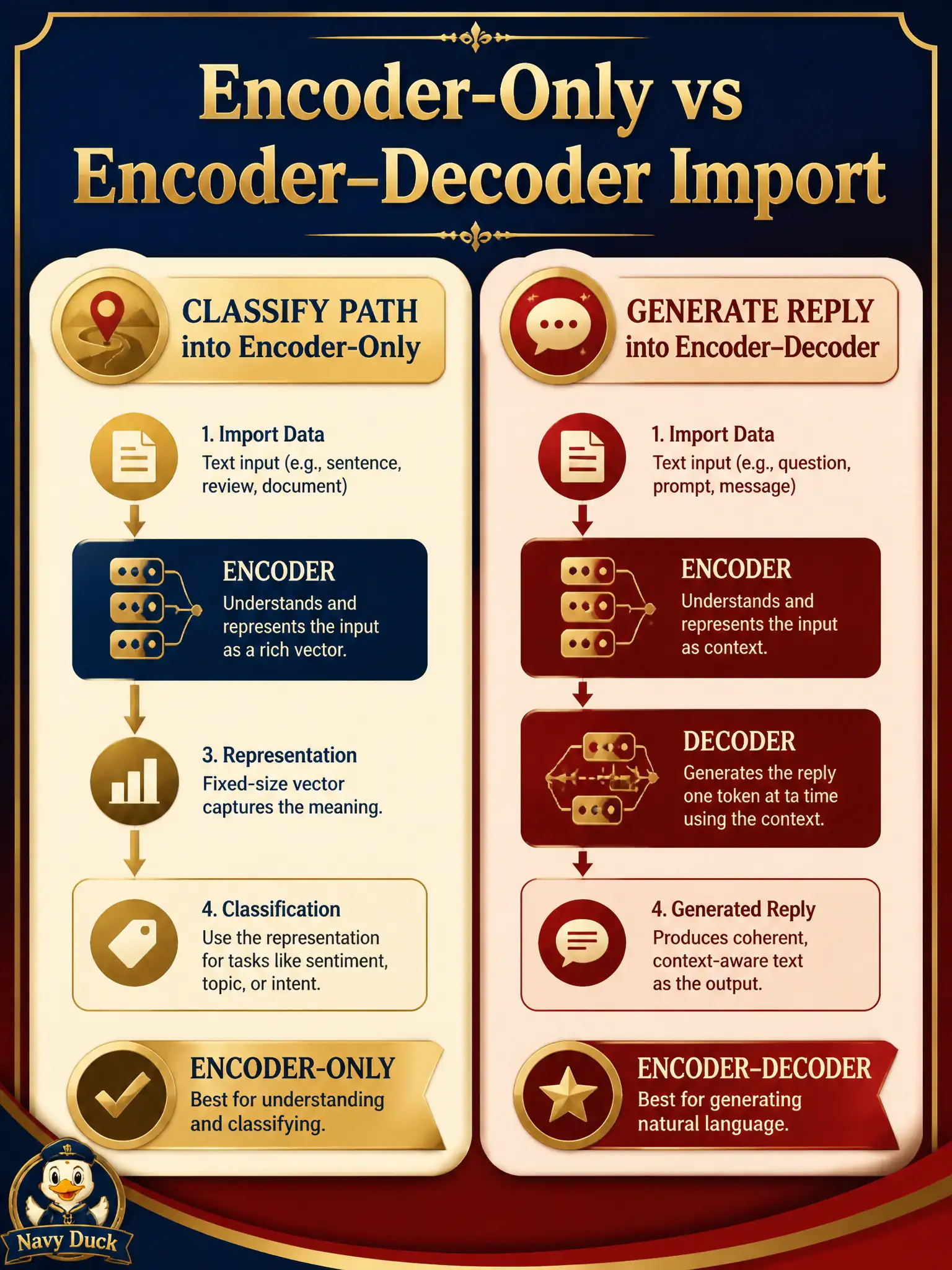
Classification is a sorting hat; writing a reply is a full letter press. Import the packaged shape that fits the behavior you need—encoder-only versus encoder–decoder.
Full Explanation
Packaged architecture choice should match the app’s text behavior—encoder-only to classify a spoken note, encoder–decoder to generate a spoken reply. That guidance is correct for the candle-dip shop. Civic speech desks that sometimes classify and sometimes reply must pick the shape that matches today’s behavior rather than always importing the heavier generative stack.
Always importing an encoder–decoder even when the job is only classification fails lean matching of model shape to task. Skipping packaged models to rewrite attention math from a Domain 2 lecture fails associate implementation practice. Importing a diffusion denoiser because every speech task needs noise-to-image fails by forcing an image generator onto speech classification/reply work.
Exam caveat: classification versus generation drives encoder-only versus encoder–decoder selection. Operational check: document the civic speech behavior (classify vs reply), import the matching packaged shape, and verify outputs match that behavior. Keep municipal reviewers in the loop whenever modality claims, fusion labels, or agent scripts are promoted from lab notes into the production corpus used by public-facing services. Record the decision, owner, and date beside the dataset manifest.