
A harmonica works wants stills grown from noise inside the project. Which piece should be added as the callable image-generation module?
Select an answer to reveal the explanation.
Short Explanation
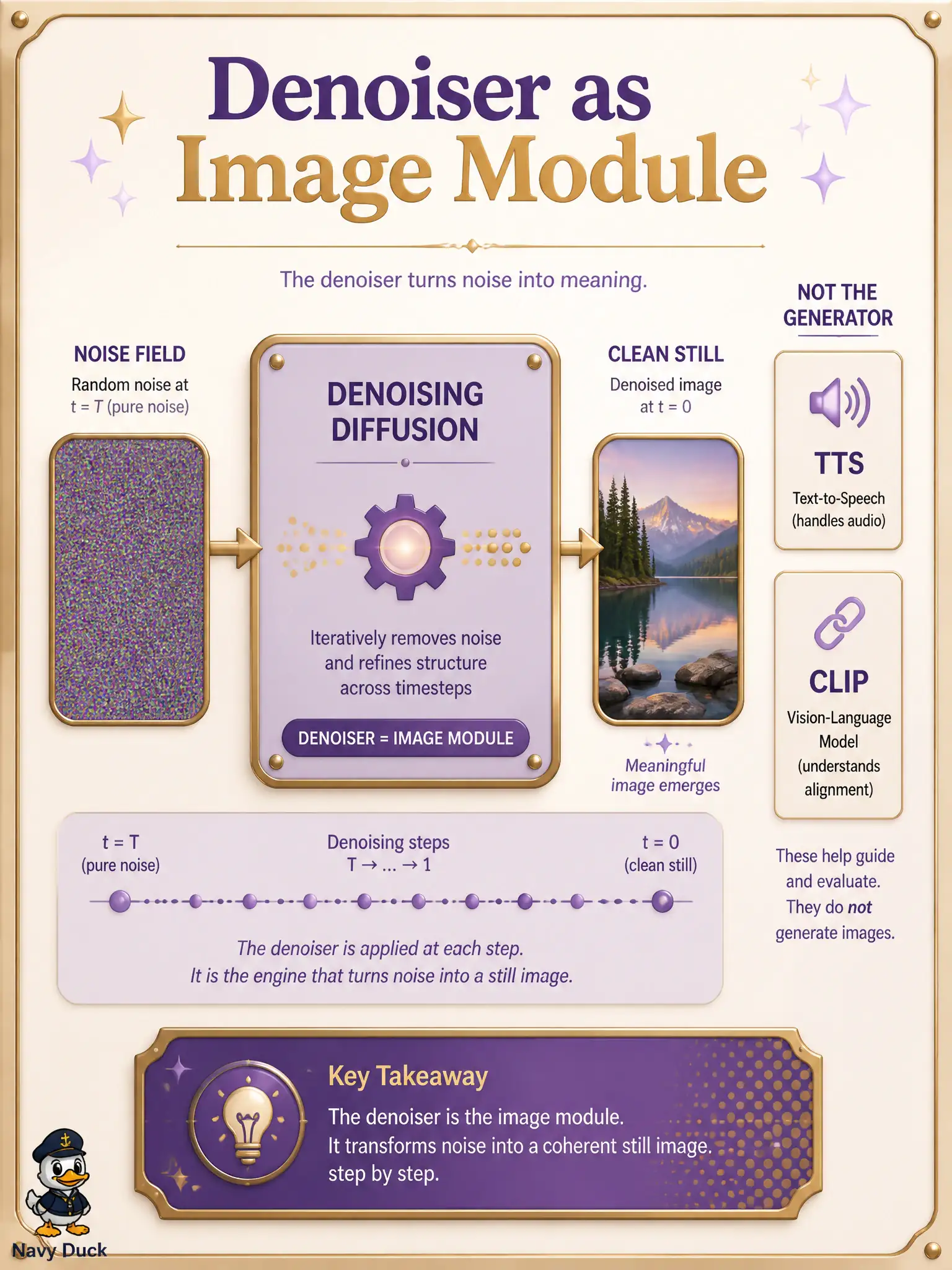
Growing a picture from static is the denoiser’s job—like polishing fog into a clear photo. Add that generator as a callable module, not as a step-count science fair.
Full Explanation
Noise-to-image generation inside the project needs a denoising-diffusion generator that turns a noise field into a still. Adding that callable module is correct for the harmonica works that wants stills grown from noise. Civic generative benches that must synthesize shop stills from noise follow the same associate implementation path.
A Domain 1 step-count experiment notebook with no generator call fails because experiments without a generate path do not implement synthesis. A Riva TTS service that only returns spoken audio fails modality: speech out is not a still. A caption-only CLIP text tower with no image synthesis path fails to produce pixels.
Exam caveat: diffusion generators are the callable noise-to-image piece at associate depth. Operational check: import a framework diffusion generator, sample noise, denoise, and write civic stills—do not confuse notebooks or TTS with generation modules. Keep municipal reviewers in the loop whenever modality claims, fusion labels, or agent scripts are promoted from lab notes into the production corpus used by public-facing services. Record the decision, owner, and date beside the dataset manifest. Align this choice with the agency’s published multimodal runbook so civic operators can audit why the row was accepted or rejected.