
A scriptorium kiosk still lacks paired transcripts (Domain 3 work). Ops wants the Helm chart “so it feels production.” What should happen first?
Select an answer to reveal the explanation.
Short Explanation
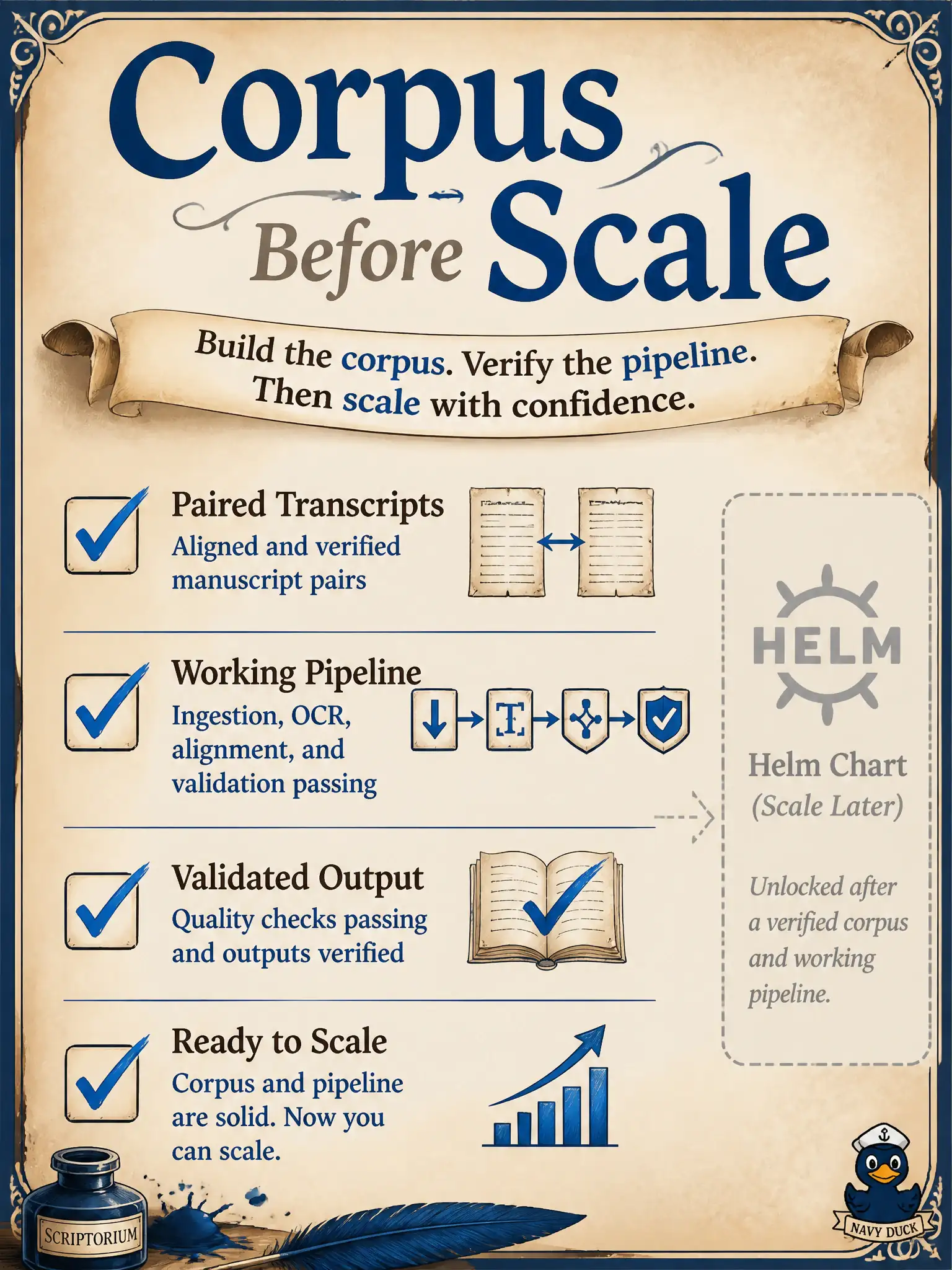
You cannot scale a booth that still has no paired ears-and-words. Finish the multimodal corpus and a working path, then talk Helm—production theater is not data.
Full Explanation
A scriptorium kiosk that still lacks paired transcripts (Domain 3 work) should finish the corpus and a working pipeline before spending effort on Kubernetes scale. Ops wanting the Helm chart “so it feels production” does not replace missing pairs for civic speech quality.
Deploying the Helm chart immediately so production feel substitutes for missing pairs fails readiness order. Scaling replicas first and inventing paired transcripts after traffic arrives fails data foundations. Treating missing transcripts as a latency bug solvable by more pods alone fails: pods cannot create labels.
Exam caveat: corpus and pipeline before scale theater. Helm is not a substitute for Domain 3 pairing work.
Operational check: complete paired transcript intake; prove a single-node pipeline; only then apply the conversational Helm chart for the municipal scriptorium; block scale tickets until pair counts clear a gate. In municipal platform operations, record the chosen performance lever and the rejected alternatives in the change record so future on-call engineers understand the failure modes avoided for citizen services. Re-check the decision after the next traffic spike or model update to ensure the same answer still holds for the city's estate.