
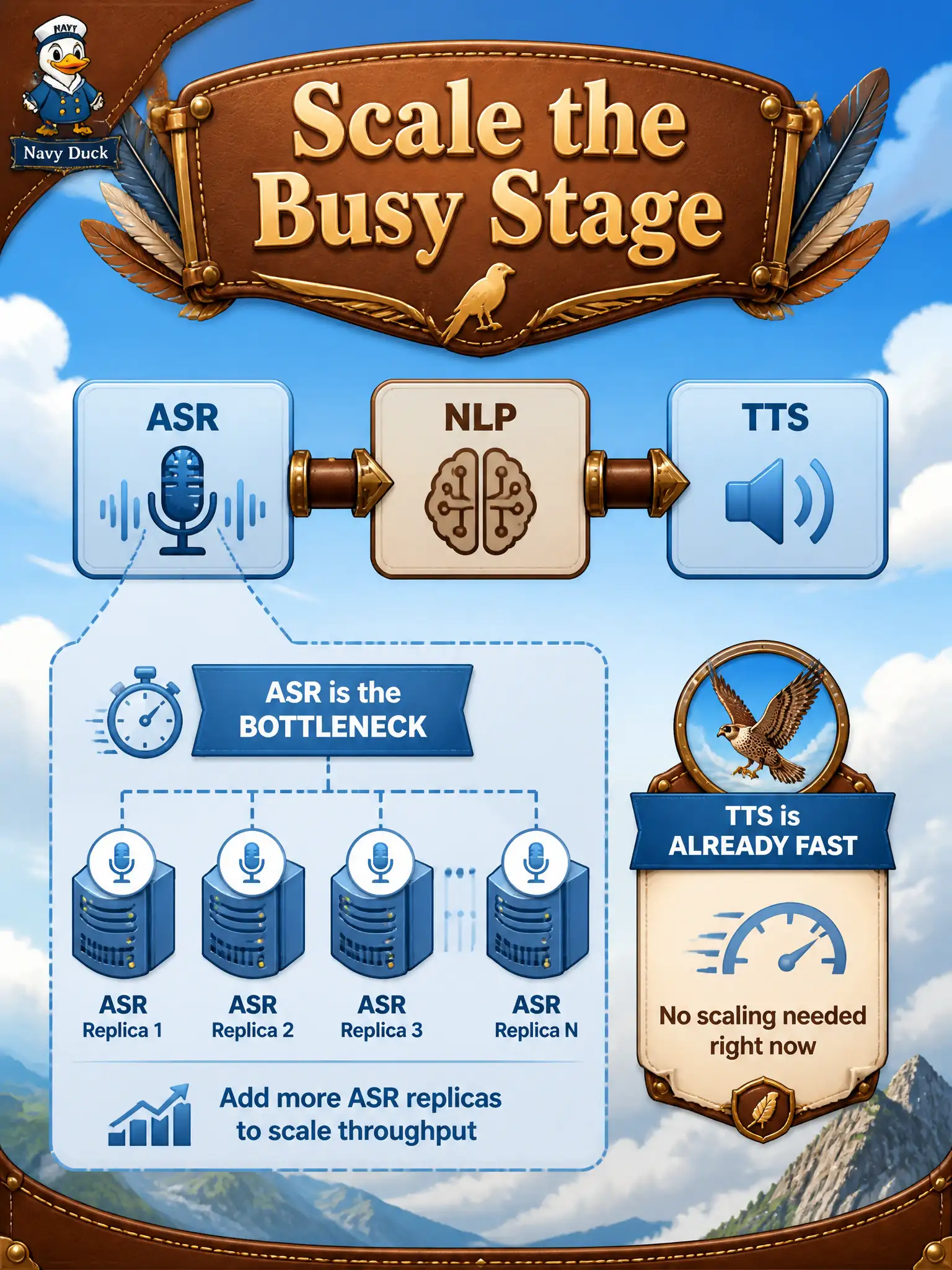
A falconry mews booth is slow in recognition, not in speech. Spoken replies are already instant. What should the candidate scale?
Select an answer to reveal the explanation.
Short Explanation
Scale the stuck door, not the one that already swings free. If recognition is the wait, add ASR capacity—do not flood TTS when speaking is already instant.
Full Explanation
A falconry mews booth that is slow in recognition, not in speech—with spoken replies already instant—should add ASR replicas (or capacity on the busy recognition stage) rather than blindly multiplying TTS. Stage-aware scaling follows where time is spent on the civic conversational path.
Multiplying TTS replicas first because speech always needs more pods than recognition fails when TTS is already instant and ASR is the bottleneck. Scaling every stage equally with no regard to where time is spent wastes capacity. Ignoring stage timing and only raising Domain 2 fusion complexity fails by escaping measurement into architecture theater.
Exam caveat: profile stages; scale the busy one. Equal scaling and fusion redesign are not substitutes for bottleneck facts.
Operational check: break out ASR vs NLP vs TTS timings; raise ASR capacity; re-check end-to-end latency at the mews; leave TTS alone while it remains fast. In municipal platform operations, record the chosen performance lever and the rejected alternatives in the change record so future on-call engineers understand the failure modes avoided for citizen services. Re-check the decision after the next traffic spike or model update to ensure the same answer still holds for the city's estate.