
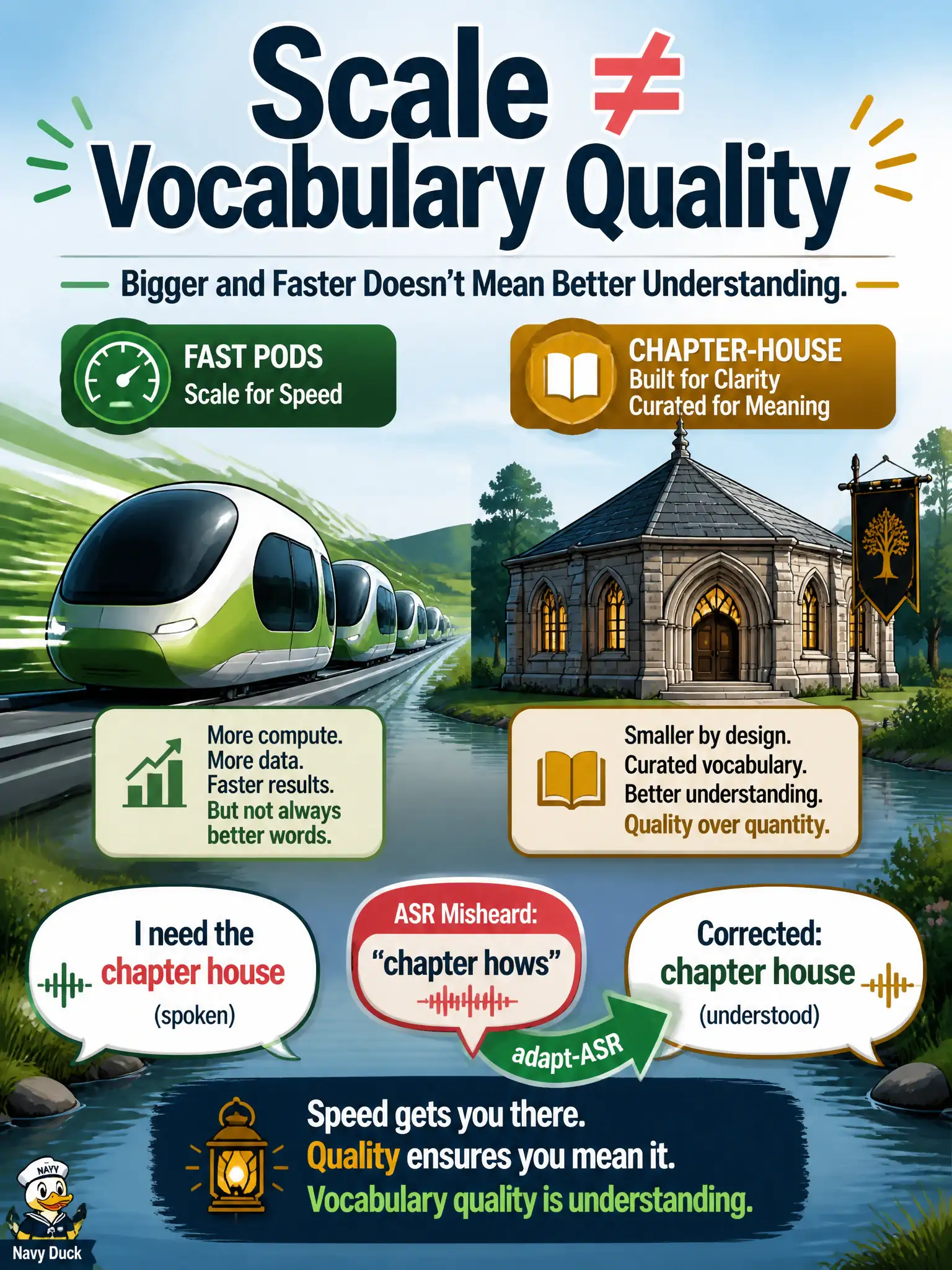
A chapter-house booth is fast after extra pods but still hears “misericord” as “mercy cord.” What should the candidate conclude?
Select an answer to reveal the explanation.
Short Explanation
Faster wrong answers are still wrong. Extra pods buy speed; teaching the booth “misericord” is adaptation work—not a latency myth.
Full Explanation
A chapter-house booth that is fast after extra pods but still hears “misericord” as “mercy cord” shows that scale does not fix recognition quality. ASR adaptation or transfer is still required, and the wrong word is not a latency bug. Domain 6 candidates must separate capacity wins from vocabulary/quality gaps.
Claiming extra pods already fixed quality, so the wrong word must be a latency bug, fails because the booth is already fast—the residual error is recognition content. Claiming wrong words prove the Helm chart should be deleted entirely fails: charts remain useful for scale; they simply do not teach vocabulary. Claiming throughput numbers automatically correct ASR vocabulary errors fails the same separation of concerns.
Exam caveat: pods ≠ pronunciation. After latency/throughput are acceptable, remaining substitutions need ASR adaptation/transfer or better pairs—not more replicas alone.
Operational check: confirm p95 latency is within SLA; collect misericord (and kin) labeled utterances; adapt Riva; re-test the civic booth glossary while leaving Helm capacity in place for load. In municipal platform operations, record the chosen performance lever and the rejected alternatives in the change record so future on-call engineers understand the failure modes avoided for citizen services. Re-check the decision after the next traffic spike or model update to ensure the same answer still holds for the city's estate.