
A chair-caning visitor desk may add a talking face later. Official extra materials name ACE with Riva ASR/TTS, Audio2Face, and a NeMo LLM. How should the speech path be handled for efficiency?
Select an answer to reveal the explanation.
Short Explanation
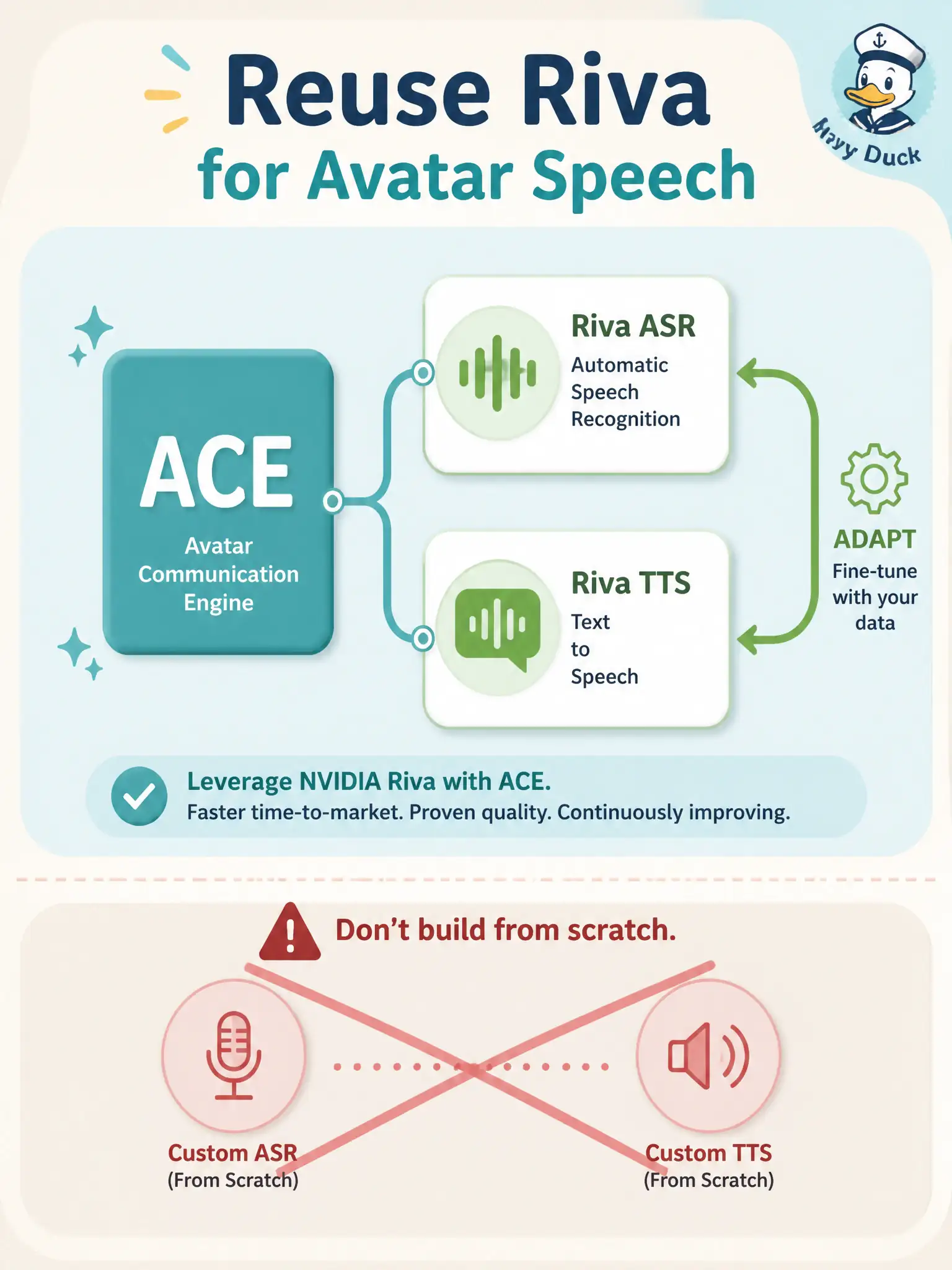
The avatar desk should borrow Riva’s ears and voice, not invent a new speech pair in the basement. Reuse and adapt—that is transfer for the official ACE speech services.
Full Explanation
A chair-caning visitor desk that may add a talking face later, with official extra materials naming ACE with Riva ASR/TTS, Audio2Face, and a NeMo LLM, should reuse and adapt Riva hearing and speaking services rather than training a new speech pair from scratch. Transfer on the speech path is the performance-minded preparation for later avatar work.
Training a brand-new ASR and TTS pair from silence before any avatar work begins fails the transfer lesson and burns scarce civic speech labels. Inventing a Picasso avatar stack because ACE is not an official tool name fails: ACE and Audio2Face appear in official extra materials—do not replace them with coined brands. Treating Audio2Face as a Domain 3 labeling campaign instead of a speech-face tool fails domain placement.
Exam caveat: adapt Riva for speech; use ACE/Audio2Face as named for talking faces. Do not invent alternate avatar brands or restart speech from silence by default.
Operational check: adapt Riva ASR/TTS on shop phrases; keep ACE/Audio2Face on the later avatar milestone; refuse from-scratch speech training proposals that ignore available pretrained Riva paths for the municipal desk. In municipal platform operations, record the chosen performance lever and the rejected alternatives in the change record so future on-call engineers understand the failure modes avoided for citizen services. Re-check the decision after the next traffic spike or model update to ensure the same answer still holds for the city's estate.