
A mother-of-pearl inlay loft reuses a pretrained stills stack. How should they adapt it with less computation than updating every layer?
Select an answer to reveal the explanation.
Short Explanation
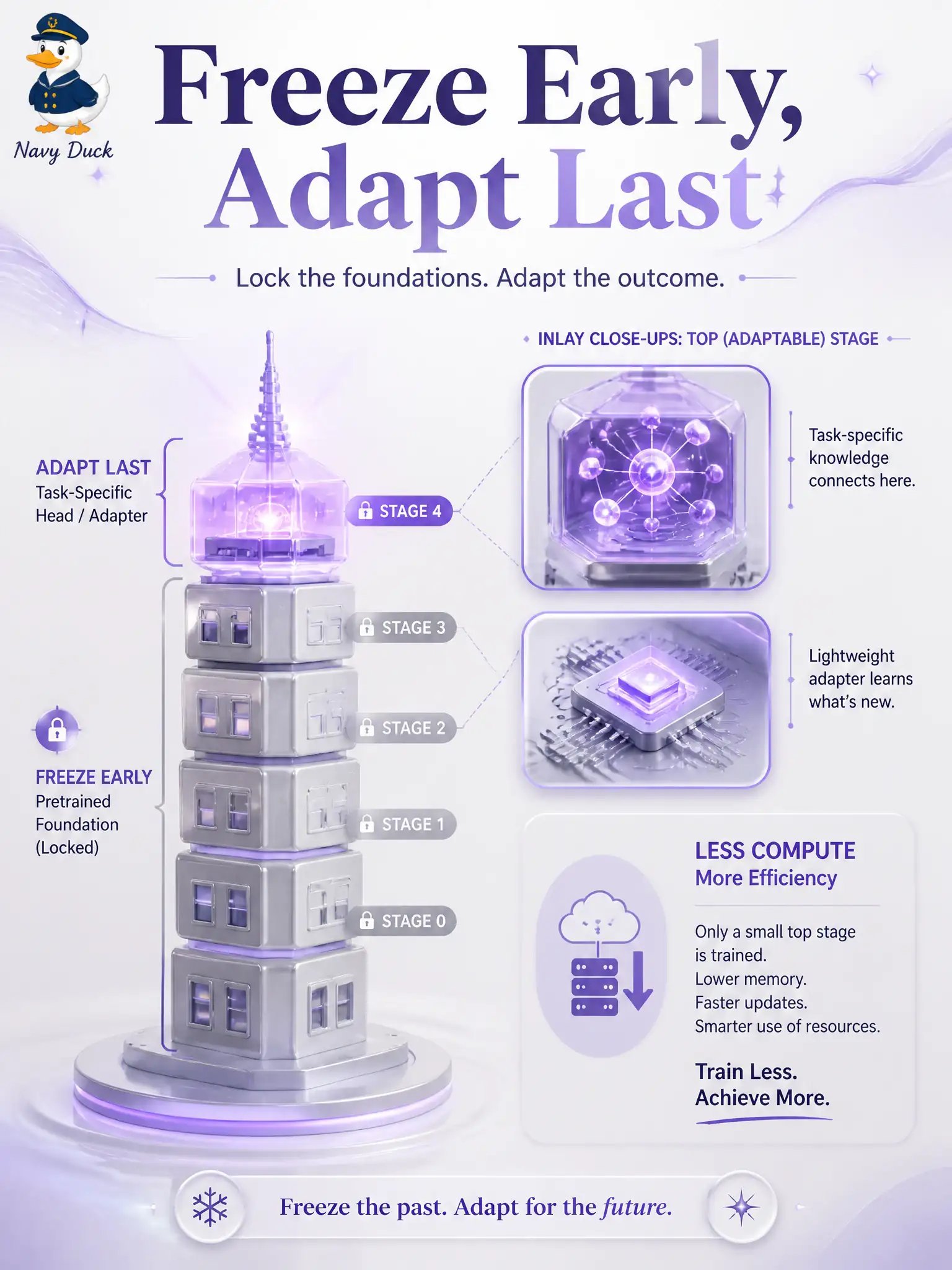
Early layers already know edges and sheen; leave them alone. Teaching only the last stage is transfer with a lighter compute bill—like polishing the final inlay, not rebuilding the whole shell.
Full Explanation
A mother-of-pearl inlay loft reusing a pretrained stills stack should freeze the early filters and train only the last stage on the inlay close-ups when the goal is less computation than updating every layer. Partial adaptation is the efficient transfer pattern for small civic specialty sets.
Unfreezing and retraining every layer on the small inlay set as the default path fails the less-computation goal and risks overfitting the tiny loft set. Deleting the pretrained weights and restarting from random initialization fails by throwing away the transferable start. Raising TTS replica count in Helm because vision adaptation is a speech-scale problem fails modality and domain—speech replicas do not adapt vision layers.
Exam caveat: freeze early, train late is the associate efficiency pattern for near-domain stills transfer. Full unfreeze is not the default on tiny sets.
Operational check: freeze backbone stages; train the last head/stage on inlay close-ups; compare compute and accuracy to a full unfreeze trial; keep the lighter recipe as the municipal loft’s default unless metrics demand more. In municipal platform operations, record the chosen performance lever and the rejected alternatives in the change record so future on-call engineers understand the failure modes avoided for citizen services. Re-check the decision after the next traffic spike or model update to ensure the same answer still holds for the city's estate.