
A jet-carver’s single bench machine cannot finish a from-scratch vision run. Someone offers to write a CUDA kernel. What is the associate-level performance move?
Select an answer to reveal the explanation.
Short Explanation
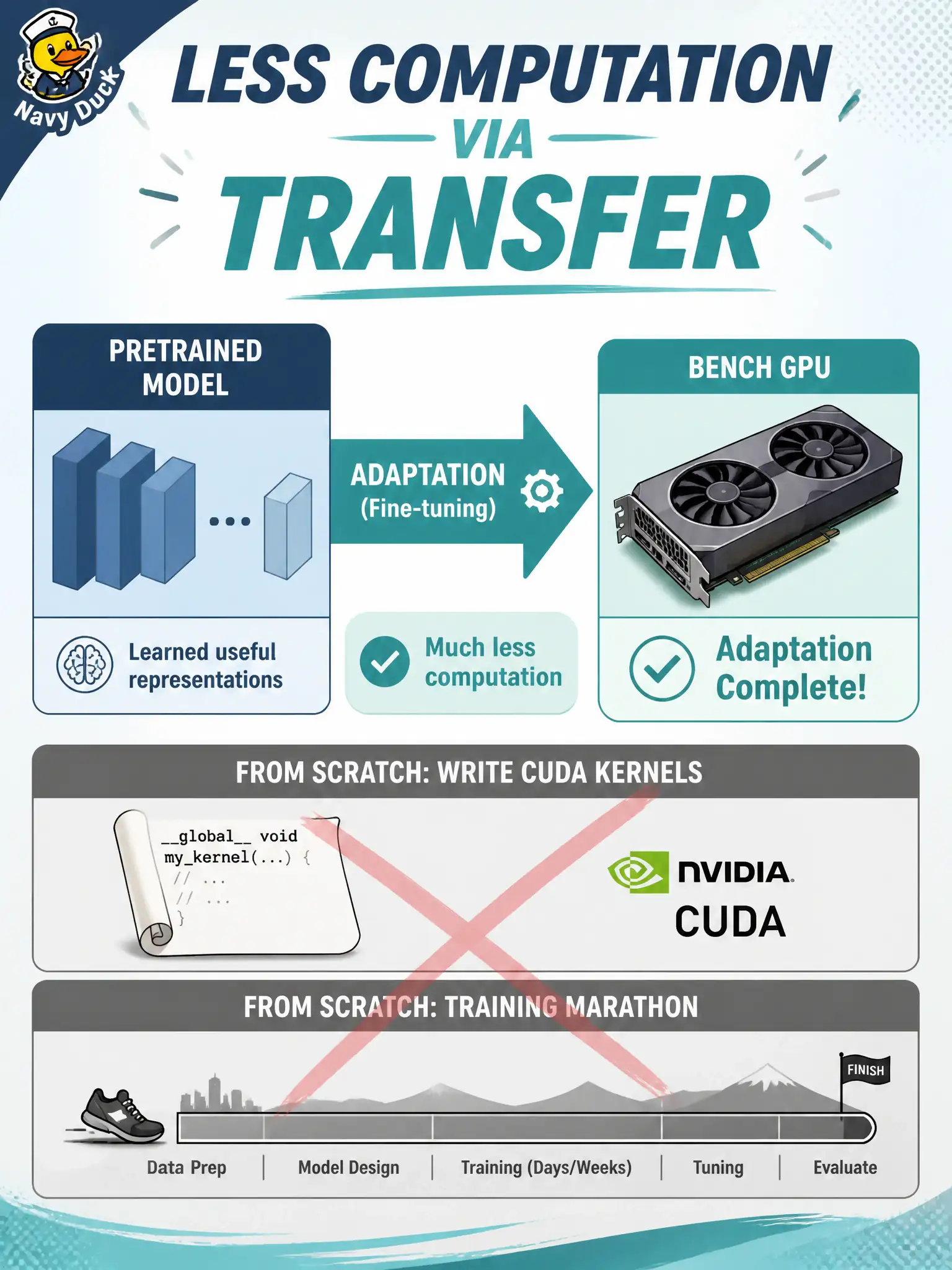
Less compute often means not starting from zero. A pretrained head start lets one humble machine finish the job—no homemade kernels required.
Full Explanation
When a jet-carver’s single bench machine cannot finish a from-scratch vision run, the associate-level performance move is to start from a pretrained model with transfer learning so the same machine finishes with less computation. That is Domain 6 efficiency—not accepting custom CUDA authorship as the official skill.
Accepting the custom CUDA kernel as the official Performance Optimization skill fails because NCA-GENM associate materials center transfer and Helm-scale, not writing kernels. Importing NCA-AIIO power and cooling plans to make from-scratch training fit fails by pulling another certification’s facilities track into a model-adaptation decision. Switching the stills task to TensorRT-LLM text serving to avoid vision compute fails by abandoning the vision job for an unrelated text-serving product story.
Exam caveat: transfer learning reduces compute on limited hardware. Custom kernels and cross-exam infrastructure tracks are not the associate answer.
Operational check: load a pretrained vision checkpoint on the bench GPU; fine-tune with a small civic jet-carver set; confirm wall-clock finishes within schedule; document that transfer—not a new kernel—unblocked the machine.