
An amber-polish cooperative has forty labeled bead stills. A vendor insists thousands of new tags are required “or the net cannot start.” How should the candidate answer?
Select an answer to reveal the explanation.
Short Explanation
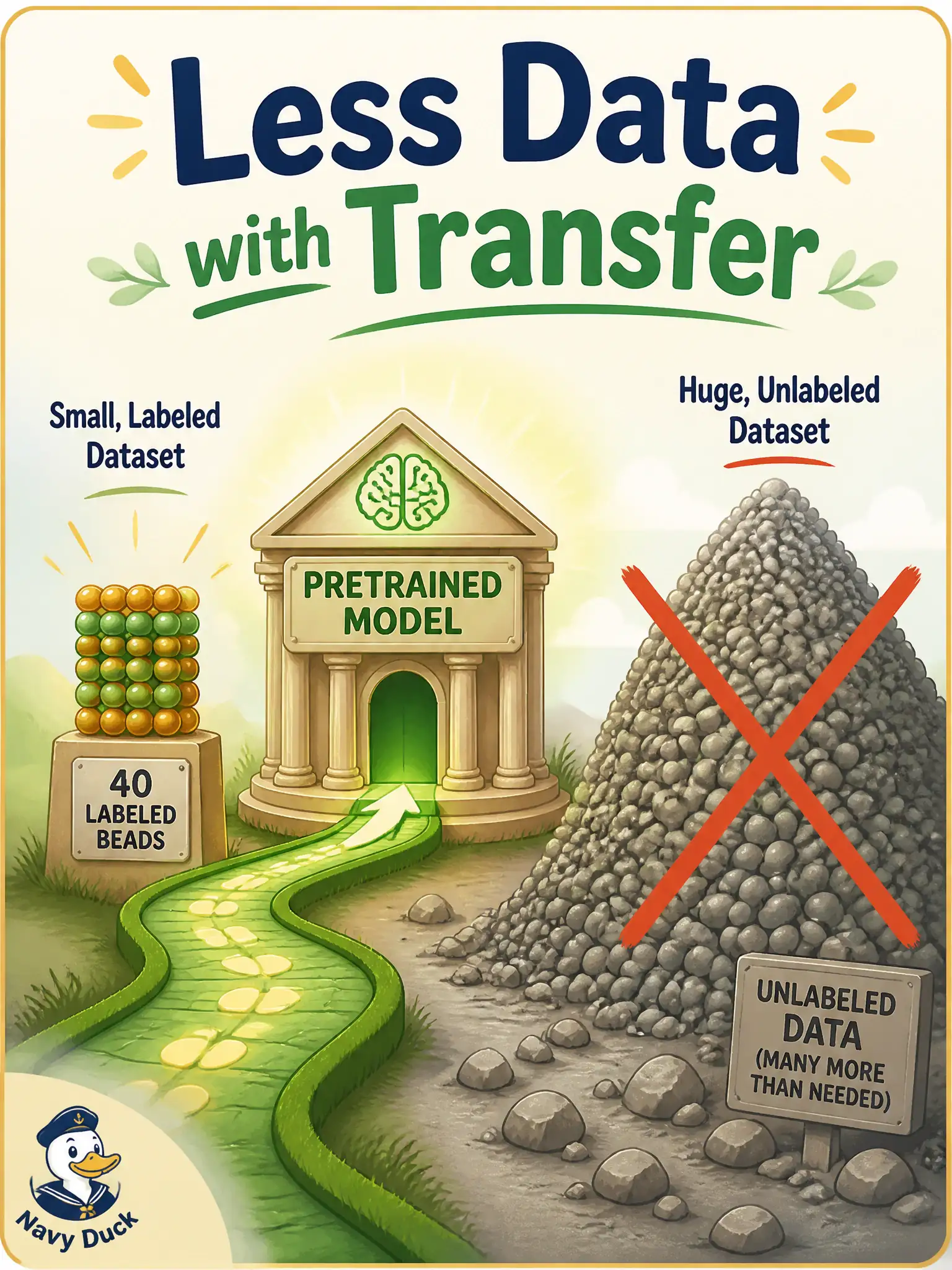
Forty good pairs plus a pretrained cousin beat a thousand blank labels. Transfer learning’s official promise is getting useful vision work done with less data.
Full Explanation
An amber-polish cooperative with forty labeled bead stills should use transfer learning: adapt a related pretrained model with the forty pairs instead of agreeing to a giant new labeling campaign. Vendor claims that thousands of new tags are mandatory before any model can begin ignore the associate Performance Optimization skill of transferring from related weights.
Agreeing that thousands of new tags are mandatory before any model can begin fails when a related pretrained model can be adapted with the forty pairs. Writing NCCL collective code so forty labels somehow behave like thousands fails because collectives move gradients across GPUs—they do not mint labels. Treating the forty stills as a Domain 7 authenticity review rather than a data-size issue fails domain: the question is performance under scarce labels, not trust labeling.
Exam caveat: scarce labels → transfer. Do not accept “thousands or nothing,” and do not confuse distributed training plumbing or trust reviews with label efficiency.
Operational check: pick a related pretrained stills model; adapt on the forty bead pairs with strong regularization; report accuracy versus a from-scratch refusal; only expand labeling where the civic cooperative’s holdout shows remaining blind spots.