
A civic spyglass shop wants English lines to meet stills. One plan trains two encoders from nothing; another reuses contrastive language-image pretraining. Which start is the transfer-learning win?
Select an answer to reveal the explanation.
Short Explanation
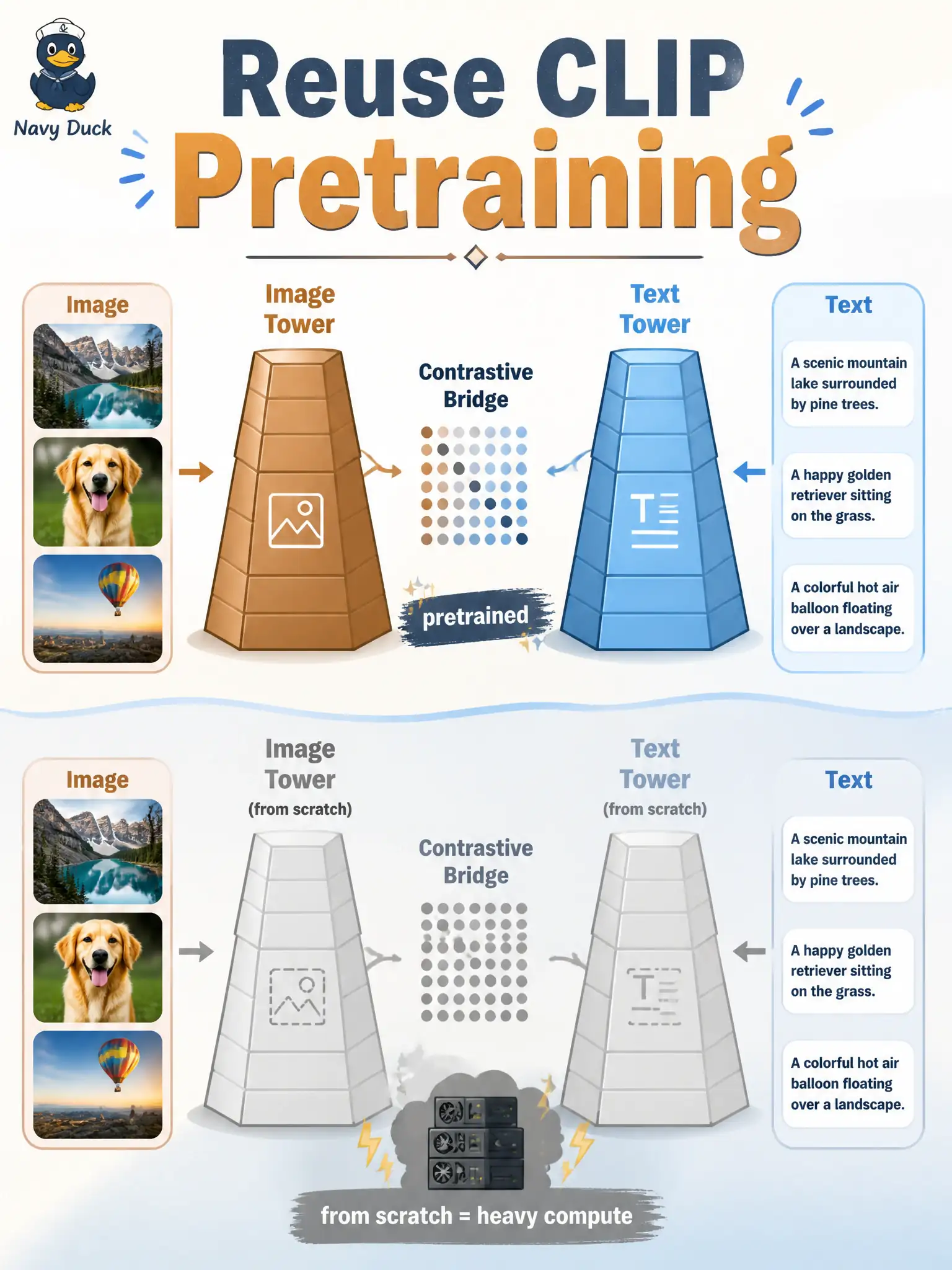
CLIP already paid the heavy tuition pairing English with pictures. Starting there is like borrowing a tuned spyglass instead of grinding new lenses from sand.
Full Explanation
A civic spyglass shop that wants English lines to meet stills should reuse official CLIP weights as a transferable English–image starting point and adapt from there. Contrastive language-image pretraining is the transfer-friendly start—not training both encoders from nothing to prove originality.
Training both English and stills encoders from random weights to prove originality fails the transfer lesson and wastes compute the shop does not need to spend. Skipping vision entirely for RAPIDS dataframe text answers fails the multimodal English–image goal. Deploying Triton as the primary serving layer before any contrastive weights exist fails by putting serving ahead of having a transferable model.
Exam caveat: CLIP-style pretrained contrastive weights are the associate transfer start for English–image work. Originality theater and premature serving brands are distractors.
Operational check: load official CLIP weights; adapt on spyglass pairs; evaluate retrieval or matching metrics; defer serving-stack debates until the municipal loft has a working adapted contrastive model. In municipal platform operations, record the chosen performance lever and the rejected alternatives in the change record so future on-call engineers understand the failure modes avoided for citizen services. Re-check the decision after the next traffic spike or model update to ensure the same answer still holds for the city's estate.