
A municipal chronometer bench needs the visitor booth to recognize shop terms like “escapement” and “fusee.” Building a speech recognizer from silence would need a huge labeled set. What is the efficient path?
Select an answer to reveal the explanation.
Short Explanation
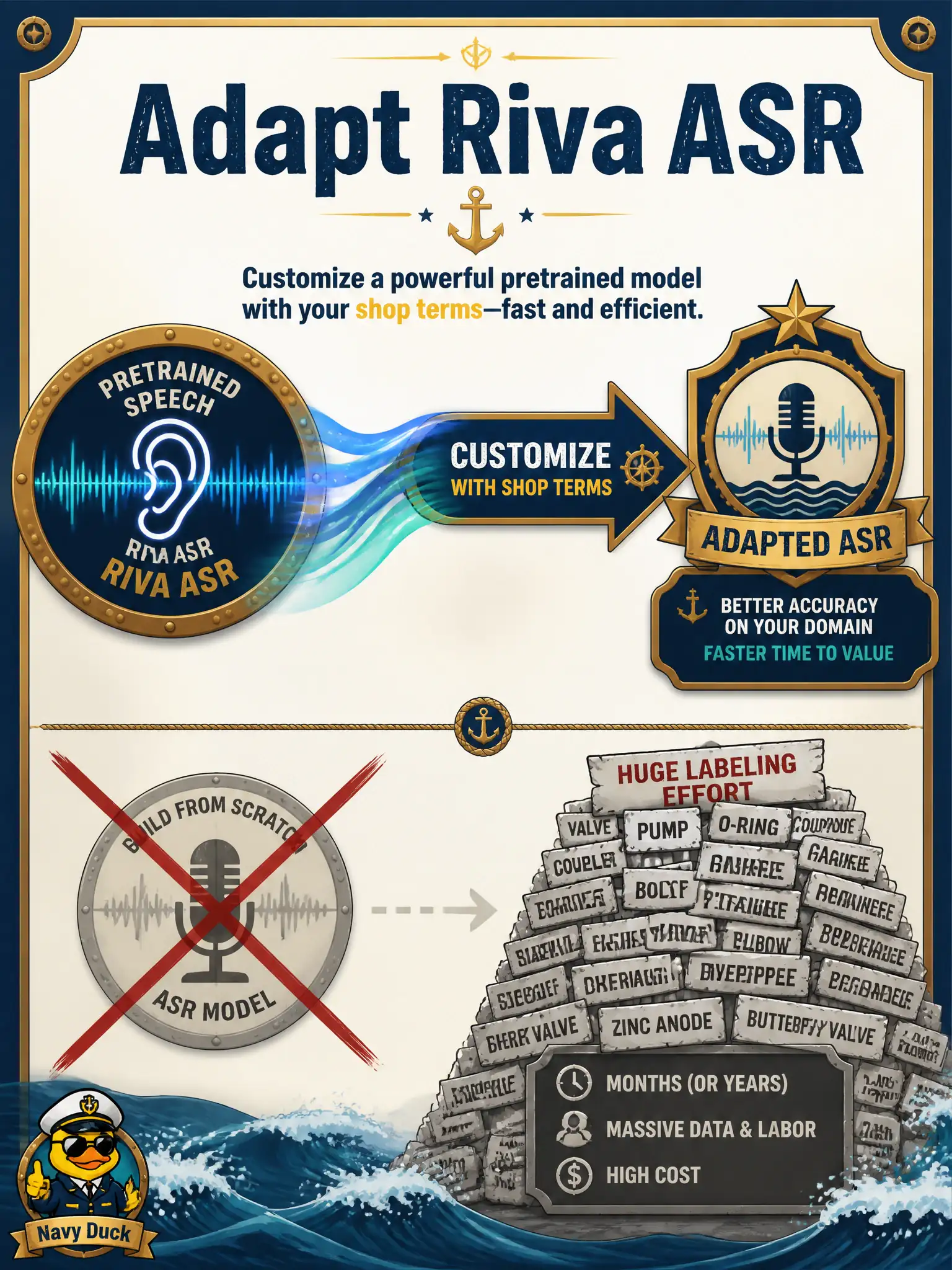
Riva already knows how to listen; you just teach it the shop dialect. Adapting a related ASR model is transfer for the speech arm—not reinventing an ear from silence.
Full Explanation
A municipal chronometer bench that must recognize shop terms like escapement and fusee should customize and adapt NVIDIA Riva ASR from a related pretrained model rather than training a new recognizer from scratch. Transfer and adaptation stretch limited labeled speech into visitor-booth vocabulary without a huge silence-to-ASR campaign.
Training a brand-new ASR network from silence using only unlabeled hum fails because unlabeled shop noise does not teach word inventory, and from-scratch ASR is data-hungry. Replacing ASR with a CLIP stills encoder because images need less speech data fails modality: recognizing spoken shop terms is a speech task. Opening a Kubernetes values file and treating replica count as the vocabulary fix fails because scale does not inject missing lexical items into the recognizer.
Exam caveat: Riva adaptation/transfer is the official speech performance path for custom vocabulary. Helm scale and vision encoders are not vocabulary substitutes.
Operational check: collect a modest set of labeled shop-term utterances; adapt Riva from a related pretrained ASR; measure WER on escapement/fusee; only then consider Helm capacity for the civic booth’s live traffic. In municipal platform operations, record the chosen performance lever and the rejected alternatives in the change record so future on-call engineers understand the failure modes avoided for citizen services. Re-check the decision after the next traffic spike or model update to ensure the same answer still holds for the city's estate.