
A city harpsichord workshop has only a few dozen labeled jack stills for a vision model. Training from random weights is too slow for the schedule. What should the candidate do?
Select an answer to reveal the explanation.
Short Explanation
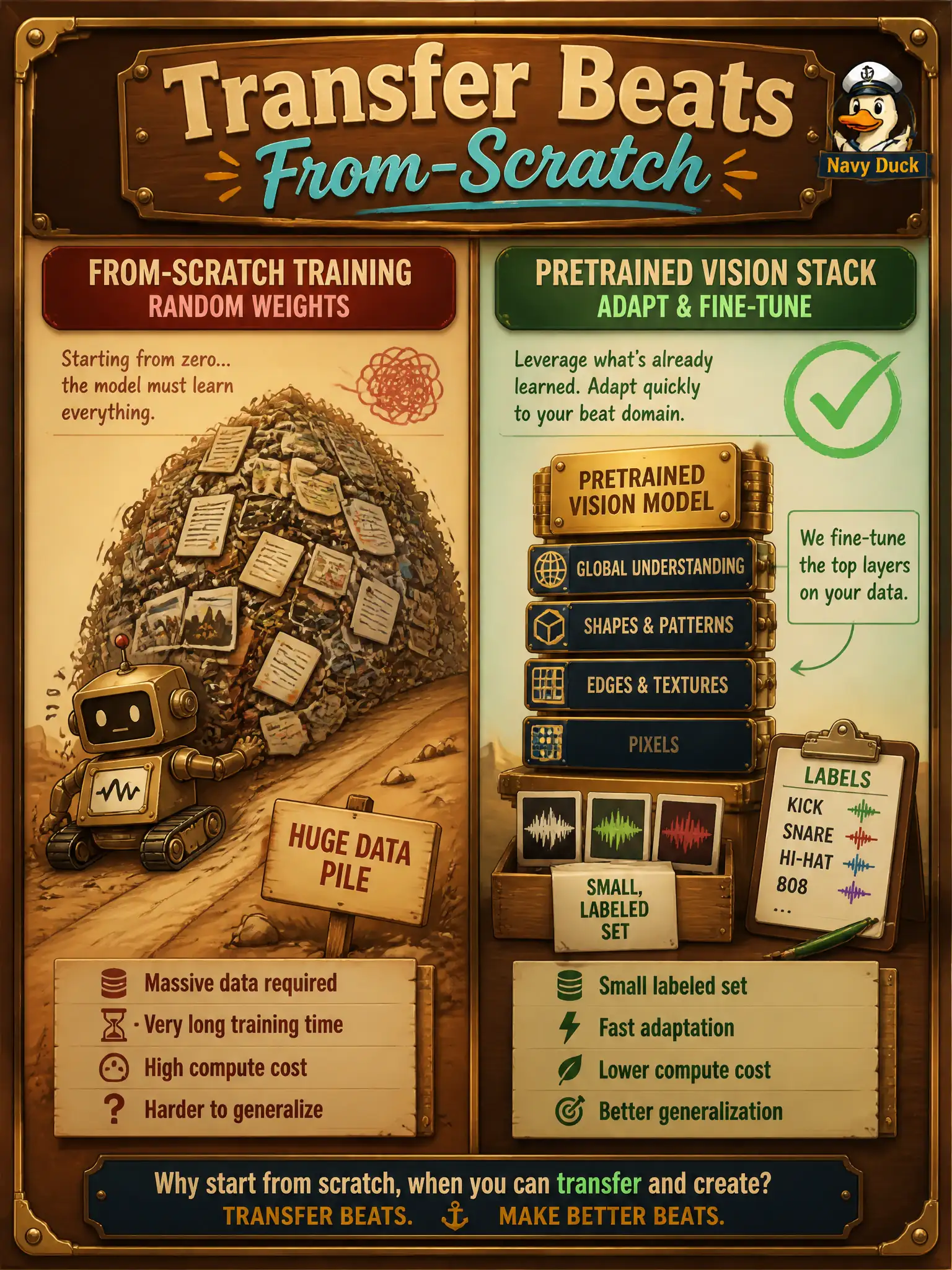
Think of a pretrained vision stack as a seasoned apprentice who already knows edges and textures. You only teach the shop-specific jack parts—far less data and compute than starting from a blank slate.
Full Explanation
A city harpsichord workshop with only a few dozen labeled jack stills should start from a pretrained stills model and adapt it with transfer learning to spend less data and computation. That Domain 6 performance move matches scarce civic labels to a related visual start instead of paying for from-scratch training that the schedule cannot afford.
Writing a custom CUDA kernel so from-scratch training finishes overnight fails because associate Performance Optimization emphasizes transfer, not kernel authorship, and a kernel does not create labeled diversity. Discarding the stills for text-only RAG with LangChain fails by abandoning the vision task and importing an out-of-scope text-app path. Raising Helm replica count first so random-weight training feels faster fails because replicas scale serving/load; they do not reduce the data hunger of training from random weights.
Exam caveat: transfer learning is the primary associate lever when labels are few. Do not substitute custom kernels, LLM-app nesting, or Helm scale for a pretrained adaptation path.
Operational check: select a related pretrained vision checkpoint; freeze early layers as policy allows; fine-tune on the jack stills; compare compute and accuracy against a aborted from-scratch baseline; document the municipal workshop’s transfer recipe before any Helm talk about traffic.