
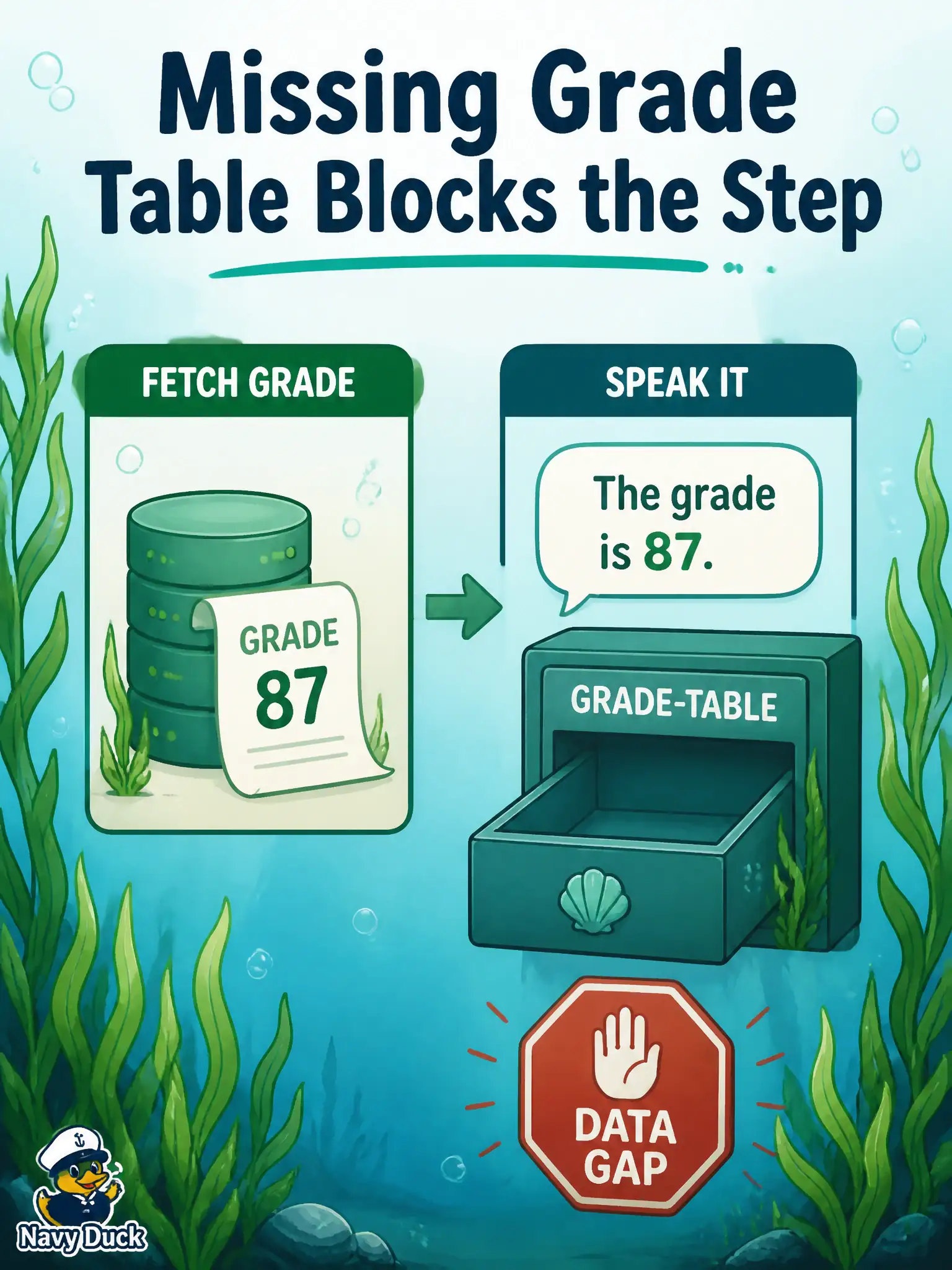
A kelp-drying rack wants the system to “fetch the grade, then speak it,” but no grade table was built. Where should work stop?
Select an answer to reveal the explanation.
Short Explanation
“Fetch the grade” needs a grade table. No table means stop at the data gap—don’t invent an agent framework to hide the empty shelf.
Full Explanation
If the system must “fetch the grade, then speak it” but no grade table was built, work stops at the missing supporting table—the blocker for the agent-orchestrated fetch step. That stop point is correct for the kelp-drying rack. Civic agent demos that skip supporting data create polished scripts that fail the first real resident request.
Inventing a full agent framework before any table exists fails by building orchestration around an empty fetch. Renaming the empty folder to “late fusion grades” fails as label theater. Swapping Riva TTS for CLIP so the grade is unnecessary fails by changing the job instead of supplying the missing asset.
Exam caveat: fetch steps imply data assets; scripts do not replace tables. Operational check: create and validate the civic grade table (or API) before enabling fetch-then-speak agent paths in any public demo. Keep municipal reviewers in the loop whenever modality claims, fusion labels, or agent scripts are promoted from lab notes into the production corpus used by public-facing services. Record the decision, owner, and date beside the dataset manifest. Align this choice with the agency’s published multimodal runbook so civic operators can audit why the row was accepted or rejected.