
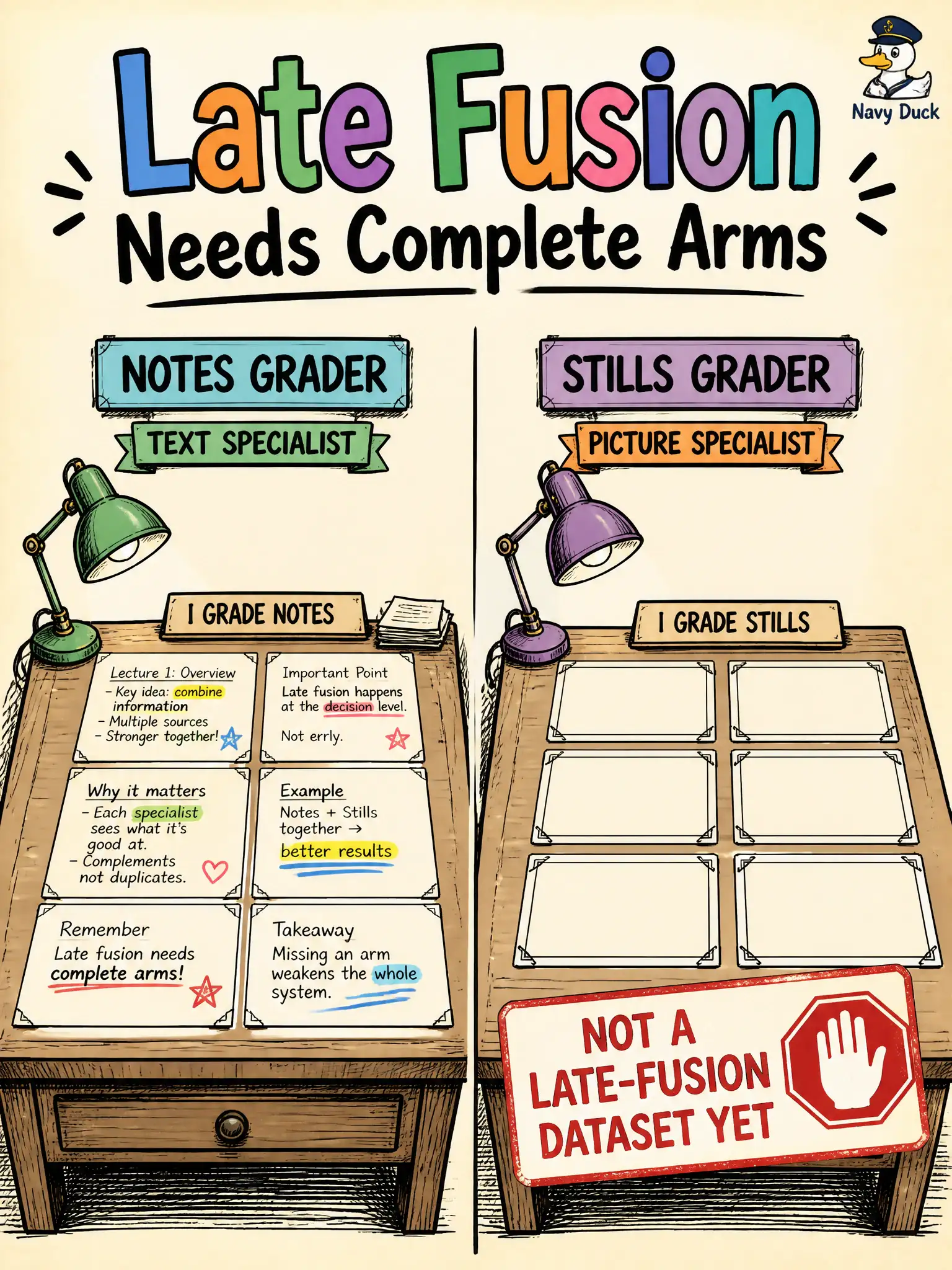
A print-works desk wants a stills grader and a notes grader to vote at decision time, but the stills grader’s rows have no pictures. Can this yet be called a late-fusion dataset?
Select an answer to reveal the explanation.
Short Explanation
Late fusion is a vote among specialists that each saw a real arm. If the stills grader has no pictures, that specialist has no dataset yet—labeling the folder “late fusion” does not fix it.
Full Explanation
Late fusion lets specialists vote at decision time, but each specialist still needs its own complete per-modality examples. Answering that the print-works desk cannot yet call this a late-fusion dataset—because the stills grader’s rows have no pictures—is correct. Empty vision arms mean the stills specialist has nothing to grade; folder labels do not invent pixels. Civic late-fusion services fail publicly when one modality specialist is a ghost with no data.
Claiming late fusion invents missing stills from notes alone fails; late fusion aggregates decisions, it does not hallucinate absent modalities. Writing “late fusion” on the folder name fails as a substitute for complete arms. Renaming intermediate fusion to late fusion in docs fails by vocabulary games that leave the missing pictures unsolved.
Exam caveat: fusion type names never complete a specialist’s corpus. Operational check: audit each civic late-fusion specialist for non-empty modality examples under shared decision ids before calling the set a late-fusion dataset. Keep municipal reviewers in the loop whenever modality claims, fusion labels, or agent scripts are promoted from lab notes into the production corpus used by public-facing services.