
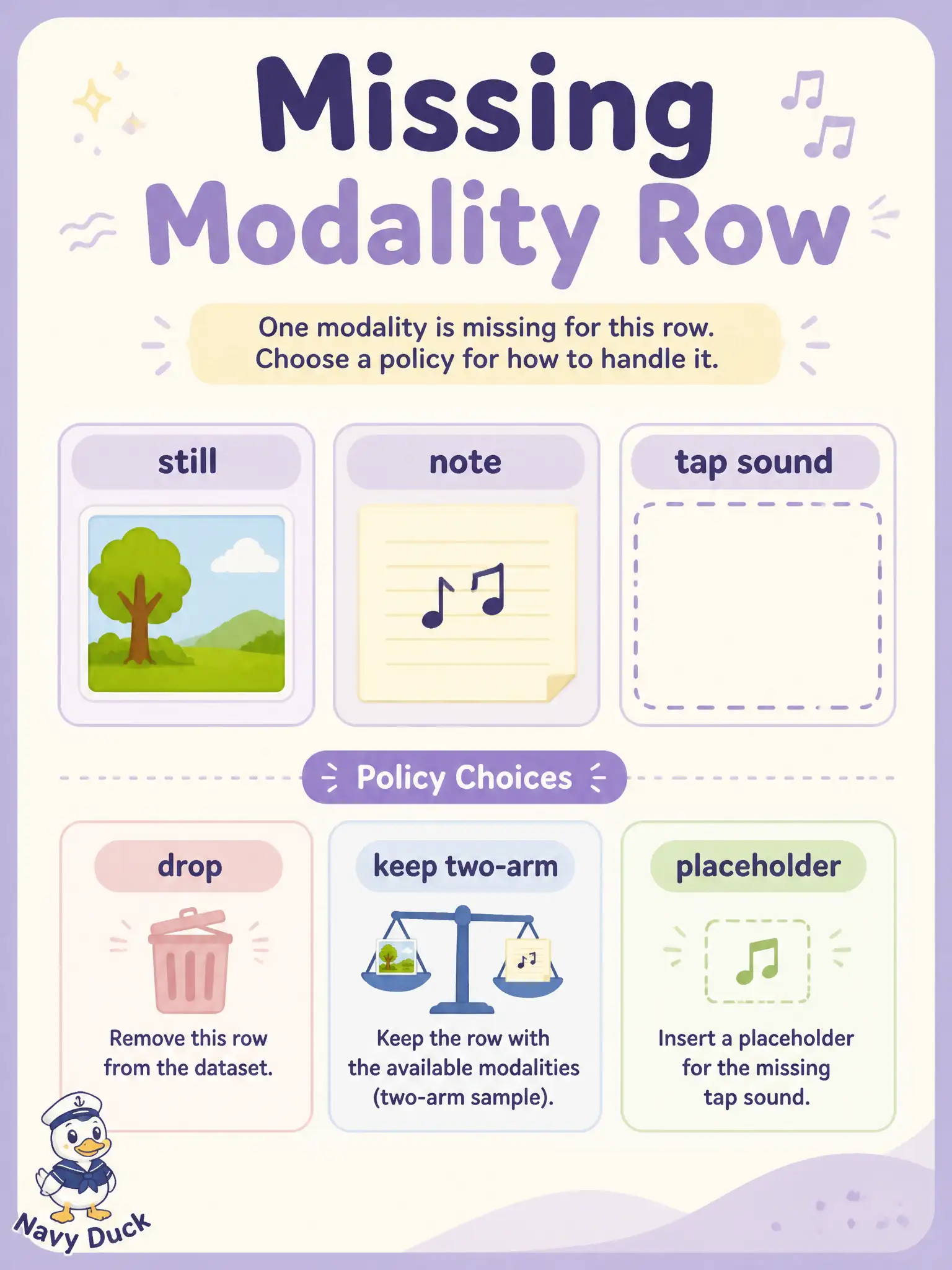
A needle-works row is planned as still + note + tap sound, but the microphone failed and no audio was captured. How should that row be treated in the multimodal corpus?
Select an answer to reveal the explanation.
Short Explanation
The plan called for three arms; the mic never delivered the third. Call it missing-modality data and choose a policy—drop, keep two arms, or placeholder—not a magic fusion invent.
Full Explanation
When a planned multimodal row loses an arm, treat it as a missing-modality example and apply an explicit data policy: drop the row, keep a two-arm row, or use a documented placeholder. That diagnosis is correct for the needle-works still+note+tap plan when the microphone fails. Civic corpora must record such decisions so auditors know whether a public model was trained without audio by policy or by accident.
Claiming intermediate fusion automatically invents the missing tap sound fails; fusion does not synthesize absent recordings. Calling it a Domain 2 encoder failure that requires retraining CLIP fails by misassigning a capture outage to vision–language architecture. Treating it as a Riva ASR outage that must be fixed before any still or note can be stored fails; remaining arms can be stored under a missing-modality policy without blocking all modalities. Written policy also helps auditors see that incomplete civic examples were handled deliberately, not silently dropped into training.
Exam caveat: missing modality is a corpus policy problem, not a silent fusion feature. Operational check: document civic drop/keep/placeholder rules, tag incomplete rows, and prevent unmarked three-arm claims when an arm never arrived.