
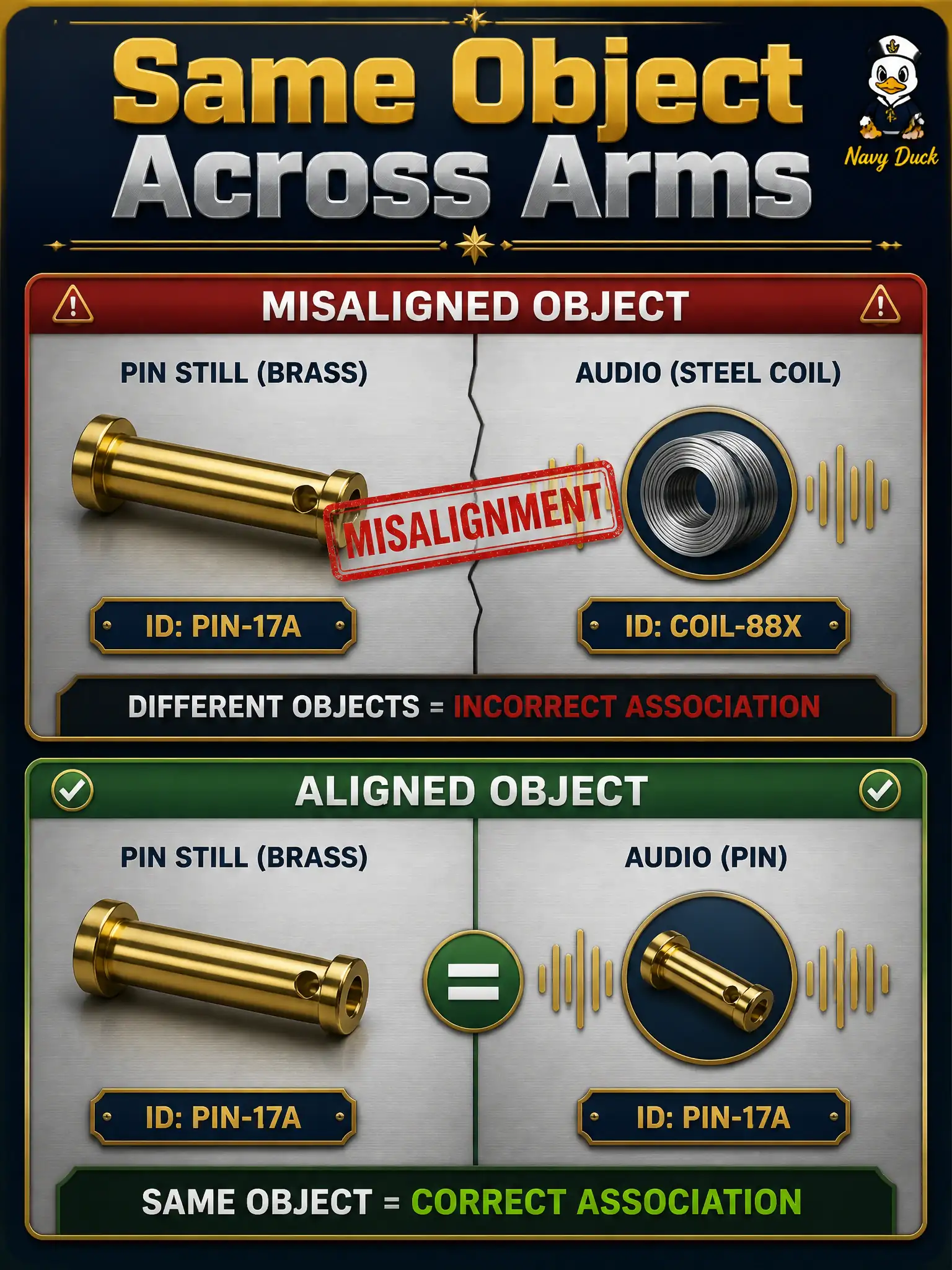
A pin-mill row shows a brass pin in the still, but the audio clip is someone describing a steel coil from the next machine. What data problem should be marked?
Select an answer to reveal the explanation.
Short Explanation
If the picture is a brass pin and the talk is about a steel coil, the arms are about different things. That is misalignment of the pair—not a fusion-type typo.
Full Explanation
When joined modalities do not refer to the same object, the data problem is cross-modal misalignment. Marking the pin-mill row that way is correct: a brass-pin still paired with audio describing a steel coil from the next machine is not a coherent multimodal example. Civic sensor-and-photo bundles used for maintenance or safety assistants must describe the same asset, or the service will confidently mix equipment identities.
Calling it the wrong fusion type—switch early to late and the mismatch vanishes—fails because fusion topology does not redefine what the files are about. Missing Helm chart for the audio specialist fails by offering packaging as a cure for content mismatch. CLIP temperature set too high for the text arm fails by blaming a contrastive hyperparameter for a corpus identity error. Quarantining mismatched arms protects residents from assistants that confuse adjacent machines or work orders.
Exam caveat: misalignment is a referential identity failure across modalities. Operational check: verify each civic joined bundle names the same object in every arm; quarantine cross-machine mixes before fusion or training. Re-verify join keys and modality completeness on every promotion from lab shelf to civic production corpus.