
A horn-button works has a still, a care sentence, and a tap-test clip that might belong to three different buttons. What must be true before anyone discusses early, late, or intermediate fusion on those files?
Select an answer to reveal the explanation.
Short Explanation
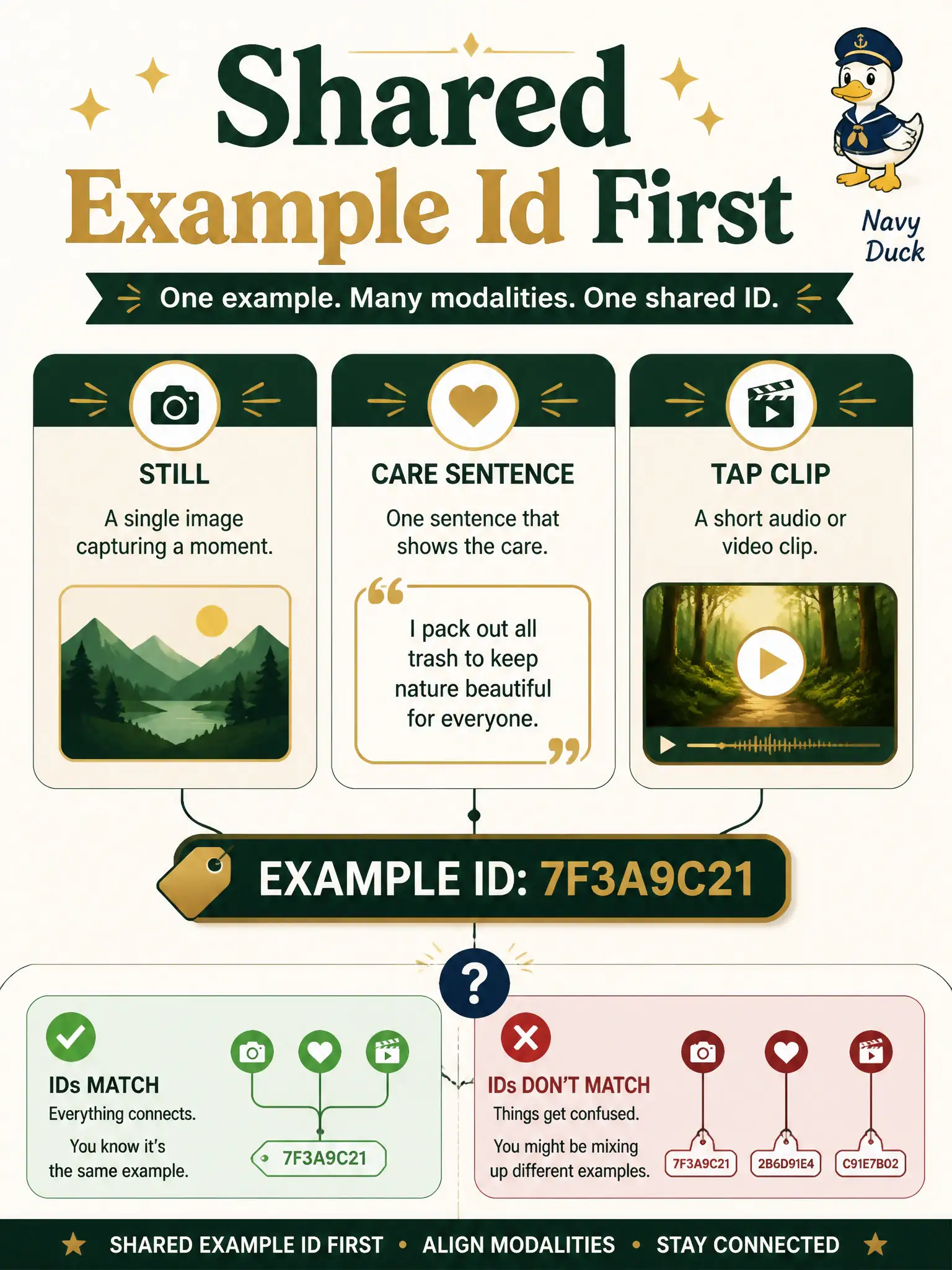
Fusion talks about joining arms of one example. If the still, sentence, and clip might be three different buttons, pin them with a shared id first—then pick a fusion style.
Full Explanation
Fusion discussions presuppose that modalities belong to the same example. Before anyone debates early, late, or intermediate fusion on a horn-button still, care sentence, and tap-test clip, all three arms must share one example identifier so they are known to be the same button. That requirement is correct because fusion joins arms of one instance; if the files might be three different buttons, architecture talk is premature. Civic multimodal cases—inspection photo, note, and audio tap—must be identity-joined first or public models learn scrambled objects.
Requiring each file to already be encoded by a Domain 2 fusion network fails by putting encoding ahead of identity. Rewriting the care sentence as a Riva TTS script fails by changing modality purpose instead of establishing a shared id. Deleting the tap-test clip so only two modalities remain fails as a default; the issue is alignment identity, not mandatory arm count. Shared ids mirror civic asset tags: without them, fusion debates are arguments about three unrelated work orders.
Exam caveat: fusion type never repairs unknown cross-file identity. Operational check: stamp civic multimodal bundles with one example id before fusion design reviews or training.