
A rush-light shop intern scores caption–still rows with a spoken-word error count borrowed from the Riva booth. How should pairing quality for those rows be judged?
Select an answer to reveal the explanation.
Short Explanation
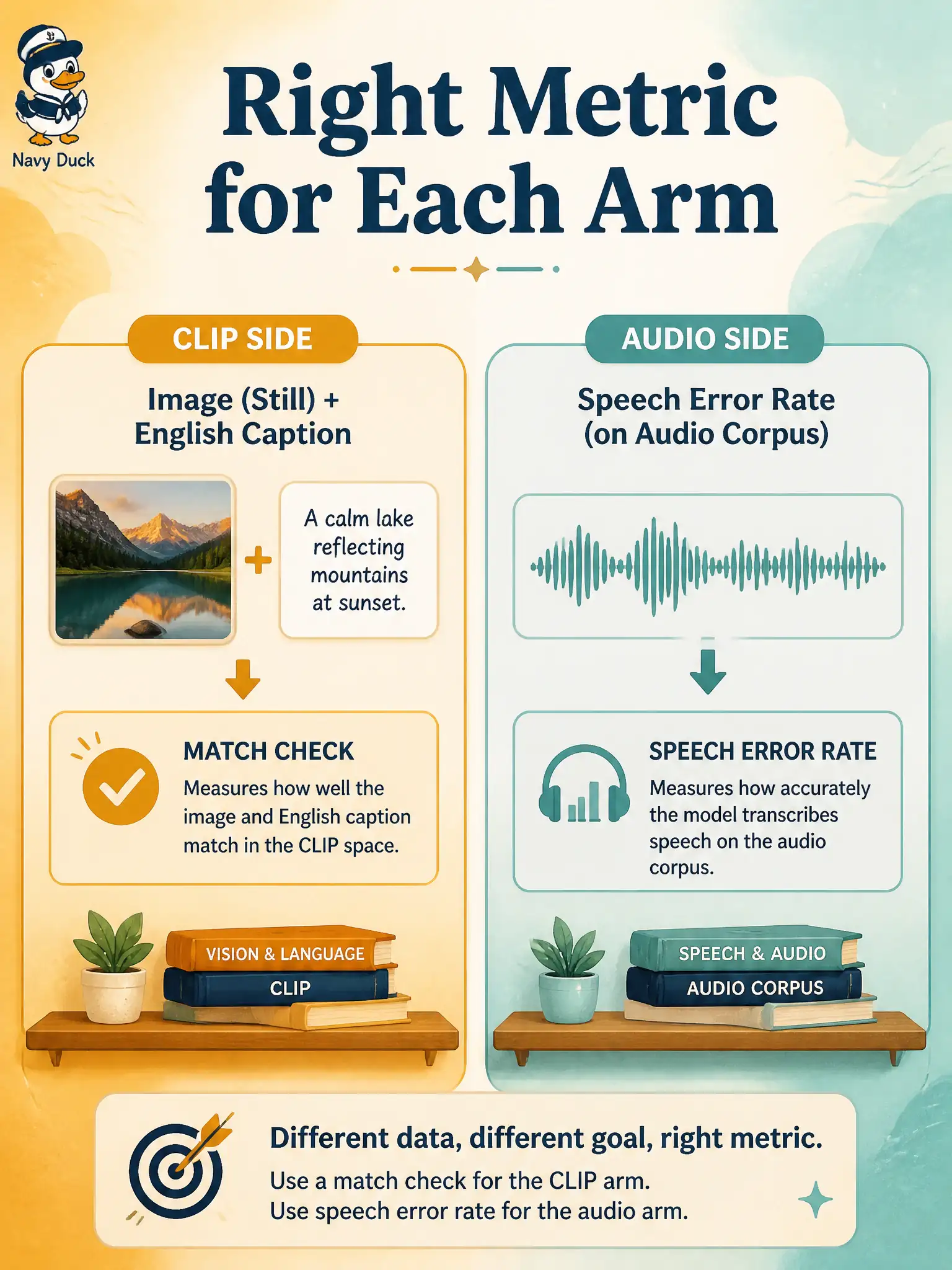
A speech scoreboard belongs on the audio shelf, not on the picture–caption shelf. CLIP cares whether the English line matches the still—not how cleanly someone spoke elsewhere.
Full Explanation
Pairing quality for CLIP rows is judged by whether the English line matches the picture, not by speech error metrics borrowed from a Riva booth. Keeping CLIP checks on caption–still match and sending speech metrics back to the audio corpus is correct because modalities have different quality scoreboards. Mixing them in a civic multimodal program produces false greens: a clean spoken-word error rate says nothing about whether a still and caption belong together for public image search.
Applying speech error rate to every CLIP row fails by using the wrong metric family. Replacing English captions with ASR transcripts before any image–text check fails when the task is caption–still alignment, not speech recognition. Treating a low speech error rate as proof that still and caption are aligned fails logically: audio quality does not certify visual–text join correctness. Separate scoreboards keep speech teams and vision–language teams accountable for the defects they can actually fix.
Exam caveat: do not share one scoreboard across unrelated modality checks. Operational check: maintain separate civic QA gates—WER/CER for speech corpora, semantic caption–still checks for CLIP—and never promote a CLIP row on speech scores alone.